When researchers started scanning the dirt near Šurany in southwestern Slovakia ahead of a massive industrial park project, they expected the usual scattered pottery or faint ditch lines. Instead, they hit something that stopped the bulldozers cold.
Buried right beneath the topsoil lay an intact 7.4-hectare Roman military camp dating back to the second half of the second century. That puts it square in the middle of the Marcomannic Wars, the brutal northern conflicts led by Emperor Marcus Aurelius between AD 166 and 180.
It's massive. It's rare. But what's really throwing historians off isn't just the sheer scale of the site. It's the horrific way the people inside it were left behind.
A Brutal Scene Cut Short
Standard Roman military procedure was strict. Discipline defined the legions. When a Roman soldier died in the field, his comrades gave him a proper burial outside the camp walls, often burning the body on a pyre or placing it in an organized cemetery.
That didn't happen here.
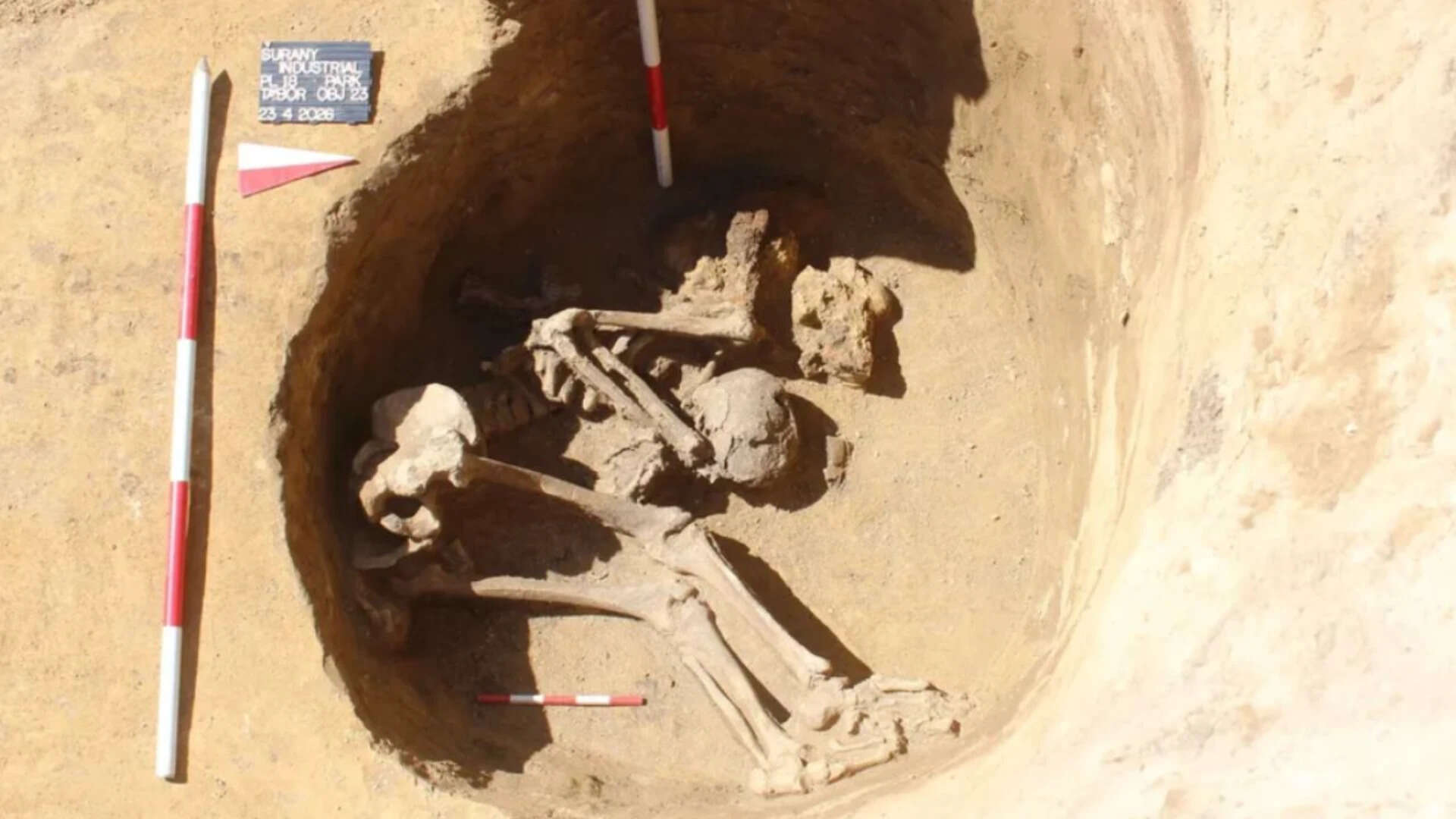
Archaeologists from the Institute of Archaeology at the Slovak Academy of Sciences (SAS), working alongside developers from MH Invest, uncovered human skeletons dumped in defensive ditches. They found full bodies and disconnected bones stuffed inside storage pits, shallow dirt trenches, and even abandoned water wells.
Preliminary analysis points to these being Roman legionaries. Why were they thrown into waste pits?
Normally, when a unit retreated or won a battle, they stripped the dead. Iron was valuable. Armor took weeks of skilled craftsmanship to build. Helmets, spears, and scale armor weren't things you just left in the mud. Yet at Šurany, researchers kept pulling high-value military gear straight out of the ground alongside the bones.
They found spearheads. They found arrowheads. Helmets, legionary brooches, and large plates of iron armor sat right next to the skeletons. The site wasn't systematically looted by enemy Germanic fighters, nor was it cleaned up by surviving Romans. Something catastrophic happened, and everyone left in a hurry.
Engineering That Defied Standard Roman Blueprints
You can't talk about this site without looking at its shape.
Most Roman marching camps look like neat rectangles with rounded corners, essentially playing-card shapes etched into the soil. The Šurany camp broke those rules entirely. Its perimeter is irregular, stretching across nearly 18 acres to adapt to the surrounding terrain along the Nitra River region.
Despite the odd layout, the camp was built for serious defense. Excavators mapped out five separate entrance gates. One gate featured a protective earthen feature known as a clavicula.
A clavicula is a curved rampart and ditch system that blocked a straight path through the entry point. It forced anyone trying to breach the camp to turn as they entered, exposing their unshielded right side to the defenders waiting on the ramparts. While common in other parts of the Roman frontier, this is the very first time a clavicula gate has been identified in Slovakia.
Dr. Matej Ruttkay, director of the SAS Institute of Archaeology, noted that exploring an entire Roman field camp of this size is almost unheard of in European archaeology. Most sites have been carved up by centuries of farming or urban sprawl. Because this area was slated for industrial development, the team had the funding and scope to strip back over 150 hectares, revealing the complete footprint of the base.
Sandals and Dice in the Dirt
Beyond the battlefield gear, the site offers a strangely intimate look at the daily routine of imperial legionaries stationed on a cold, hostile frontier.
Archaeologists recovered small personal possessions scattered among the defensive works. A single gaming die turned up in the soil. An axe and a basic cutting knife sat near one of the storage pits. Coins minted during the era gave researchers a tight window for dating the occupation.
Then there are the shoes.
Leather doesn't last nearly two millennia in wet northern European soil, but the iron hobnails driven into the soles of Roman military sandals—known as caligae—did. Over time, the iron rusted and bonded with the surrounding clay, forming solid clumps that encased the original nail patterns.
Rather than breaking those clay blocks apart and ruining the artifacts, the research team brought them to specialized laboratories for X-ray analysis. The scans let scientists map the exact nail patterns on the sandal soles down to the millimeter without touching the metal inside. It's a clever bit of modern lab work solving an ancient puzzle.
The Ghost of Marcus Aurelius North of the Danube
Why were Roman legionaries even in Slovakia back then?
Under Marcus Aurelius, Rome pushed hard across the Danube River to hammer the Germanic Marcomanni and Quadi tribes who had been raiding imperial territory. The Danube was long considered the hard border of the Roman world. Crossing it meant stepping into deep, unfamiliar territory with long supply lines and harsh winters.
For a long time, physical proof of these northern campaigns was scarce. A major discovery near Želiezovce previously made news as a candidate for where Marcus Aurelius wrote parts of his famous Stoic journal, Meditations.
The new find at Šurany bridges a critical geographical gap. It shows that Roman combat units were not just conducting quick hit-and-run raids across the river; they were setting up heavy, complex field bases deep inside hostile country.
What Happens Next at the Šurany Site
Excavations on this scale move fast when an industrial project is waiting on the land, but the real scientific work is just getting started in the lab.
Teams at the Slovak Academy of Sciences are running isotopic, genetic, and anthropological tests on the recovered human bones. These tests will answer the big lingering questions that field digging can't:
- Biological origins: Were these men recruited from Italy, the Danube provinces, or local auxiliary units?
- Cause of death: Do the bones show clear weapon trauma from Germanic blades and arrows, or did a sudden outbreak of disease sweep through the camp?
- Health and diet: What were these men eating during their final weeks on the march?
If you want to track updates on this discovery, follow the published field reports released directly through the Institute of Archaeology at the Slovak Academy of Sciences. They regularly update their public research portals as bioarchaeological data clears laboratory review.