Property deeds written in the nineteenth century rarely stop modern commercial contractors in their tracks. Yet an Ohio appellate court recently proved that a piece of paper signed back in 1843 carries enough legal weight to block a million-dollar real estate push.
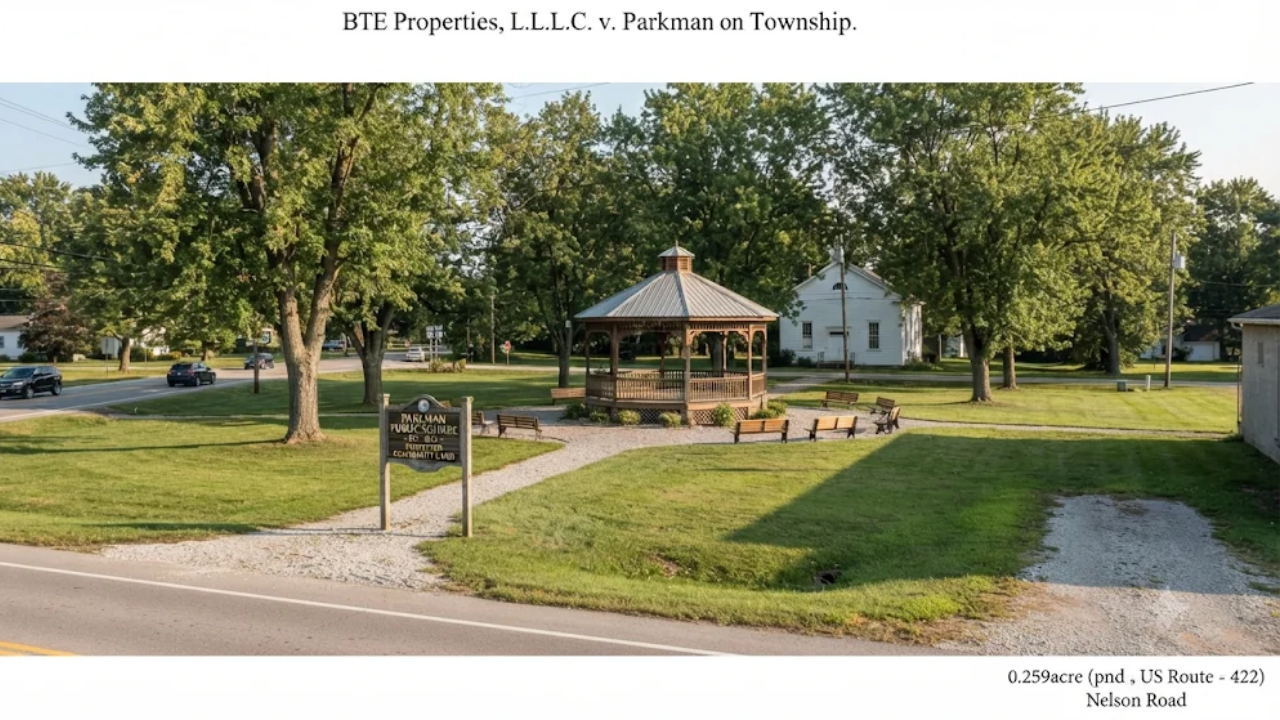
Back on June 7, 1843, Simon and Nancy Perkins handed over 2.63 acres of land in Parkman Township for the symbolic price of ten cents. They didn't want cash. They wanted a guaranteed green space for the community. The original deed explicitly required that the plot remain a public square or open common area, banning heavy commercial structures and limiting changes strictly to walkways and railings. Fast forward over a century and a half later, and that exact clause just derailed a modern developer's expansion plans.
How a Tiny Strip of Land Sparked a Court Battle
The core dispute centers on a sliver of that historic acreage measuring roughly 0.2596 acres. BTE Properties wanted to acquire this parcel to create a crucial access route to an adjacent commercial lot. Parkman Township originally transferred the small strip in 2018, but the new deed contained a major catch. It explicitly stated that the land remained subject to all original historic easements and covenants from the 1800s.
By December 2023, ABC Development agreed to buy the property from BTE. Realizing the title defect threatened the deal, the firms pivoted. They went to court in April 2024 to wipe out the 1843 restriction entirely, arguing it was obsolete and unenforceable.
Instead of getting the clean slate they wanted, they hit a brick wall. On November 16, 2026, the Ohio Court of Appeals for the Eleventh District officially upheld the lower court's ruling. Presiding Judge Matt Lynch, alongside Judges John J. Eklund and Scott Lynch, confirmed that the historic public square restriction remains fully active and legally binding against anyone who bought the land with notice of the covenant.
The Legal Reality of Restrictive Covenants
Real estate developers often assume ancient deed restrictions weaken over time, but property law doesn't work that way. If a condition is recorded properly and touches the land directly, future owners inherit those exact limitations.
In this case, BTE's own stakeholders admitted they knew about the restriction when they acquired the strip. When ABC Development tried to push the sale through, they gambled on judicial leniency. Courts rarely overturn clear public trust restrictions simply because commercial land values have climbed or because a developer needs a better driveway.
Local municipalities find themselves caught in the middle of these fights. Parkman Township defended the restriction vigorously, arguing that protecting the public square honors the original intent of the Perkins family. An adjacent property owner, A.L.L., Inc., also tried to join the lawsuit to defend the park, though the appeals court ultimately ruled that the township's successful defense rendered the neighbor's intervention unnecessary.
What This Means For Future Land Disputes
Property buyers often skip deep historical title searches, focusing entirely on recent zoning maps and commercial potential. Cases like BTE Properties, L.L.C. v. Parkman Township serve as a blunt warning. You cannot simply pave over history because a deed is yellowed with age.
If you're looking at parcels tied to nineteenth-century public trusts or historic common land, assume the restrictions mean what they say. Courts will protect community green spaces when the paper trail is airtight.
Check your chain of title before dropping capital on land locked behind century-old conditions, because overturning a ten-cent nineteenth-century promise is basically impossible.