History books love to draw clean, separate boxes for ancient civilizations. We learn about Rome, ancient India, and early Southeast Asian states as if they operated on entirely different planets. A stunning discovery in western Thailand just shattered that narrative completely.
Archaeologists digging at a newly discovered site in Phetchaburi province recently pulled two gold rings out of the dirt. They were resting right alongside human skeletal remains. One ring is a simple, unadorned gold band. The other is a beautifully crafted gold signet ring engraved with ancient characters. This isn't just a piece of pretty jewelry. It's a smoking gun that proves global trade networks during the Iron Age were far more sophisticated, interconnected, and wealthy than most people realize. Read more on a similar issue: this related article.
The discovery happened at the Don Yai Thong archaeological site, located in the Ban Lat district about 130 kilometers southwest of Bangkok. Experts from Thailand's Fine Arts Department date the site back roughly 1,900 to 2,100 years. That puts it squarely in Thailand's late prehistoric period. If you look at what was happening globally at that exact moment, the Roman Empire was cementing its power in the West, the Han Dynasty ruled China, and India's trade networks were rapidly expanding across the Indian Ocean. This tiny gold ring proves that Thailand wasn't an isolated jungle outpost. It was a primary hub for international merchants.
The Rice Field Discovery That Blew Up the Map
Great archaeological discoveries rarely start with an academic plan. They usually start with a regular person stumbling over something weird while doing everyday work. That's exactly what happened earlier this year at Don Yai Thong. Further journalism by Reuters explores comparable perspectives on the subject.
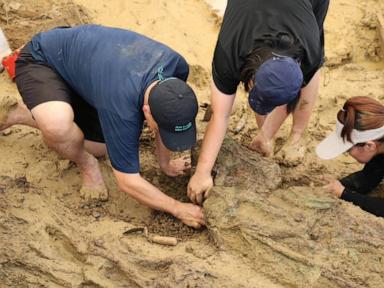
Local residents were working in a routine rice field when they hit something hard buried in the soil. They dug up heavy, metallic fragments that turned out to be pieces of ancient bronze drums. Recognizing that these weren't ordinary scrap metal, they alerted the authorities. The Fine Arts Department stepped in immediately, launching a full-scale excavation in February.
What looked like a simple field turned out to be an incredibly rich late Iron Age burial ground. Over the last several months, the team has uncovered eight human skeletons. Along with the bones, they found a treasure trove of artifacts: complex pottery, ancient beads, bronze vessels, and high-end gold jewelry.
The presence of these items tells us a lot about the people buried here. These weren't ordinary villagers or subsistence farmers. This was a ceremonial burial site reserved exclusively for the ultra-wealthy, the ruling elite, or highly successful international merchants. The sheer concentration of luxury goods in one concentrated area indicates a highly stratified society with significant disposable wealth.
Decoding the Brahmi Script and the Ring Owner
The real prize of the excavation came to light during the careful clearing of "skeleton number four." Resting with the bones were the two gold rings. The plain band is fascinating for its material purity, but the signet ring is what has historians dizzy with excitement.
Dr. Uthen Wongsathit from the Faculty of Archaeology at Silpakorn University, working alongside language specialists from the Fine Arts Department, analyzed the tiny engravings on the head of the ring. They identified the text as ancient Brahmi script. Brahmi is one of the oldest writing systems used in ancient India, acting as the ancestor to dozens of modern South Asian and Southeast Asian scripts.
The experts managed to read the specific inscription: pusarakhitasa.
In translation, this phrase literally means "belonging to Pusarakita" or "the one protected by Pushya." In ancient Indian astronomy and astrology, Pushya is regarded as one of the most auspicious lunar mansions or zodiac signs. It's associated with wealth, protection, and prosperity.
This single word provides a massive clue about who wore this ring before they were buried in a Thai rice field. The Fine Arts Department noted that the name and the style of the signet ring strongly point toward the owner being part of the Vaishya caste. In the ancient Indian social hierarchy, the Vaishyas were the merchants, traders, and landowners.
Think about what this means. A high-status merchant from India, or a local elite who adopted Indian religious, linguistic, and cultural practices so thoroughly that they wore a personalized Sanskrit-adjacent astrological signet ring, died and was buried with high honors in western Thailand two millennia ago.
This isn't the first time Brahmi script has shown up in Thailand, but its location is highly significant. Previously, similar seals and jewelry bearing this script were found further south, at famous maritime trade sites like Khlong Thom in Krabi province and Khao Sam Kaeo in Chumphon province. Finding it this far north in Phetchaburi demonstrates that these trade routes cut much deeper into the interior of the mainland than previously assumed.
The High Stakes Race Against Mud and Saltwater
While the discovery is a triumph, the actual physical work on the ground has turned into a high-stakes race against the elements. Phanombut Chantarachoti, the Director-General of the Fine Arts Department, had to issue urgent orders to alter the excavation strategy due to severe environmental threats.
The rainy season in Thailand is brutal for archaeological sites. At Don Yai Thong, the combination of heavy seasonal downpours, rising groundwater, and high soil salinity creates a destructive environment for ancient artifacts.
When bronze artifacts are trapped in damp, salty soil, the corrosion process accelerates dramatically. The copper in the bronze reacts with the chlorides in the salt, causing a rapid degradation known as "bronze disease" that can turn a beautiful ancient vessel into green powder in a matter of years once disturbed. The human bones are in equally grave danger. The water logging softens the ancient skeletal remains, making them incredibly fragile and prone to crumbling under the weight of the shifting wet mud.
To save the history, archaeologists are using a dual recovery method. For the more stable items, they are carefully extracting them piece by piece. For the highly vulnerable skeletons, they are using a technique called block lifting. Instead of trying to clean and remove the bones individually on site, the team digs a trench around the entire skeleton, encases the surrounding block of soil in a protective structure, and lifts the entire heavy chunk of earth intact.
This allows them to transport the bones safely to a climate-controlled conservation facility in Pathum Thani. There, specialists can painstakingly micro-excavate the dirt in a dry, stable environment without the threat of a sudden rainstorm ruining the find. Among the fragile items being protected this way is a skeleton believed to belong to a young child, found buried with a large, heavy bronze vessel placed deliberately around the middle of its body.
Why This Overturns What We Think About Ancient Globalization
Most people assume globalization is a modern invention, something that started with steamships or the internet. This find proves that theory wrong. The world was already deeply connected 2,000 years ago.
The presence of the Vaishya merchant ring highlights the depth of early trans-oceanic contact between the Indian subcontinent and Southeast Asia. This period is often referred to by historians as the "Indianization" of Southeast Asia, but that term can be misleading because it implies a one-way cultural conquest. In reality, it was a dynamic commercial exchange.
Merchants traveled across the Bay of Bengal, using the monsoon winds to power their ships. They brought with them not just goods like textiles, glass beads, and precious metals, but also ideas, religions (Buddhism and Hinduism), and writing systems like Brahmi. Local Southeast Asian leaders didn't just passively accept this culture; they selectively adopted and adapted it to increase their own prestige and political power.
Owning a gold signet ring with an Indian astrological inscription was the ultimate ancient power move. It showed you were wealthy, you had international connections, and you understood the high-culture language of the dominant trading superpower of the era.
The find also highlights the strategic importance of Phetchaburi. Located near the Gulf of Thailand, this region served as a natural transit point. Traders could avoid the long, dangerous pirate-infested sea journey through the Malacca Straits by porting their goods across the narrow necks of the Malay Peninsula and using internal river networks to move wealth inland. Don Yai Thong was clearly a critical node in that network.
What Happens Next and How to Track This History
The field excavation at Don Yai Thong is scheduled to wrap up within the next month, but the scientific analysis is just getting started. The Fine Arts Department has a detailed plan to squeeze every bit of data out of this site.
First, technicians are conducting full 3D scans of the excavation pits to preserve the exact spatial context of where every bone and ring was found. Second, they are sending organic charcoal samples collected from the burial layers to a specialized laboratory in the United States for advanced radiocarbon dating. This will give us a highly precise timeline of exactly when these people lived, moving beyond the current estimate of 1,900 to 2,100 years old.
The political ripples of the find are also growing. Thiwalrat Angkinan, a Member of Parliament for Phetchaburi, is publicly leveraging the discovery to demand funding for the province's first central museum. Currently, Phetchaburi lacks a proper facility to store and display high-value historical treasures. Most local artifacts end up shipped away to museums in other provinces or stored out of sight in national repositories.
The Phra Nakhon Khiri National Historical Park museum has limited physical space and poor accessibility for elderly visitors. The local push is to build a modern museum right in the province to keep these gold rings and bronze drums where they were found. For now, the artifacts will remain at the conservation facility in Pathum Thani through the wet season for stabilization, with plans for a major public exhibition in Phetchaburi once the rains stop.
To keep tabs on this discovery, you should bookmark the official announcements page of Thailand's Fine Arts Department. They regularly post excavation updates and high-resolution photos of newly cleaned artifacts. If you are planning a trip to Thailand later this year, keep an eye on local news for the opening of the temporary exhibition in Phetchaburi, where these rings will be displayed to the public for the first time.