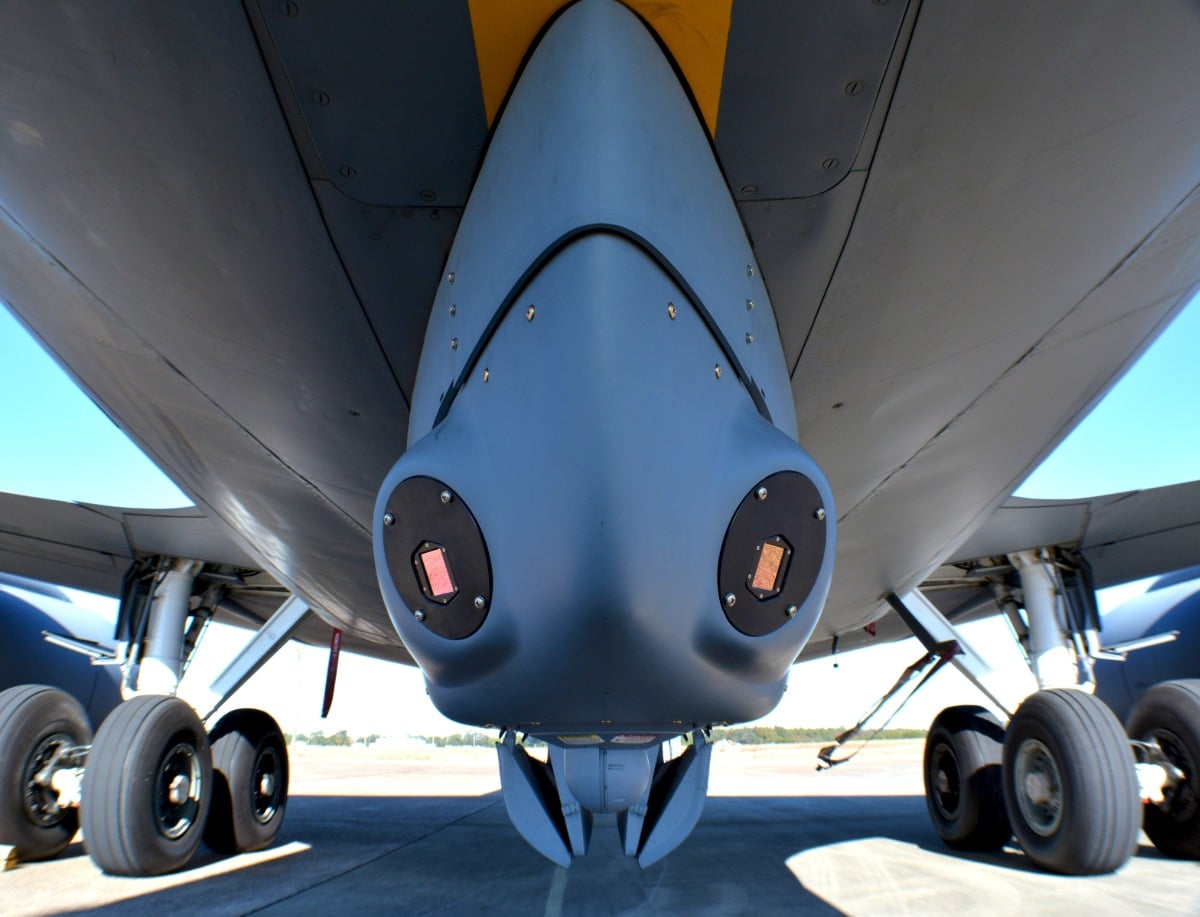
Slow, heavy cargo planes are sitting ducks. If you're flying a massive C-17 Globemaster III or a KC-46 tanker near a combat zone, you aren't dodging an incoming missile with fancy aerial maneuvers. You can't outrun it. Your life depends entirely on automated hardware bolted to the fuselage.
For decades, that hardware had one primary job. It had to stop shoulder-fired, heat-seeking missiles. If a portable air defense system fired a rocket from the ground, onboard sensors spotted the exhaust plume. A high-intensity laser then shot directly into the missile's eye to blind its tracking system and force it off course. It worked well.
But the threat environment changed. It changed fast. Flying objects in modern conflict zones aren't just traditional anti-aircraft missiles anymore. The sky is filled with cheap kamikaze drones, weaponized commercial quadcopters, and hidden laser designation systems that can blind pilots or guide heavy ordnance.
That is why the U.S. Air Force just handed Northrop Grumman a $60.4 million contract. The goal is straightforward. The military needs to upgrade its Large Aircraft Infrared Countermeasures system, known as LAIRCM. They're developing a new sensor suite called the Optical Detection and Identification Node, or ODIN. This isn't just a minor software patch. It's a complete rewrite of how transport aircraft protect themselves.
The Secret Expansion of the LAIRCM System
The old approach to defensive suites relied on specialization. You had one system for radar warnings, another for flares, and another for infrared tracking. This created a mess of heavy black boxes filling up electronics bays.
The ODIN upgrade changes that. It forces multiple defensive roles into a single sensor architecture. The Air Force Life Cycle Management Center out of Wright-Patterson Air Force Base is directing this effort. They're funding it using fiscal 2026 research, development, test, and evaluation money.
Look at what this new sensor package actually does. It keeps the core laser-jamming capability that defines LAIRCM, but it bakes three new critical survival features directly into the hardware.
First, it adds Hostile Fire Indication. Traditional missile warning systems ignore conventional gunfire because unguided bullets don't have rocket motors that emit specific infrared signatures. If a rebel faction opens up on a landing cargo plane with heavy machine guns or rocket-propelled grenades, older systems won't register the threat. Hostile Fire Indication tracks the flash and trajectory of unguided ballistic threats. This gives pilots immediate situational awareness so they can bank away or warn ground teams.
Second, the system incorporates Laser Warning functionalities. Modern adversaries use lasers to paint targets for precision-guided munitions or to disrupt optical sensors. If an enemy laser touches the skin of an American refueling tanker, the crew needs to know instantly. The ODIN sensor identifies the wavelength and angle of incoming laser energy.
Third, and perhaps most importantly, it introduces Counter Small Unmanned Aerial Systems detection. Drones are everywhere. They're cheap, deadly, and incredibly hard for traditional military radar to spot. A drone striking a jet engine during takeoff can bring down a $200 million airlifter just as easily as a specialized surface-to-air missile. Bolting drone detection directly into the primary missile defense suite means transport planes won't need to carry separate, bulky drone-hunting gear.
Why Legacy Systems Fail in Modern Airspace
Think about how a standard anti-missile system functions. It looks for hot things. A shoulder-fired missile leaves a brilliant, scorching trail of burning propellant. Sensors pick up that thermal spike against the cool background of the sky. The system computes the trajectory, slews a turret, and fires a laser beam right into the seeker head of the incoming threat.
Drones don't work like that. A small, battery-powered quadcopter has almost no thermal signature. It uses electric motors. It moves slowly. To an old-school infrared sensor, a quadcopter looks like a large bird or a piece of airborne trash.
The military learned this lesson the hard way in recent global conflicts. Cheap commercial drones modified with explosives routinely take out multi-million dollar ground assets. It was only a matter of time before these tactics scaled up to target low-flying logistics aircraft near forward operating bases.
By integrating optical tracking that searches for structural shapes alongside thermal signatures, the ODIN system closes that defensive gap. It stops looking exclusively for rocket plumes. It starts looking for anything that shouldn't be in the airspace near the aircraft.
The Financial Reality of Keeping Transports Alive
The cost of this initial development contract is exactly $60,438,241. Northrop Grumman will do the heavy lifting at its facility in Rolling Meadows, Illinois. They have until April 30, 2029, to get this production-ready.
Some critics argue that spending tens of millions of dollars to tweak existing sensors is an inefficient use of defense funds. They're wrong.
Consider the alternative. Building a brand-new, stealthy cargo airplane from scratch takes fifteen to twenty years. It costs hundreds of billions of dollars. The Air Force has to keep its current fleet of C-17s, C-130Js, and KC-46s viable through the 2030s and 2040s. Upgrading the modular sensors inside the existing LAIRCM housings avoids the need to redesign the actual airframes.
This contract is actually part of a much larger, broader strategy. The Air Force is separately laying the groundwork for a massive program called Large Aircraft Survivability Systems, or LASS. Internal budget documents show the service wants to pour over $508 million into active defense systems for tankers and airlifters over the next five years.
The service is splitting that money between two main efforts. They're spending about $176 million on advanced situational awareness sensors that look both upward and downward to give aircrews a total view of their surroundings. The rest of the cash, roughly $264 million, goes toward developing new effectors. These effectors will include both kinetic weapons, like small interceptor projectiles, and non-kinetic weapons, like high-powered microwave emitters designed to fry drone electronics mid-air.
The ODIN sensor development is the tactical bridge leading to that future. It proves that the Air Force is done viewing cargo planes as defenseless backend buses. They're turning them into hardened platforms capable of detecting and defeating threats organically.
What Happens Next for Air Mobility Crews
If you're an aerospace engineer or a defense contractor, watch the testing phases out of Wright-Patterson closely. The Air Force is using a cost-plus-fixed-fee structure for this project because the technical risk of blending four vastly different sensor profiles into one unit is incredibly high. They're exploring unproven territory here.
For operators on the ground and crews in the air, the next steps are all about integration testing. We will likely see prototype ODIN sensor pods flying on select testbed aircraft within the next twenty-four months.
If you want to track how this deployment rolls out, you need to look at specific milestones.
First, watch for the initial design reviews coming out of Illinois over the next year. This is where engineers will lock down the physical dimensions of the ODIN node to make sure it fits within legacy LAIRCM mountings without ruining the aerodynamics of the planes.
Second, monitor the flight test announcements at Edwards Air Force Base. They'll need to prove the system can detect simulated small drone swarms while simultaneously tracking simulated missile launches.
The days of flying fat, happy logistics missions outside the reach of enemy weapons are completely over. Airspaces are contested from the ground all the way to the upper atmosphere. Hardening these support fleets isn't optional anymore. It's the only way the military can guarantee its global logistics chain doesn't collapse during the opening days of a serious conflict. Keep an eye on the April 2029 deadline to see if Northrop delivers on this critical shield.