We have an unglamorous crisis on our hands, and it hides right inside your TV remote, your smart thermostat, and those little wireless sensors tracking shipments across the globe. It's the disposable battery. Every year, humans throw away billions of alkaline and lithium single-use batteries. Most wind up in landfills, slowly leaking heavy metals into the soil.
We talk a lot about massive grid-scale batteries and electric vehicle packs. Yet we completely ignore the trillions of tiny Internet of Things devices scattered across the planet. Powering them all with traditional mining-dependent tech is a mathematical and environmental impossibility.
Researchers at the University of Cambridge quietly built a functioning alternative. They created a living, breathing bio-battery that runs on blue-green algae. It generates electricity around the clock using nothing but water and ambient light. It doesn't rely on rare earth minerals. It doesn't explode. When it dies, you can basically compost most of it.
This isn't just a neat lab trick anymore. It's a fundamental shift in how we think about low-power electronics.
The Cambridge Experiment That Provoked a New Field
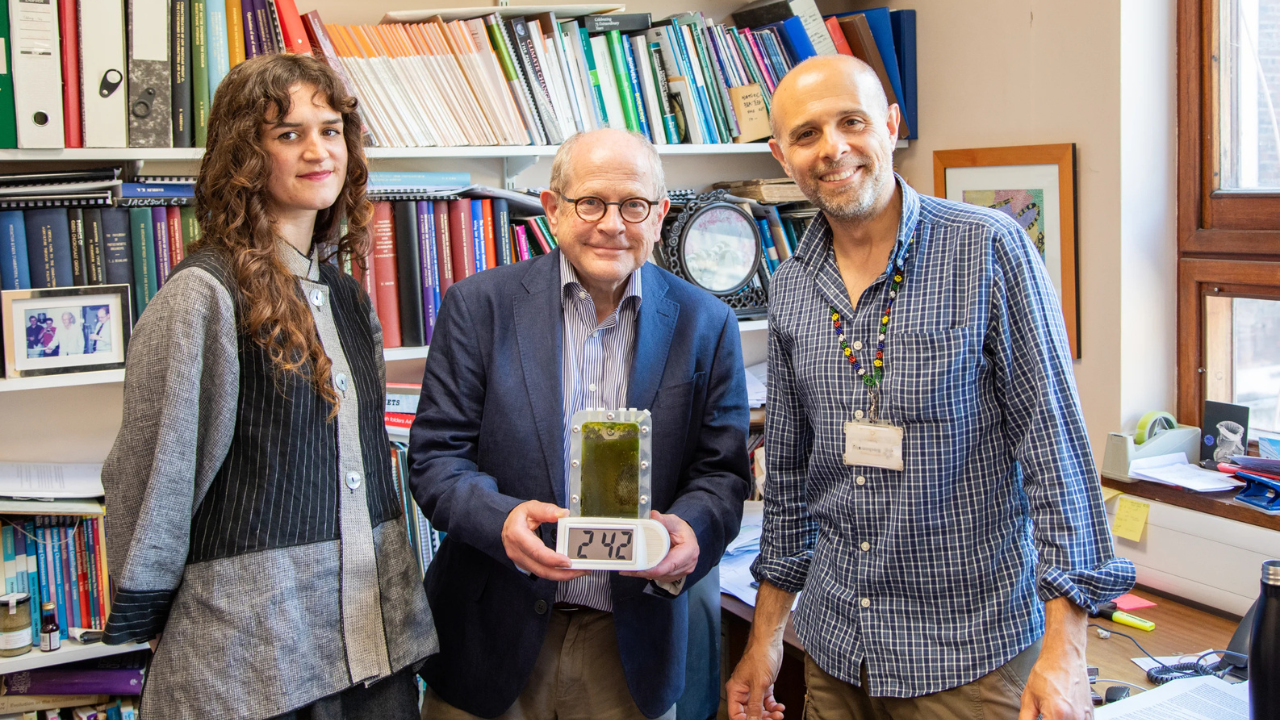
To understand why this matters, you have to look at the sheer endurance of the system the Cambridge team engineered. Led by Professor Christopher Howe and Dr. Paolo Bombelli, researchers placed a small enclosure about the size of a standard AA battery on a windowsill. Inside was Synechocystis, a common, non-toxic species of cyanobacteria widely known as blue-green algae.
They hooked this tiny algal cell container up to an ARM Cortex-M0+ microprocessor. If you aren't familiar, that's a highly efficient microchip used extensively in smart home gadgets, environmental sensors, and industrial tracking devices.
The scientists expected the system to run for a few weeks. Instead, it ran continuously for over half a year. Then it crossed the one-year mark. It kept processing data, cycling through operations, and humming along without a single drop in performance.
The system didn't require feeding. It didn't need a pristine laboratory environment. It sat on a normal windowsill, exposed to regular domestic temperature fluctuations and natural day-night light cycles. It just worked.
How Algae Generates Power When the Sun Goes Down
Most people assume solar-derived energy stops working the moment the sun slips below the horizon. That's the fatal flaw of standard solar cells unless you pair them with expensive storage systems. Algae solves this naturally.
During the day, the cyanobacteria harvest sunlight through photosynthesis. This process splits water molecules, producing oxygen and releasing electrons. The battery architecture captures these free electrons before they can recombine, channeling them along an electrical circuit to power the microprocessor.
When darkness falls, the magic doesn't stop. The algae switches its survival strategy. It begins processing its internal food reserves, breaking down stored carbohydrates to stay alive. This metabolic activity continues to liberate electrons.
The power output dips slightly during nocturnal hours, but it remains entirely sufficient to keep low-draw microchips alive. It's an autonomous, self-sustaining biological engine. You get continuous power generation without buying a separate storage unit.
The Massive Waste Problem of the Internet of Things
Let's look at the numbers. Industry forecasts suggest we will have up to a trillion active IoT devices globally within the next decade. If we power those devices with traditional lithium-ion or alkaline batteries, we face two catastrophic bottlenecks.
First, the sheer volume of batteries requires an unfeasible scale of mining. Lithium, cobalt, and nickel extraction destroys local ecosystems and consumes massive amounts of water. We simply do not have enough easily accessible minerals to build a trillion tiny batteries alongside the billions of massive batteries needed for electric cars.
Second, the logistics of replacing these batteries is a nightmare. Imagine managing a smart factory or a large-scale agricultural operation with 10,000 wireless temperature sensors scattered across fields or ceilings. Sending technicians to swap out dead batteries every couple of years is incredibly expensive and inefficient.
Many of these devices end up discarded entirely because retrieving them costs more than buying new ones. This creates a mountain of electronic waste that stains our environmental track record.
Algae bio-batteries change the economics completely. The raw materials are exceptionally cheap. You need water, a small plastic or aluminum housing, a simple electrode material, and a starter culture of algae that multiplies on its own.
The Engineering Realities and the Power Output Catch
I want to be completely honest here. You aren't going to power your iPhone with an algae battery anytime soon. You certainly won't use one to drive an electric truck.
The current generated by a single Cambridge-style bio-battery is incredibly small. We are talking about nanowatts to microwatts of power. For high-drain devices that require bursts of high electrical current, biological systems fall flat. They lack the energy density found in dense chemical matrices like lithium cobalt oxide.
The trick lies in matching the battery to the right workload. Microprocessors have become incredibly efficient. A modern chip can sleep for 99% of the hour, waking up for a mere fraction of a second to read a sensor value, transmit a tiny radio packet, and fall back into a deep sleep.
When you design systems around this duty cycle, a trickle of continuous power from an algal colony is exactly what you need. It charges a small internal capacitor during the sleep phase, which then dumps enough energy to power the brief active phase.
Why This Beats Traditional Solar and Mechanical Harvesting
People often ask why we don't just use tiny solar panels or kinetic energy harvesters on these remote sensors. It sounds simpler on paper, but practical deployment reveals serious limitations.
Standard silicon solar cells degrade when exposed to harsh outdoor elements over long periods. They also fail completely in dark indoor environments, like warehouses, grain silos, or underground pipes. Mechanical kinetic harvesters require consistent physical vibration or movement, which isn't present on a stagnant water pipe or a structural bridge beam.
Algae is inherently resilient. It self-repairs. If a few cells die due to a temperature spike, the surviving cells divide and repopulate the colony. It's a living system that adapts to its environment in ways that solid-state electronics never can.
The construction materials used by the Cambridge researchers are also a major step forward. Instead of using toxic rare-earth elements, the housing can be constructed from biodegradable polymers or highly recyclable, abundant metals like aluminum.
What Needs to Happen Next for Commercial Adoption
We can't just buy a box of algae batteries at the local hardware store yet. Transitioning from a successful university windowsill experiment to a mass-manufactured commercial product requires solving a few distinct engineering hurdles.
Evaporation Control
The biggest threat to a biological battery is drying out. The algae needs a liquid water medium to survive and facilitate electron transport. Researchers must design ultra-reliable, sealed enclosures that prevent water vapor from escaping over a ten-year lifespan while still allowing necessary gas exchange.
Power Density Optimization
While we don't need megawatt power, increasing the output per square centimeter allows us to shrink the footprint of the battery. Scientists are looking into modifying the electrode surfaces with nanostructures to harvest electrons more efficiently from the cell membranes.
Manufacturing Scale
Growing algae is easy, but assembling millions of bio-electrochemical cells with consistent quality control requires new manufacturing lines. Companies need to figure out how to pre-load these cells, seal them, and ship them safely without killing the biological components during transit.
Practical Steps to Prepare for the Bio Tech Shift
If you build hardware, manage supply chains, or design IoT infrastructure, you should start tracking this technology immediately. The transition away from disposable chemistry will happen faster than most realize due to impending environmental regulations on battery disposal.
Evaluate your current hardware power budgets. Work on optimizing your firmware to run on minimal microampere currents. The closer you get your remote hardware to a zero-power standby state, the easier it will be to drop in a biological battery option when commercial modules hit the market.
Look into alternative energy harvesting strategies today. Don't wait for your supply chain to get choked by lithium shortages or disposal taxes. Testing low-power setups now positions you to win when living infrastructure becomes the standard.