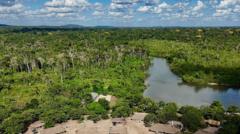
In 2024, the Amazon rainforest suffered one of the worst burning seasons in modern memory. Flames tore through millions of hectares, thick smoke choked South American cities, and low river levels left isolated river communities stranded.
Then came 2025, and the narrative flipped completely. In similar updates, take a look at: Why The Black Sea Cargo Strike Is Testing India And Russia Relations.
Fresh satellite analysis from the environmental monitoring network MapBiomas reveals that just 3.1 million hectares (7.7 million acres) burned in the Brazilian Amazon in 2025. That marks the smallest burned area recorded since systematic tracking began in 1985. Across the entire country of Brazil, fire scars dropped by nearly half compared to the previous year, plummeting to levels not seen since 2018.
It feels like a massive victory. Environmental groups celebrated, government officials pointed to stronger enforcement, and observers praised the turnaround. But if you take a closer look at the data, the story behind this sudden drop is a lot more complex than a simple win for conservation. Associated Press has provided coverage on this important issue in extensive detail.
The 2025 Amazon Fire Numbers Everyone Is Talking About
To grasp what happened in 2025, you have to look at how bad 2024 actually was.
During 2024, an intense, climate-fueled drought hit South America. It turned huge stretches of native vegetation into tinderboxes. In the Brazilian Amazon alone, more than 15.8 million hectares burned. Across all of Brazil, total burned area reached a staggering 24.8 million hectares.
Compare that to 2025.
MapBiomas data shows that total burned territory across all Brazilian biomes fell to 12.7 million hectares in 2025—a 31% reduction below the four-decade historical average. The drop was led almost entirely by the Amazon basin, where burned land crashed by over 80% year over year.
That single-year drop is stunning. Satellite monitors from Brazil's space research agency, INPE, logged a 45% fall in burn scar alerts across the country through September 2025.
Why did the Amazon suddenly stop burning at such catastrophic rates? The answer comes down to weather quirks, human psychology, and aggressive policy enforcement.
Why the Fire Footprint Dropped So Fast
When an environmental shift this large happens in twelve months, people naturally look for a single cause. In reality, a unique mix of nature and human behavior aligned to put out the flames.
Weather Broke the Burning Window
Fires in the Amazon rarely start on their own. Lightning strikes account for a tiny fraction of blazes; almost every fire in the rainforest is lit by human hands. Ranchers, farmers, and land grabbers clear trees, let the brush dry for months, and then ignite it to clear pasture or farmland.
In late 2024 and early 2025, weather patterns disrupted that cycle. A delayed rainy season kept moisture levels high in key agricultural frontier states like Pará and Mato Grosso right when farmers usually set fires.
As MapBiomas report coordinator Ane Alencar pointed out, the delayed rains wiped out the "ideal window" for land clearing. Farmers who usually ignite dry brush in specific months simply couldn't get the fires to catch or spread effectively.
On top of that, the extreme El Niño phenomenon that baked the region throughout 2024 finally relaxed. The extra humidity gave primary forests just enough natural moisture to resist invading flames.
Fear Changed Behavior on the Ground
There was also a psychological shift among local communities and land managers.
The catastrophic 2024 fire season frightened local populations. Uncontrolled blazes destroyed crops, burned down farm equipment, wiped out livestock, and caused severe health problems across northern Brazil.
When the 2025 season began, smallholders and indigenous communities took extra precautions. They formed local watch brigades, created wider firebreaks around property, and avoided setting controlled burns on windy or unusually dry days. MapBiomas researchers highlighted this "psychological factor" as a major reason small intentional fires didn't spiral into regional disasters.
Stronger Oversight and Real Penalties
Policy played a big role too. President Luiz Inácio Lula da Silva's administration continued ramping up field operations by IBAMA and ICMBio, Brazil's environmental enforcement agencies.
Under the previous administration, environmental fines were routinely ignored and field operations scaled back, which encouraged illegal land grabbing. Over the last two years, field agents resumed seizing cattle from illegally deforested reserves, blocking credit access for violators, and burning equipment used by illegal miners.
When land grabbers know their expensive bulldozers will be set on fire by federal agents, the financial incentive to clear forest dries up fast. Official PRODES satellite monitoring showed annual Amazon deforestation dropping 11% in the 12 months ending July 2025, reaching its lowest level since 2014. Less newly cut timber lying on the forest floor means far less fuel for fires.
Fire Reduction Does Not Mean Deforestation Solved
It is easy to get caught up in encouraging headlines. A record-low fire year is genuinely great news for air quality and regional biodiversity. But confusing a low-fire year with permanent protection is a dangerous mistake.
Fires and deforestation are closely linked, yet they aren't the exact same thing.
Deforestation is the intentional clearing of standing forest. Fire is a tool used during that process, but it is also a secondary hazard that escapes into surrounding healthy forest.
When standing forest is fragmented by roads, logging trails, or clearings, the edge of the forest dries out. Even in a year with fewer active blazes, millions of hectares of Amazonian forest remain degraded. degraded trees lose their canopy, let in sunlight, and become far more vulnerable to future droughts.
Look at the neighboring Cerrado, Brazil's vast tropical savanna. While the Amazon saw a massive decline in burned territory in 2025, the Cerrado kept burning at alarmingly high rates. Over 7 million hectares of savanna were hit by fire, driven largely by expanding agribusiness in the MATOPIBA region (the border areas of Maranhão, Tocantins, Piauí, and Bahia).
If clearing operations simply shift from dense Amazon rainforest to nearby savannas, the overall ecological balance of South America still suffers immensely.
The Pressure Facing President Lula and COP30
The timing of this fire decline carries massive political weight.
Brazil is preparing to host the COP30 UN Climate Summit in the Amazonian city of Belém. President Lula intends to use the event to showcase Brazil as a global climate leader. The historical drop in 2025 fire numbers gives Brazilian diplomats strong leverage when asking wealthy nations to fund forest preservation.
Brazil is actively pushing for international backing for its proposed Tropical Forest Forever Facility (TFFF), a $125 billion sovereign wealth fund designed to pay developing nations annually for keeping their tropical forests standing. Showing that fire rates and clear-cutting can both trend downward under active governance makes that proposal far more convincing to international investors.
Yet Lula's environmental record faces serious internal contradictions.
Environmental activists continuously criticize his support for major infrastructure projects, including paving the controversial BR-319 highway through preserved central Amazon forest and authorizing state oil firm Petrobras to explore offshore drilling near the mouth of the Amazon River. Critics argue that opening up new transport corridors through primary forest will inevitably trigger a fresh wave of land grabbing, regardless of short-term fire declines.
There is also the impending threat of changing climate cycles. Climatologists warn that a potential "super El Niño" or Atlantic warming event could hit South America again within a year or two. If another intense drought arrives while forest fragmentation remains high, the fire counts could jump right back up.
What Needs to Happen Next
Celebrating a quiet fire year is fine, but long-term stability requires structural fixes that outlast weather cycles and political terms. Here is what actually matters moving forward.
1. Expand Indigenous Land Tenure
Decades of satellite data prove that indigenous territories act as the strongest barrier against both fires and clear-cutting. Primary forests under indigenous management consistently show lower fire frequencies and higher carbon storage than state-managed lands. Fast-tracking official land titling for native communities is the single most cost-effective way to stop illegal fires.
2. Strengthen Real-Time Monitoring in Neighboring Biomes
Enforcement cannot focus exclusively on the Amazon. Protecting the Amazon rainforest while letting the Cerrado and Pantanal wetlands burn creates a dangerous ecological imbalance. Brazil needs to apply the same strict credit restrictions and field monitoring to savanna clearings in MATOPIBA.
3. Maintain Continuous Field Enforcement
Temporary weather relief bought the Amazon time in 2025. But if environmental agencies relax their patrols or cut field budgets, illegal land grabbers will simply wait out the rain and resume burning dry brush during the next dry season. Permanent field bases and real penalties must remain active year-round.
The 2025 decline in Amazon fires shows that strong government action combined with favorable weather can produce fast results. Keeping those numbers down when the next big drought strikes will be the real test.