Planes grounded. Thousands of frustrated passengers stranded. Ash clouds stretching 50,000 feet into the stratosphere.
When Indonesia’s Anak Krakatau volcano erupted early Sunday, global media treated it like a bolt from the blue. It wasn't. Anyone tracking the Sunda Strait knew this restless child of the infamous 1883 disaster had been brewing trouble for months.
Indonesia’s Geological Agency noted that activity had steadily intensified since July. Yet, modern aviation and travel networks still scramble every time Mother Nature decides to clear her throat. Let's look at what actually happened, why the fallout was so massive, and what travelers caught in the ring of fire need to keep in mind.
The Anatomy of a Sunda Strait Explosion
At 3:53 a.m. local time, Anak Krakatau erupted for just 30 seconds. That sounds brief. It isn't. Closed-circuit cameras caught bright lava flares slicing through the dark, while satellite imagery quickly identified two colossal ash plumes.
The first cloud rose 20,000 feet, drifting northeast over Jakarta and West Java. The second punched up to a staggering 50,000 feet, blanketing parts of Banten, Lampung, and parts of the Indian Ocean.
Authorities didn't issue mass evacuation orders. Why? The nearest human settlement sits more than 16 kilometers away from the crater. Officials learned hard lessons from past tragedies. They kept a strict three-kilometer safety radius around the active zone. No casualties were reported on the ground.
Why Jakarta Airspace Shut Down Instantly
Volcanic ash and jet engines mix about as well as oil and water. Jet turbines pull air in at thousands of revolutions per minute. When microscopic glass-like volcanic particles enter that furnace, they melt, coat the turbine blades, and stall the engine completely.
AirNav Indonesia didn't hesitate. They ordered sweeping airspace closures across Jakarta's massive Soekarno-Hatta International Airport, Halim Perdanakusuma, and six regional hubs including Lampung's Radin Inten II.
By Sunday evening, the numbers were staggering:
- 467 flight movements impacted at Soekarno-Hatta alone.
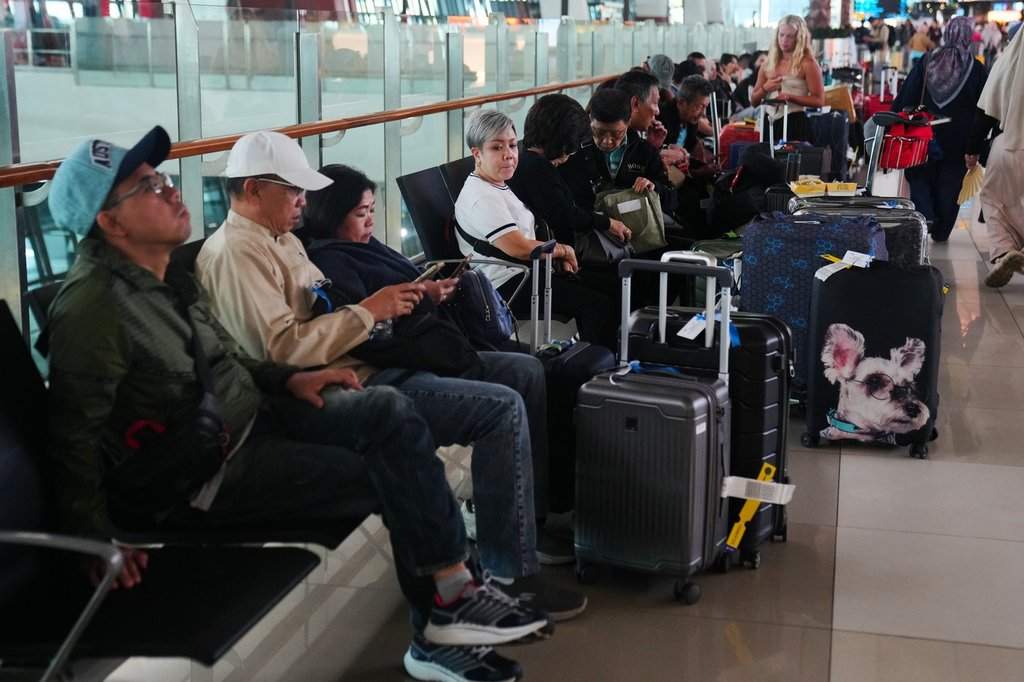
- Approximately 150,000 passengers left cooling their heels in crowded terminals.
- Operations halted entirely until late into the night.
Travelers expressed familiar resignation. Stranded tourists from Madrid to Jakarta shrugged and accepted the force majeure reality. You can't argue with an active magma chamber.
The Long Shadow of Krakatau
We can't talk about Anak Krakatau—literally meaning "Child of Krakatau"—without acknowledging its terrifying lineage. The parent volcano blew its top in 1883 in one of the loudest explosions in recorded human history, triggering a global volcanic winter.
Its modern offspring carries the same genetic volatility. Back in 2018, an underwater landslide triggered by an eruption caused a section of Anak Krakatau's southwest slope to collapse into the sea. That collapse generated a killer tsunami that claimed over 430 lives across Sumatra and Java, shrinking the island to a fraction of its original size.
Lana Saria, head of Indonesia’s Geological Agency, pointed out the core issue: a continuous, heavy supply of magma and volcanic gases keeps feeding the conduit below. Officials cannot predict if a larger blast is coming. They monitor seismic data, tiltmeters, and thermal imaging around the clock.
What to Do If You're Traveling Through Indonesia Right Now
If you're booking trips through Southeast Asia's busiest archipelago, you live on active geological real estate. Mother Nature doesn't care about your tight connection schedules.
Check flight status boards directly through airline apps before heading to major hubs like Soekarno-Hatta or Ngurah Rai in Bali. Regional airports can cascade delays instantly through aircraft rotations. Keep flexible travel insurance handy that explicitly covers natural disasters and force majeure events. Don't rely solely on automated airport announcements when airspace shuts down. Take initiative, secure your accommodation vouchers early, and remember that safety protocols exist because jet engines and pulverized rock are a fatal combination.