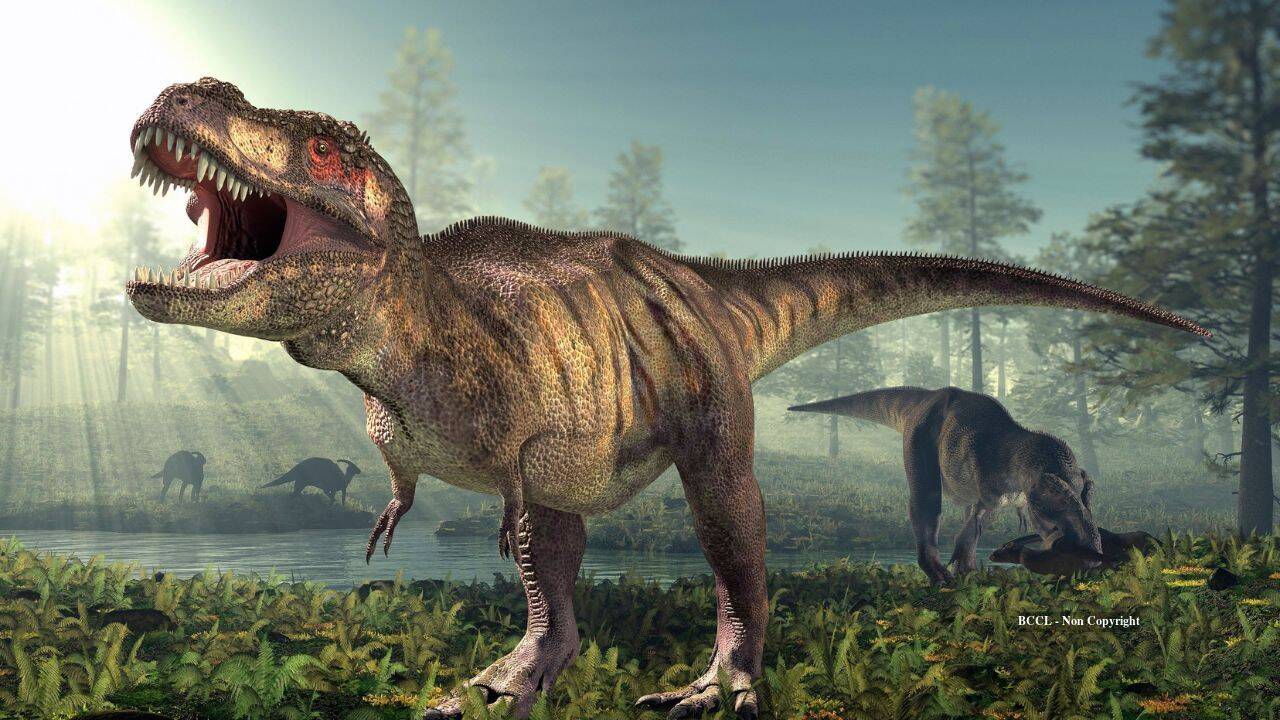
For decades, pop culture has fed us a very specific picture of Tyrannosaurus rex. Movies and museum dioramas love to show a sprinting, roaring engine of destruction chasing down prey at breakneck speeds. But fossils tell a much quieter, more grounded story.
Back in 2025, a volunteer named Kent Hups spotted something extraordinary while working with the Denver Museum of Nature and Science in the Hell Creek Formation of southwestern North Dakota. Etched into stone layers dating back 66.5 million years were four massive, three-toed tracks spanning roughly 23 feet. This wasn't just another isolated footprint. It was a connected trail left behind by a full-grown adult T. rex. And when paleontologists ran the math on the stride length, the results shocked assumptions about how these giant predators navigated their ancient world.
The Reality of a Brisk Prehistoric Stride
Forget the Hollywood chase scenes. The spacing between those alternating left and right steps points to a speed hovering between 3.5 and 4.5 miles per hour.
That is not a sprint. It is a brisk human walking pace.
When you calculate a 13-foot stride length alongside an estimated massive body weight of several tons, you realize this individual wasn't charging down a meal. It was simply traveling. Maybe it was heading toward a riverbank, migrating across the floodplain, or moving between feeding sites.
Scientists rely heavily on biomechanics to piece together these movements. A walking animal keeps at least one foot planted on the ground at all times during a step cycle, which leaves a distinct geological signature compared to a running gait. This find confirms that despite being capable of faster movement when necessary, a slow, conservative walk was likely the default daily mode for an adult T. rex. Conserving energy mattered, even if you stood tall at the top of the food chain.
Why Behavioural Fossils Change Everything
Bones are fantastic for mapping out anatomy, but they leave too much room for guesswork when it comes to daily habits. Skeletons tell you what an animal looked like, while trackways show you what it was actively doing.
Finding a connected series of adult T. rex prints is rare. Isolated impressions pop up occasionally across the Hell Creek region—stretching through North Dakota, South Dakota, Montana, and Wyoming—but consecutive trackways give researchers a concrete timeline of motion.
When you study these prints, you look at more than just size. Researchers analyze:
- The narrow angle between individual toes
- The depth and displacement of the surrounding sediment
- The exact spacing that differentiates a casual stroll from a rapid escape or pursuit
This direct evidence helps paleontologists test computer simulations and skeletal models. If a computer model predicts a certain walking posture, finding physical mud impressions that match those predictions validates the math. If it doesn't match, scientists have to go back to the drawing board regarding leg posture and muscle placement.
A Glimpse Into the Final Days of the Cretaceous
These footprints didn't just land anywhere. They were stamped into mud roughly 66.5 million years ago, placing them dangerously close to the end of the Cretaceous Period and the catastrophic asteroid impact that wiped out all non-avian dinosaurs.
During that era, the Hell Creek landscape was a warm, vibrant mix of broad floodplains, winding rivers, and forests sitting near the Western Interior Seaway. The environment bustled with horned dinosaurs, duck-billed herbivores, armored species, crocodilians, turtles, and early mammals.
This specific T. rex shared its home with a rich ecosystem right before everything collapsed. We will never know the exact destination of that walk, or whether this specific individual survived long enough to witness the end of an era. But those four impressions offer a rare, tangible link to a living animal going about its daily routine.
The next time you picture a apex predator tearing through a prehistoric forest, imagine it moving with heavy, deliberate steps—a steady walk rather than a frantic charge. The mud remembered what the movies forgot.