You'd think water was everything. Open textbooks, watch documentaries, and you'll hear the same old story about human migration. Give people water, food, and air, and they will follow. But recent excavations inside the Arabian Peninsula turn that simplistic survival rule completely upside down.
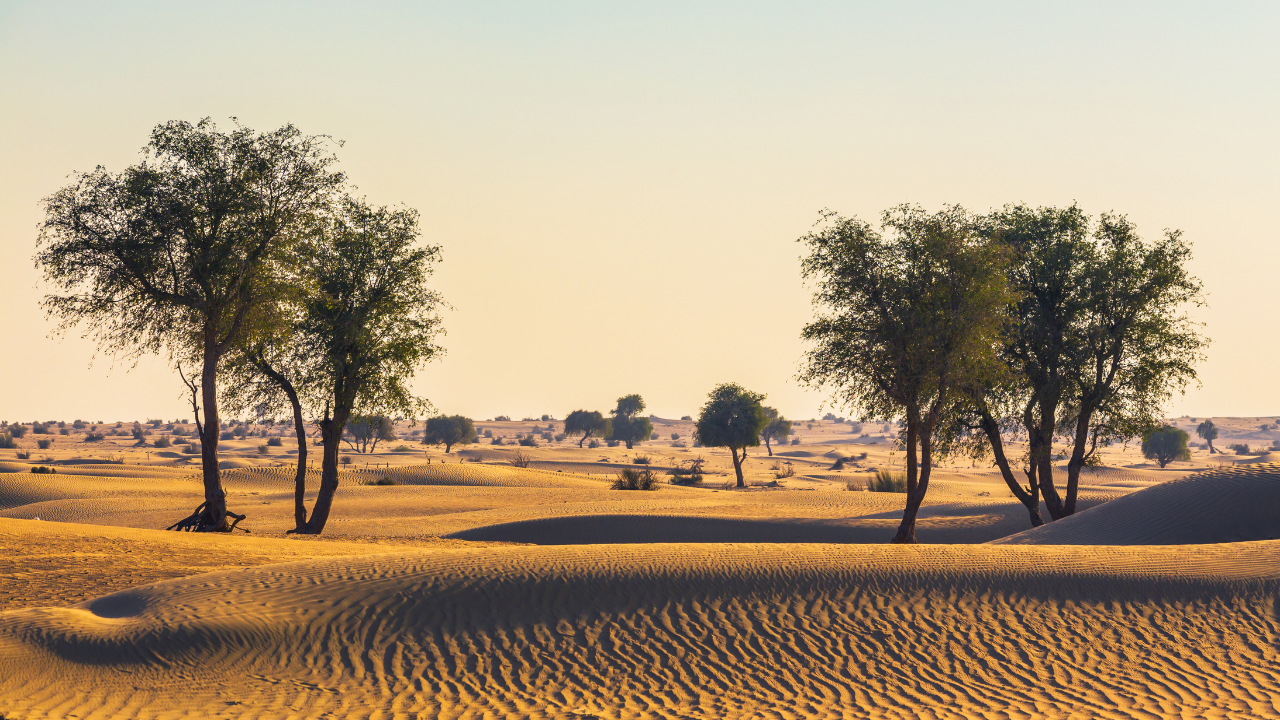
Researchers mapping the Rub al-Khali, the world's largest continuous sand sea, found something strange. They tracked ancient lakes across hundreds of kilometers of barren dunes. They found freshwater shells, fossilized remains, and sediment beds. They found clear, undeniable proof of Green Arabia.
Yet, they found zero early human tools.
Not a single flake. Not a single handaxe.
The Missing Ingredient Beneath Our Feet
For decades, scientists mapped prehistoric human migration using climate data alone. If rainfall patterns pointed to ancient lakes, researchers assumed early humans settled right there. But a team of international researchers ran a 1,500-kilometer survey across the Empty Quarter, examining 125 specific sites.
They confirmed ancient lakes at 55 of those locations. The water was there. The wildlife was there. But the people weren't.
Why? Because early humans needed more than a drink. They needed rocks.
Survival in the Paleolithic era required sharp edges. You couldn't butcher an animal, scrape a hide, or process tough plant fibers with your bare hands. You needed knappable stone—flint, chert, or other fine-grained rocks that could be chipped with predictable precision.
The interior basin of Arabia mostly lacked these materials. Over 95 percent of the ground surface was wide open for observation during the survey, and the stone just wasn't there.
Rethinking Green Arabia
We love to picture Green Arabia as a prehistoric paradise where ancient humans roamed freely across lush grasslands and drinking spots. The reality was much more fragmented.
The region operated like a literal stone desert. When researchers built geographical models comparing 363 known archaeological sites against water and stone distribution, a clear pattern emerged. Roughly 57 percent of the peninsula's water-accessible terrain sat on geological foundations completely devoid of proper toolmaking stone.
Humans didn't avoid the interior because they were scared of open spaces. They avoided it because they couldn't survive there long-term without their technology toolkit.
Archaeologists now refer to this phenomenon as a lithic archipelago. Think of it as a collection of islands. The islands weren't just wet spots. They were rare pockets where freshwater and workable stone coexisted. Step outside those tiny zones, and you faced a fatal manufacturing bottleneck.
What This Means for Human History
This discovery forces a major shift in how we interpret archaeological voids. When scientists dig in a region and find nothing, they usually assume humans never went there.
That assumption is wrong.
Early humans likely explored deep into the Arabian interior during wet phases. They scouted the lakes. They tracked animals. But they couldn't stay. Without local stone to manufacture replacement tools, staying meant running out of gear with no way to repair or replace their survival equipment.
Water brought them to the edge, but geology decided where they could actually live.
Next time you look at a map of ancient migrations, remember that history wasn't just shaped by the weather. Sometimes, survival came down to the simple rocks beneath your feet.