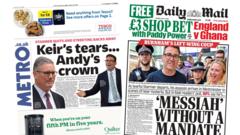
The British political meat grinder just chewed up and spat out another prime minister. Sir Keir Starmer stood outside Downing Street on Monday morning, his voice cracking as he announced the end of his two-year premiership. It feels like we’ve seen this film before. We have. He’ll be the seventh prime minister to occupy Number 10 in a single decade.
The immediate frontrunner to replace him isn't a current cabinet heavyweight. It's Andy Burnham. The former Mayor of Greater Manchester just won a by-election in Makerfield, walked into Westminster, got sworn in as an MP, and immediately put his hand up for the top job. With Wes Streeting already folding his own leadership ambitions to back him, Burnham is looking at a straight shot to a coronation. In similar news, we also covered: Why The Uk Will Fail Its Climate Goals Without New York Style Realism.
But let’s look at the actual reality of this situation. The British public didn't vote for this. Burnham wasn't even an MP when the country went to the polls in the 2024 general election. Now, he's weeks away from running the country. The right-wing press is already having a field day, with the Daily Mail branding him a "Messiah without a mandate." They aren't entirely wrong.
The Rapid Fall of Keir Starmer
Starmer’s exit wasn’t a sudden shock. It was the slow, painful puncture of a political project that ran out of air. Only two years ago, he secured a massive landslide victory. But that victory was always built on shaky foundations. He won with the backing of just a fifth of the total electorate. BBC News has analyzed this critical topic in great detail.
Voters weren't in love with Labour in 2024. They were desperate to punish the Conservatives. When Starmer stood in the Downing Street garden a month into his term and told the public that "things will get worse before we get better," he set a grim tone he could never quite shake.
The public quickly grew tired of the endless policy U-turns. Inheritance tax changes for farmers, tinkering with business rates for pubs, and moving goalposts on welfare reform alienated core groups of voters. By June 2026, his approval rating sat at a dismal -46%. The breaking point came with disastrous local and devolved election results. Cabinet ministers Shabana Mahmood and Ed Miliband privately warned him that his time was up. Over the weekend, Starmer huddled with his wife, Victoria, realized the parliamentary party had abandoned him, and chose to walk before he was pushed.
Andy Burnham and the Coronation Problem
Now the spotlight turns to Burnham. He has long cultivated an image as the "King of the North," a relatable guy who left the Westminster bubble to fight for regular people in Manchester. He is seen by many Labour MPs as the perfect antidote to the rising threat of Reform UK, especially after seeing off Nigel Farage's party in Makerfield.
But entering Downing Street via a back-room deal creates an immediate legitimacy crisis.
If no other Labour MP steps up to challenge him by the July deadline, Burnham could be prime minister by July 17. No public vote. No proper national campaign. Just a swift transition of power handled entirely within the Westminster corridors.
Farage is already capitalising on this, demanding an immediate general election and calling it ridiculous to pretend Burnham has any meaningful mandate to lead. He has a point that resonates far beyond Reform voters. When Boris Johnson was replaced in 2022, Burnham himself was loud in demanding a general election, arguing that a new leader needed a fresh mandate from the public. Now that the shoe is on the other foot, he's brushing those old quotes aside.
What a Burnham Government Means for Your Pocket
Financial markets don't like political instability, and Britain has become a textbook example of it. Following Starmer's resignation, the pound saw immediate volatility. Ten-year gilt yields hovered around 4.84%, a number significantly higher than international peers. Investors are pricing in a permanent British political risk premium.
City analysts are deeply nervous about Burnham’s spending instincts. During his time as mayor, he pushed heavy regulation and public spending. Investors would vastly prefer a competitive leadership race where he is forced to spell out his economic plans, rather than a silent coronation.
The structural problems facing the UK haven't vanished just because the face at the podium changed. Public borrowing numbers are still terrifying. Major decisions on welfare reform and defence spending are looming. Because Burnham lacks a direct mandate from the public, he will likely avoid massive structural changes. Expect him to tinker with personal taxation thresholds instead. The freeze on tax thresholds—which has dragged millions of working people into higher tax bands—remains a massive point of anger. The trade union Unite is already demanding an immediate reversal of this fiscal drag, along with strict caps on energy bills. Burnham will be caught between a furious public and an unforgiving financial market.
The Next Moves in Westminster
The political calendar has been completely upended by Starmer's departure. The European Union has already postponed next month's planned summit with the UK to give the incoming administration time to prepare. The official Labour leadership nominations open on July 9, and the party intends to have everything wrapped up before the summer recess.
Watch the cabinet positioning over the next fortnight. Wes Streeting's decision to step aside suggests he has been promised a massive prize, likely the Chancellor's office. Keep an eye on figures like Al Carns and Darren Jones. They haven't ruled out a run, and a wild-card bid is the only thing that could force a genuine debate over the direction of the country.
If you want to understand where British politics is heading next, ignore the vague promises of a fresh start. Watch the gilt yields and watch the tax thresholds. Burnham's biggest challenge isn't winning the keys to Number 10. It's convincing a deeply cynical public that he has any right to be there.