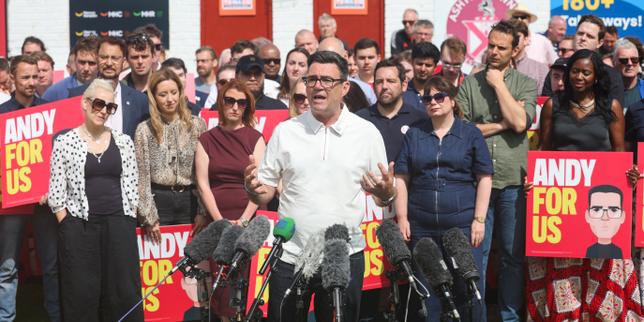
The British political establishment just felt a massive tremor, and the epicenter is a town in Greater Manchester. Andy Burnham is returning to Westminster. He didn't just win the Makerfield by-election on June 18. He absolutely crushed it. By securing nearly 55% of the vote and widening his party's lead in an area where right-wing populists were supposedly dominant, the self-styled King of the North has done something far bigger than merely winning a seat in Parliament. He has officially fired the starting gun on an inevitable battle for the soul of the Labour Party, and his sights are set directly on Downing Street.
This isn't your average political comeback. It's a calculated, high-stakes coup attempt happening in plain sight. For months, Westminster insiders watched Keir Starmer's poll numbers drop like a stone. The optimism of the July 2024 general election landslide vanished, replaced by public exhaustion, policy stagnation, and bruising local election defeats. Sensing blood in the water, Burnham orchestrated a stunning move. He convinced Josh Simons, the sitting MP for Makerfield, to step down and trigger a by-election. The goal was simple. Burnham needed a seat in the House of Commons because, under Labour Party rules, you cannot run for leader unless you are a sitting member of the Parliamentary Labour Party. Now he has that seat. Starmer has a massive problem.
The Shockwave From Makerfield
If you look closely at the numbers from the June 18 vote, you realize why the Prime Minister's inner circle is panicking. Makerfield was supposed to be a dangerous battleground. In the May local elections across the wider Wigan borough, Reform UK took a staggering 46.2% of the vote while Labour cratered to just 26.6%. The political commentators predicted an incredibly tight race, suggesting that Reform might even snatch the seat or leave Burnham clinging to a razor-thin majority.
The reality turned out completely different. Burnham secured 24,927 votes. His closest challenger, Robert Kenyon of Reform UK, finished a distant second with 15,696 votes. That gives Burnham an absolute majority of 54.8% and a commanding margin of 9,231 votes. That is almost double the majority his predecessor held. Even when you factor in the 3,111 votes won by the hard-right Restore Britain party, Burnham outpolled the entire combined right-wing vote with room to spare.
Turnout was impressively high for a modern by-election, hitting nearly 59%. People didn't stay home. They turned up specifically to send a message, and that message was a ringing endorsement of Burnham's brand of populist, regional politics. During his victory speech at the count in Wigan, Burnham didn't sound like a standard backbench MP happy to have a job. He sounded like a leader-in-waiting. He declared that politics isn't working and the country isn't working, calling the result a turning point for British democracy. He openly warned his own party leadership that this is their final chance to get things right before the electorate turns permanently toward a dark, divided style of politics.
Why Keir Starmer is Sweating Right Now
Let's be blunt about Starmer's position. He is leading a government that feels entirely out of steam. Since taking office in 2024, his administration has struggled to define a clear identity. They have squeezed public spending, alienated the traditional left wing of the party, and failed to deliver the visible, rapid improvements that voters expected after years of Conservative rule. As a result, Labour has been bleeding support in two directions at once. Progressive, urban voters are defecting to the Green Party, while working-class northern towns have been drifting rapidly toward Nigel Farage's Reform UK.
Enter Andy Burnham. He offers an alternative that makes Starmer look incredibly weak. While Starmer is often criticized as a cautious, legalistic London technocrat, Burnham has spent the last nine years building an empire in Greater Manchester. He took control of the local transport system, launched the Bee Network, stood up to the central government during pandemic lockdowns, and championed regional devolution. He speaks with a soft northern accent, talks passionately about the working class, and possesses a natural charisma that Starmer simply cannot replicate.
The narrative is already writing itself. Burnham represents the authentic, passionate, northern heart of the Labour Party, while Starmer represents the cold, managerial Westminster elite. Burnham's allies are already whispering to journalists that he could replace Starmer within months, if not weeks. Much depends on whether Starmer decides to dig in his heels and fight a brutal internal war, or whether the pressure from panicked backbenchers facing electoral wipeout forces him to step aside gracefully.
What the Media Missed About the Reform UK Collapse
Every major news outlet is focusing heavily on what this means for the Labour leadership, but there is another massive story hidden inside these numbers. Nigel Farage and Reform UK completely missed their moment. Reform went into this by-election with immense momentum, riding high on their spectacular performances in the local elections just a month earlier. They genuinely believed Makerfield would be their breakthrough moment in the North West.
Instead, they hit a brick wall. Farage publicly expressed his deep disappointment with their 34.5% share of the vote, trying to blame tactical voting. His deputy, Richard Tice, claimed that many Reform-minded voters deliberately chose Burnham simply because they viewed him as the fastest vehicle to humiliate Starmer. That is a weak excuse.
The truth is simpler. Burnham ran an intensely localized, high-energy campaign that focused heavily on regional pride and tangible investment. He neutralised the standard Reform UK talking points by agreeing that Westminster has completely failed northern communities. By positioning himself as an anti-establishment outsider despite his decades of political experience, Burnham snatched the protest vote right out of Farage's hands. It proves that a specific type of Labour politician can still defeat right-wing populism in its heartlands. You just have to offer voters an optimistic vision of state-led investment instead of bland managerial competence.
The High Stakes Gamble of Giving Up Manchester
Winning this election wasn't a cost-free move for Burnham. By choosing to return to Westminster, he has been forced to abandon the very power base that made him relevant in the first place. Under current British law, the Mayor of Greater Manchester holds significant Police and Crime Commissioner powers. Because of this specific setup, the moment a returning officer declares a sitting mayor to be a Member of Parliament, that individual is instantly disqualified from holding the mayoral office.
There is no transition period. Burnham ceased to be the Mayor of Greater Manchester the exact moment his victory was announced in the early hours of Friday morning. This immediate vacancy triggers an automatic requirement for a massive mayoral by-election, which officials are already scheduling for July 30, 2026.
This is a massive gamble for the Labour Party as a whole. They now have to defend an electoral territory of over two million voters in the middle of summer, when turnout is traditionally low and unpredictable. If Labour loses the Greater Manchester mayoralty to a surging Reform UK or an independent candidate, the blame will fall squarely on Burnham's shoulders for abandoning his post. Communities Secretary Steve Reed, a fierce Starmer loyalist, pointedly reminded everyone of this risk immediately after the count. He publicly stated that the party's absolute priority must now be finding a successor to hold Manchester, deliberately trying to defuse talk of a Westminster leadership challenge.
How Burnham Actually Reaches Downing Street
It's easy to get swept up in the drama, but the road from winning Makerfield to moving into 10 Downing Street is full of massive institutional hurdles. Burnham will be sworn in as an MP on Monday, June 22. From that moment, he is a backbencher. He holds no official shadow cabinet role and no government ministry. To take the top job, he has to trigger an official leadership contest.
Under the current rules of the Labour Party, a leadership challenge against a sitting Prime Minister requires the backing of a significant percentage of the Parliamentary Labour Party. Burnham needs to convince dozens of cautious, risk-averse MPs that Starmer is an electoral liability who will cost them their seats at the next general election. He has to run an underground campaign within the corridors of Westminster, whispering in the ears of disgruntled colleagues and building a coalition across the various factions of the party.
He also faces a major branding challenge. His critics are already reminding voters that Burnham isn't actually a fresh, new outsider. He is a political veteran who served as a minister in both the Tony Blair and Gordon Brown governments. He ran for the Labour leadership twice before, in 2010 and 2015, and lost miserably both times. Back then, he was viewed as a slippery, focus-group-driven centrist who lacked a core conviction. His transformation into the radical, flat-cap-wearing champion of the working-class North is highly effective, but his opponents will do everything they can to paint it as an act of pure political opportunism.
What Happens Next for the King of the North
The immediate next steps will tell us exactly how fast this crisis is going to accelerate. Watch the body language when Burnham enters the House of Commons on Monday. Watch who sits next to him on the benches and who line up to congratulate him. The scale of his victory gives him immense leverage, and he has zero intention of sitting quietly in the background.
If you want to track where this goes, keep your eyes on three specific indicators over the next month.
First, look at the selection process for the Greater Manchester mayoral candidate. If Starmer's allies manage to impose a fierce loyalist to run for the mayoralty, it will be a direct attempt to cut off Burnham's lingering influence in his home region.
Second, monitor the public statements of senior cabinet figures like Wes Streeting. The Health Secretary conspicuously praised Burnham's campaign as proof that Labour needs to change. That is an incredibly coded, dangerous statement for a cabinet minister to make about his own government. It suggests that the internal rebellion is already spreading to the highest levels of the front bench.
Third, watch the national polling data over the next two weeks. If Labour's numbers continue to drop while Burnham's personal approval ratings soar, the pressure on Starmer will become completely unbearable. Burnham didn't give up his comfortable, high-profile kingdom in Manchester just to be an anonymous backbencher in London. He came back to take the crown, and the clock is ticking for the man currently wearing it.