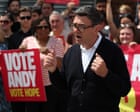
Andy Burnham wants to run the country, but first he has to survive the people who actually fund it.
As the Makerfield byelection reaches its climax, the Greater Manchester mayor isn't just trying to win over local voters. He's frantically trying to reassure the City of London that he won't burn the economy down if he launches a coup against Keir Starmer.
To do that, he's just brought in a trio of economic heavyweights. We're talking about former Bank of England chief economist Andy Haldane, former Office for Budget Responsibility chief Richard Hughes, and Jim O’Neill, the crossbench peer who helped dream up George Osborne’s Northern Powerhouse.
It's a massive defensive play. Gilt investors are already jittery, pushing 10-year borrowing costs to their highest levels since 2008 on the mere prospect of a Burnham premiership. They remember his past comments about the UK being too reliant on the whims of bond traders. Now, he's trying to show he can play by their rules.
The Tricky Dance of Big Spending Vibes
If you listen to Burnham on the campaign trail, he sounds like a man ready to tear up 40 years of trickle-down economics. He talks about slashing energy and water bills, investing in social care, and bringing public utilities under state control. It’s a message designed to win over a public tired of stagnant living standards.
But look closer at the actual commitments. It's a strategy of big spending vibes wrapped in tiny spending promises.
Burnham has already U-turned on his previous rhetoric. He quickly promised to stick to the fiscal rules set out by chancellor Rachel Reeves. He won't raise income tax, national insurance, or VAT. He's even walked back suggestions of raising the top income tax rate to 50p.
Instead, his team is floating less volatile ideas. He wants a land value tax to target property wealth rather than income. He's proposed replacing inheritance tax with a universal social care levy. He's even talking about raising the personal income tax allowance to give lower earners a break.
The strategy is obvious. He needs to convince the left wing of the Labour party that he represents radical change, while whispering to the markets that he's perfectly safe.
The Battle For Number 11
If Burnham successfully rolls Starmer within the coming weeks, his biggest decision won't be policy. It'll be his chancellor.
The names currently swirling around his camp show the deep division in his strategy.
- Ed Miliband: The energy secretary is a close ally and shares Burnham's desire for public control of utilities. But Miliband’s aggressive stance on net zero and North Sea oil licenses makes the City nervous.
- Wes Streeting: A leadership rival who recently gave a speech pushing "progressive capitalism." Appointing him would instantly calm the bond markets, but it would alienate Burnham's left-wing base.
- John Healey: The former defence secretary who resigned recently. He's seen as a stabilizing, orthodox pair of hands.
The markets want continuity. They trust Rachel Reeves. If Burnham dumps her for someone perceived as a big spender, gilt yields will spike on Friday morning before he even sets foot back in Westminster.
Can Manchesterism Work Nationally
Burnham’s entire pitch relies on "Manchesterism"—the idea that economic progress and social progress are completely linked. He points to the Bee Network, where he took control of Greater Manchester’s buses, cut fares, and saw passenger numbers rise by 8%.
But running a city-region is different from running a G7 economy. Reforming national social care and fixing the NHS requires massive capital injection.
Because of current Treasury accounting rules, spending on public services is treated as day-to-day consumption, not long-term investment. If Burnham sticks to Starmer's rigid fiscal framework, he won't have the cash to fund his vision. He'll be trapped in the exact same economic straitjacket that has paralyzed the current government.
What Happens Next
The immediate focus is the Makerfield result. If Burnham wins, the clock starts ticking for Keir Starmer.
If you want to know if Burnham's economic shield is working, don't watch the victory speeches. Watch the bond markets. If gilt yields steady, Burnham has his license to challenge for the leadership. If they spike, his campaign might be dead before it even starts.