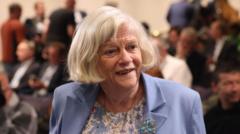
When a high-profile political figure is killed at home, our minds instantly jump to the worst-case scenario. We think of radicalization. We think of targeted ideological hits. So when news broke that former Conservative minister and Reform UK figure Ann Widdecombe was found dead with serious injuries in her isolated Dartmoor home, the national anxiety gauge spiked immediately.
But the actual evidence points somewhere else entirely.
Devon and Cornwall Police have made it clear that there is nothing to suggest a political motivation behind the killing. Despite the initial shockwave and the early involvement of specialized units, detectives are treating this as a localized criminal investigation. A 28-year-old man from South Yorkshire has been arrested on suspicion of murder, and police aren't looking for anyone else.
If you're trying to make sense of what happened at that rural Devon property, you need to separate the public profile of the victim from the actual realities of the forensic investigation.
What Actually Happened at Dartmoor
Widdecombe, 78, was found dead on Thursday morning at her home in the village of Haytor, right on the edge of Dartmoor National Park. Alarm bells rang when she failed to appear for a scheduled television interview on Wednesday afternoon.
Police believe the attack happened around 12:30 BST on Wednesday, just hours after she had completed a previous media appearance. Ambulance crews called in the police after discovering her body, which showed signs of severe trauma.
The investigation moved fast. Initially, officers picked up a 26-year-old man in Newton Abbot, a town roughly nine miles from her house. By Saturday morning, that man was released and entirely ruled out of the inquiry.
The real breakthrough came later that day. Acting on behalf of Devon and Cornwall Police, Counter Terrorism Policing North East and South Yorkshire Police arrested a 28-year-old white British national at an address in Rotherham. He remains in custody.
Understanding the Counter Terrorism Involvement
It’s completely natural to question the police narrative when you hear that counter-terrorism units were involved in the arrest. If it isn't political, why bring in the specialist squads?
The answer comes down to standard operational protocol for high-profile public figures. When a former Member of Parliament and government minister is murdered, the risk assessment automatically escalates. Given the tragic UK histories involving politicians like Jo Cox and Sir David Amess, police forces cannot afford to take chances. They use the resources of counter-terrorism networks for their rapid deployment capabilities and cross-border intelligence sharing, not necessarily because the crime itself is tied to an ideology.
Assistant Chief Constable Matt Longman explicitly stated that Devon and Cornwall Police retain primacy over the investigation. The case is not being treated as a terrorist incident. The involvement of the northeastern units was a matter of geographic logistics and speed, nothing more.
The Public Figure vs. The Private Reality
Widdecombe spent decades in the public eye. She was an uncompromising Home Office minister under John Major, a fierce Brexit advocate alongside Nigel Farage, and more recently, a contributor for Talk TV. She was famous for her blunt, traditionalist views.
Because she was a polarizing figure who never shied away from the cultural battles of the day, speculation ran rampant online that her political stances made her a target. It's a lazy assumption that ignores how most violent crime actually happens.
Rural isolation often presents a far greater vulnerability than political affiliation. Her home in Haytor was secluded. For opportunistic criminals or individuals with completely non-political motives, an isolated property belonging to an elderly woman presents a specific type of target, regardless of who lives inside.
What Happens Next in the Investigation
The public needs to let the judicial process work without filling the information vacuum with conspiracy theories. Right now, forensic teams are continuing their work at the Dartmoor property, analyzing surveillance footage from the surrounding area, and conducting house-to-house inquiries.
The police have stated there is no wider risk to the public. The focus now shifts entirely to the custody suite in South Yorkshire and the subsequent formal charging process.
If you want to understand this case accurately, stop looking at it through the lens of Westminster politics. Watch the forensic evidence instead. The facts of the case, rather than the internet commentary, will dictate where this prosecution goes. Expect formal court appearances to outline the specific timeline and relationship, if any, between the suspect and the victim in the coming days.