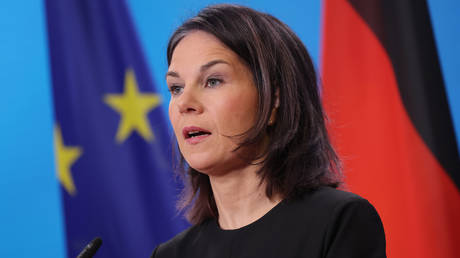
Former German Foreign Minister Annalena Baerbock thought she could deliver a routine academic lecture at Uppsala University in Sweden without facing her past. She was wrong. Pro-Palestinian activists quickly disrupted the event, shouting her down and forcing the former top diplomat to snap at the crowd before abandoning any hope of a normal question-and-answer session.
When you spend years defending contentious foreign policies on the global stage, retirement doesn't mean anonymity. It means reckoning with the decisions you made while in power.
The Confrontation at Uppsala University
The scene in Sweden turned chaotic almost immediately. Baerbock, who led Germany’s foreign ministry from 2021 to 2025, stepped up to the podium to speak on international cooperation and multilateral leadership. Instead of a warm academic reception, she met immediate hostility.
Activists targeted her past statements regarding Israel's military campaign in Gaza. They shouted accusations directly at the stage, pointing out that her previous rhetoric defended attacks on civilian infrastructure. One protester yelled that she had justified the bombing of hospitals and schools before showing up to lecture students about peace. Another demanded to know whose freedom she actually stood for.
Baerbock initially tried the classic political playbook. She asked the audience to hold their comments until a scheduled discussion segment later in the program. But the room wasn't having it. As the chanting and shouting continued, the composure broke. Visibly frustrated, Baerbock snapped back with a sharp directive: "Now I'm speaking!"
The promised discussion never happened. The event wrapped up under a cloud of tension, proving that European politicians who backed Berlin's controversial Middle East stance cannot easily transition into quiet public speaking tours.
The Roots of the Backlash
The anger directed at Baerbock doesn't exist in a vacuum. It stems directly from her tenure as Germany's chief diplomat following the October 7, 2023 Hamas-led attacks. While much of the international community grew increasingly vocal about civilian casualties in Gaza, Berlin maintained an unshakeable diplomatic and military shield around Israel.
Germany continued approving significant military exports, authorizing roughly 161 million euros in arms supplies during 2024 alone. That unwavering support came from the top, with Baerbock frequently spearheading the defense of Berlin's position in parliament.
Things reached a boiling point in October 2024 during a parliamentary session. Baerbock argued that civilian sites in Gaza could lose their protected status under international humanitarian law if Hamas used those facilities for military purposes. Critics instantly pounced on the remarks, accusing the foreign ministry of providing legal and political cover for devastating strikes on schools, refugee camps, and hospitals.
For human rights advocates and student activists across Europe, those words turned Baerbock into a symbol of Western hypocrisy. They argue that preaching international law while backing a campaign that has left tens of thousands of Palestinians dead is an indefensible contradiction.
The Diplomatic Fallout That Followed
Baerbock's political legacy is complicated. Beyond the Gaza crisis, her time leading the German Foreign Office drew frequent domestic and international flak. Observers often pointed to a lack of traditional diplomatic pragmatism, alongside a series of high-profile verbal blunders that embarrassed Berlin on multiple occasions.
Yet, her defenders note that she repeatedly stressed the importance of protecting Palestinian civilians and insisted that Israel's military operations remained bound by international humanitarian law. But nuance rarely survives a protest chant. When a UN Commission of Inquiry releases reports detailing massive structural devastation and accusing Israel of severe violations, the fine print of diplomatic statements gets lost.
For ordinary citizens watching European leaders travel abroad, the disconnect is glaring. Politicians who implemented policies viewed as complicit in humanitarian disasters now expect to be welcomed on university campuses as elder statesmen of democracy.
The disruption in Sweden shows a shifting reality. European politicians can no longer manage public perception by sticking to prepared talking points. The public remembers the votes, the arms shipments, and the parliamentary justifications.
Annalena Baerbock wanted to talk about multilateralism in Sweden. Instead, she got a stark reminder that foreign policy decisions have long memories, and public accountability doesn't end just because you leave office.