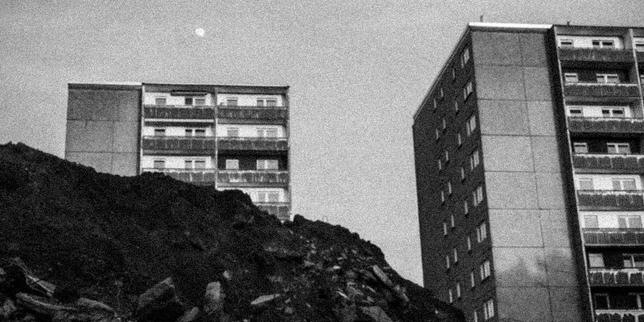
History doesn't always vanish with a bang. Sometimes, it simply rusts away in the fading light of towns built for a utopian future that never quite arrived.
When you look at the work of French photographer Antoine Lecharny, you aren't just seeing old buildings or abandoned streets. You're confronting the physical aftermath of geopolitical shifts that reshaped Europe. His lens frequently fixates on the melancholic architecture of former East Germany, specifically industrial strongholds like Eisenhüttenstadt—once known as Stalinstadt—where socialist urban planning met post-reunification reality.
If you've ever walked through these regions, you know the distinct feeling in the air. It's a mix of heavy silence and profound architectural ambition left behind by history.
The Weight of Concrete Dreams
Eisenhüttenstadt was born as a pristine model city of steel and labor during the German Democratic Republic. It was designed to showcase the triumph of industrial socialism. Wide boulevards, monumental housing blocks, and sprawling factories promised a utopian worker's paradise.
Then the Wall fell.
Industries privatized or collapsed overnight. Young people packed their bags and moved west for better wages. What remained was a ghost of a dream, frozen in concrete and weathered by decades of neglect.
Lecharny doesn't approach these spaces as a cynical tourist looking for cheap ruins porn. His background, shaped by stark documentary projects exploring deep historical scars and collective amnesia—such as his documentation of mass execution sites in Eastern Europe—informs how he frames decay. He treats these East German urban landscapes with a somber dignity. His grain-heavy, high-contrast imagery highlights how modern life tries to persist amidst monumental obsolescence.
Why These Forgotten Towns Still Matter
People often ask why we should care about declining industrial towns in former East Germany. After all, the Cold War ended decades ago.
The answer is simple: urban decay tells the truth that political speeches hide.
These towns expose the human cost of rapid economic transitions. When a state-planned economy disappears in a flash, it leaves a massive vacuum in community identity. You see it in the shuttered storefronts, the empty plazas, and the aging populations who remember a completely different social contract.
Lecharny's photographs force us to acknowledge what political maps leave out. They capture the uneasy friction between historical memory and contemporary banality. You have quiet streets, parked cars, and everyday routines unfolding against a backdrop of ideological ruins. It's a powerful reminder that history isn't confined to textbooks; it's baked into the very bricks of the buildings we walk past.
Beyond Nostalgia
There is a major difference between romanticizing the past and confronting it honestly. Pop culture loves "Ostalgie"—the bittersweet commercialized nostalgia for everyday items and aesthetics of the former GDR.
Lecharny's photography rejects that superficial gloss. His work avoids easy sentimentality. The light in his shots is often harsh or deeply shadowed, creating a feeling of unease rather than cozy longing. He looks at the structural abandonment of towns like Stalinstadt not as a quirky historical footnote, but as an ongoing process of erasure.
If you want to understand modern Europe, you have to look at these margins. The political fractures playing out across the continent today are deeply tied to the economic hollowed-out zones left behind in the 1990s.
Pay attention to the places society tries to forget. That's usually where the real story is hiding.
Antoine Lecharny art exploration
This video provides a deep look into Antoine Lecharny's documentary photography approach, exploring memory, loss, and the visual traces of historical absence in Eastern Europe.