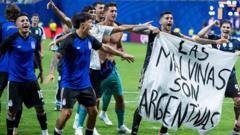
Imagine playing the game of your life, pulling off a breathtaking comeback to reach a World Cup final, and then immediately igniting an international diplomatic incident. That is exactly what the Argentina national team did on Wednesday night in Atlanta. After a tense, chaotic 2-1 victory over England, several Argentine players held up a banner claiming sovereignty over the Falkland Islands.
The words Las Malvinas son Argentinas (The Falklands are Argentine) were splashed across the stadium. It did not take long for the images to go viral. The British government immediately demanded answers, Argentina's vice president cheered the players on, and FIFA was left holding a very hot political potato right before Sunday's final against Spain.
If you thought football and politics could be kept in separate boxes, this is your reality check. The Argentina Falklands banner controversy shows that on the biggest stage, sport and history are utterly inseparable.
What Happened in Atlanta Was Never Just a Football Match
The 2026 World Cup semifinal between England and Argentina had enough sporting drama to feed a nation for months. Thomas Tuchel's England took an early lead, but Argentina fought back with two late goals to secure their ticket to MetLife Stadium. The referee blew the final whistle, the celebrations began, and then the script changed.
Several high-profile Argentine players, including Giovani Lo Celso, Lisandro Martinez, and Nicolas Otamendi, walked over to the fans. A banner was passed down. It bore the classic, deeply emotional Argentine slogan asserting claim over the South Atlantic islands. Lo Celso even laid the banner flat on the pitch, ensuring every television camera in the stadium got a clear shot.
For Argentines, the Falklands (or Las Malvinas) are a deeply sensitive topic, a wound that has never fully healed since the 1982 war. For the British, the islands are a self-determining British overseas territory whose residents have repeatedly voted to remain British. Bringing this dispute onto a pitch in Georgia was always going to cause an explosion.
The Long and Bitter History of England vs Argentina on the Pitch
To understand why a simple banner can make front-page news in both London and Buenos Aires, you have to look at the history between these two teams. They do not just play football; they play out national narratives.
The sporting rivalry turned toxic long before the 1982 war. Back in the 1966 World Cup, England manager Alf Ramsey famously referred to the Argentine players as "animals" after a brutal, ill-tempered quarter-final match at Wembley. That comment cemented a deep-seated resentment in Argentina.
But the 1986 World Cup quarter-final in Mexico City is where football and geopolitics merged forever. Just four years after the Falklands War ended, Diego Maradona scored his two most famous goals against England. The first was the infamous "Hand of God" handball, and the second was a mesmerizing, brilliant solo run through the entire English defense. Maradona later admitted in his autobiography that the match felt like a symbolic battle. They were playing for the fallen Argentine soldiers.
That emotional weight has passed down to the modern squad. The current players still sing dressing room chants that reference the Malvinas alongside Maradona and Lionel Messi. To the players, holding that banner in Atlanta was not a random act of defiance; it was a continuation of a decades-old tradition.
How the Las Malvinas Banner Ended Up on the Pitch
Early reports suggest the banner was not smuggled onto the pitch by the players themselves. Instead, fans had displayed it in the stands earlier in the match. Under standard FIFA stadium protocols, security teams are supposed to confiscate highly charged political items at the turnstiles. Somehow, this massive banner slipped through.
During the post-match frenzy, fans handed the banner down to the players. Instead of handing it back or ignoring it, the players embraced it.
Midfielder Leandro Paredes did not mince words when reporters asked him about the gesture. He made it clear that the squad knew exactly what this game represented for their country. He noted they wanted to represent the people who lived through that painful era of Argentine history. To them, this was about national pride.
But FIFA sees things differently. Their rules are designed to keep the world of politics completely detached from what happens on the grass.
What the Rulebook Says and What Sanctions Argentina Faces
FIFA has opened an investigation into the incident, with its independent disciplinary committee reviewing match reports from Atlanta. The governing body is under intense pressure from the UK government to act quickly and decisively before Sunday's final.
The legal basis for any potential punishment lies in FIFA's Stadium Code of Conduct and its strict Disciplinary Code.
- The Stadium Code of Conduct explicitly bans any materials, banners, flags, or apparel that are of a political, offensive, or discriminatory nature.
- Article 17, Section 2(e) of the FIFA Disciplinary Code prohibits using gestures, words, or objects to transmit messages that are not appropriate for a sports event, specifically highlighting those of a political, ideological, or religious nature.
So, what kind of punishment is Argentina actually looking at?
History gives us a very clear clue. Back in 2014, before a friendly match against Slovenia, Argentine players held up a nearly identical banner. FIFA did not hesitate. They slapped the Argentine Football Association (AFA) with a fine of £20,000 for breaching rules on political action and team misconduct.
Because this violation occurred on the massive stage of a World Cup semifinal, the financial penalty will likely be significantly higher. Some British politicians and public figures, including Liberal Democrat leader Ed Davey, have called for the players involved to be banned from Sunday's final.
But realistic football insiders know a player ban is highly unlikely. FIFA's initial steps suggest the disciplinary action will target the Argentine federation rather than individual players. Stripping stars like Lo Celso or Martinez of their spots in a World Cup final over a banner celebration would create a massive sporting crisis that FIFA desperately wants to avoid. Expect a hefty fine and a very stern warning.
The Diplomatic Firestorm Between Buenos Aires and London
While FIFA lawyers parse their disciplinary code, politicians in both hemispheres have jumped on the issue. The fallout from the Atlanta stadium has turned into a full-scale diplomatic war of words.
Downing Street released a sharp statement following the match. "The World Cup might not be ours, but the Falkland Islands definitely are," a spokesperson for the UK Prime Minister said, reaffirming Britain's commitment to the islanders. Business Secretary Peter Kyle went further, calling the players' actions "entirely inappropriate" and demanding a thorough FIFA probe.
On the other side of the Atlantic, Argentine politicians went into overdrive to defend the national team.
Vice President Victoria Villarruel praised the players on social media, posting a tribute alongside historical military footage. She pointed out that while authorities banned the banners from the stadium, they forgot that Argentines carry the Malvinas in their hearts. Before the match, she had even described the game as an opportunity to put "the invaders in their place".
Meanwhile, President Javier Milei took a slightly more measured but supportive stance. He called the players' banner display understandable and valid, though he admitted to broadcasters that pitch actions are separate from formal diplomacy. He maintained that Argentina will continue to pursue its claim over the islands, but through peaceful, strategic channels.
The Flaw in FIFA Claims of Political Neutrality
This entire episode exposes a massive contradiction at the heart of modern sports governance. FIFA desperately wants to market football as a neutral, sanitized space where the troubles of the real world do not exist. They write endless rules banning political expression, yet they happily sell their tournament to countries using the sport for state-level public relations.
You cannot separate football from national identity because football is often the loudest expression of national identity we have left. When players walk onto the pitch representing a country, they carry that country's history, its traumas, and its unresolved conflicts. Expecting young players to completely turn off their national sentiments the second they win a massive match is fundamentally unrealistic.
Argentina's players knew they would get fined. They knew the British press would be outraged. They did it anyway because, in their eyes, some things are more important than a FIFA fine.
What Happens Next for the World Cup
Argentina is still scheduled to play Spain in Sunday's final at MetLife Stadium. Their pursuit of back-to-back world titles remains on track, regardless of the ongoing investigation.
The immediate next steps are highly predictable:
- The Argentine Football Association (AFA) will receive formal notification of the disciplinary proceedings from FIFA.
- AFA lawyers will submit statements defending the players, likely arguing the banner was handed to them spontaneously by fans and was not a pre-planned political demonstration.
- FIFA's disciplinary committee will issue a ruling, almost certainly consisting of a substantial five-figure or six-figure fine for the Argentine federation.
- Security protocols at MetLife Stadium will be heavily tightened ahead of the final to prevent similar banners from reaching the pitch.
Do not expect Argentina's players to apologize, and do not expect the UK government to drop its demands for respect. This controversy highlights a fundamental truth about modern sports: you can build all the rules you want to keep football "neutral," but when history and national identity are on the line, the pitch will always become a battleground. Keep a close eye on how FIFA handles the fallout over the next few days, because their decision will set the precedent for political expression in football for years to come.