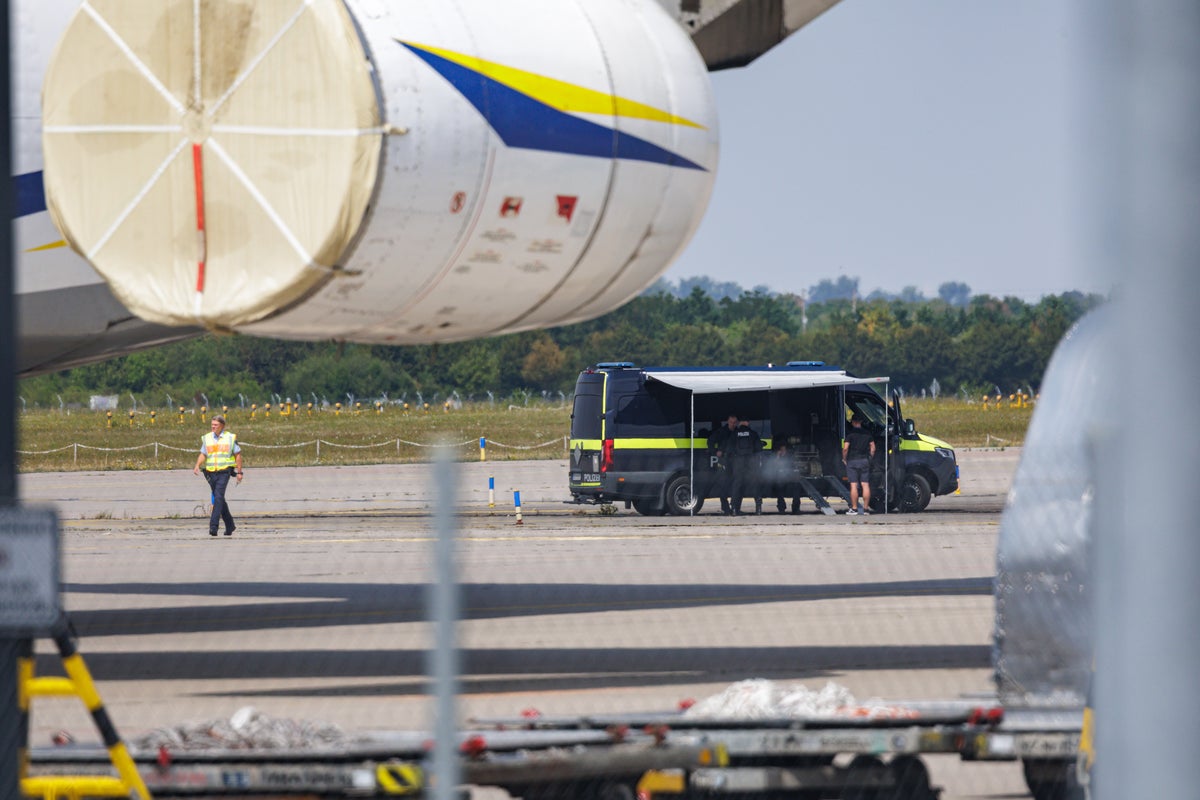
When a modified quadcopter carrying explosives turns up right next to a Ukrainian cargo plane at a major European logistics hub, nobody should be shrugging it off. That is exactly what happened at Germany’s Leipzig/Halle Airport, triggering an immediate security lockdown, runway closures, and emergency flight diversions.
German federal police and counter-terrorism prosecutors didn't have to guess at the gravity of the find. An airport worker spotted the drone near the southern runway, sitting mere meters away from an Antonov transport aircraft operated by Ukraine's national airline. A bomb disposal robot had to be deployed to safely remove the detonator from the payload. Meanwhile, an incoming freight flight had to abort its landing, later reporting a mid-air collision with a mysterious object that left minor damage on its airframe.
Let's look past the initial breaking news alerts. This incident isn't just an isolated security breach. It exposes a terrifying evolution in how critical infrastructure across Western Europe is being targeted.
Why Leipzig/Halle Is a Prime Target
Leipzig/Halle isn't just another regional airstrip. It functions as a vital logistics artery for central Europe, serving as a massive sorting hub for DHL alongside its strategic role as an operational base for Ukrainian Antonov cargo planes since the full-scale Russian invasion began.
Because the facility handles regular military transports and heavy Ukrainian freight, it has sat squarely in the crosshairs of hybrid warfare tactics for years. Back in 2024, an incendiary device concealed in a freight container caught fire right inside a Leipzig logistics warehouse, part of a wider sabotage campaign linked by Western intelligence to Russian operatives.
Finding an armed drone on the tarmac takes things to a completely different tier. German Interior Minister Alexander Dobrindt cut his vacation short to visit the site, openly telling reporters that an explosive-laden drone sitting at a commercial airport represents "a new quality of danger" and a clear hybrid attack scenario.
The Mechanics of the Threat
Details emerging from state investigators and local reports indicate the drone was carrying a substantial amount of high explosive—reportedly up to 800 grams of plastic explosive material. Aviation experts point out that commercial aircraft bodies are engineered for maximum fuel efficiency and weight savings, meaning their aluminum hulls are often only a few millimeters thick.
An 800-gram charge detonating next to a parked transport plane wouldn't just scratch paint. It would catastrophically breach the fuselage, potentially triggering secondary detonations if fuel or munitions were onboard.
Even though the detonator failed or was disabled before it could do its job, the real victory for whoever launched the drone was psychological and operational. Shutting down runways, scrambling bomb squads, and grounding international cargo fleets throws supply chains into instant chaos.
Who Is Behind the Escalation?
While German prosecutors and the Central Office for Extremism Saxony (ZESA) are keeping their official cards close to their chest while forensic teams comb through the drone parts, Ukrainian officials haven't hesitated to point fingers. Ukraine's ambassador to Germany openly questioned who else could benefit or possess the capability, while European security agencies continue tracking a relentless wave of suspicious drone overflights above military bases, LNG terminals, and logistics hubs.
Moscow has consistently denied involvement in these operations. Yet, Western intelligence services note a distinct pattern of proxy sabotage, infrastructure probing, and GPS-jamming campaigns designed to test the resilience of NATO's rear guard.
The Broader Aviation Security Nightmare
Commercial aviation has spent decades tightening perimeter security against traditional terminal threats, suitcase bombs, and insider hijacking. Open-air perimeter defense against small, commercially available quadcopters is an entirely different beast.
You can't put a brick wall around every square kilometer of a major international airfield. When drones can be smuggled near operational zones, loaded with military-grade explosives, and left feet away from high-value aircraft, the traditional security playbook breaks down entirely.
European airports are waking up to a reality where their sprawling asphalt perimeters are porous. Expect a massive scramble for counter-drone electronic warfare jamming tech, acoustic sensors, and thermal perimeter cameras across every major logistics hub on the continent before the year is out.
Check your flight schedules if you're routing cargo through central Germany this week, and watch for tighter airspace restrictions over European transit corridors as authorities reevaluate what "secure" actually means.


