Attack helicopters are sitting ducks on modern battlefields.
Ukraine proved it. Cheap shoulder-fired missiles, loitering munitions, and non-stop drone surveillance turned the low-altitude airspace into a meat grinder. Flying a $30 million crewed helicopter anywhere near the front line now carries an almost suicidal risk. pilots know it, generals know it, and defense contractors definitely know it.
That's where Anduril's latest reveal comes in.
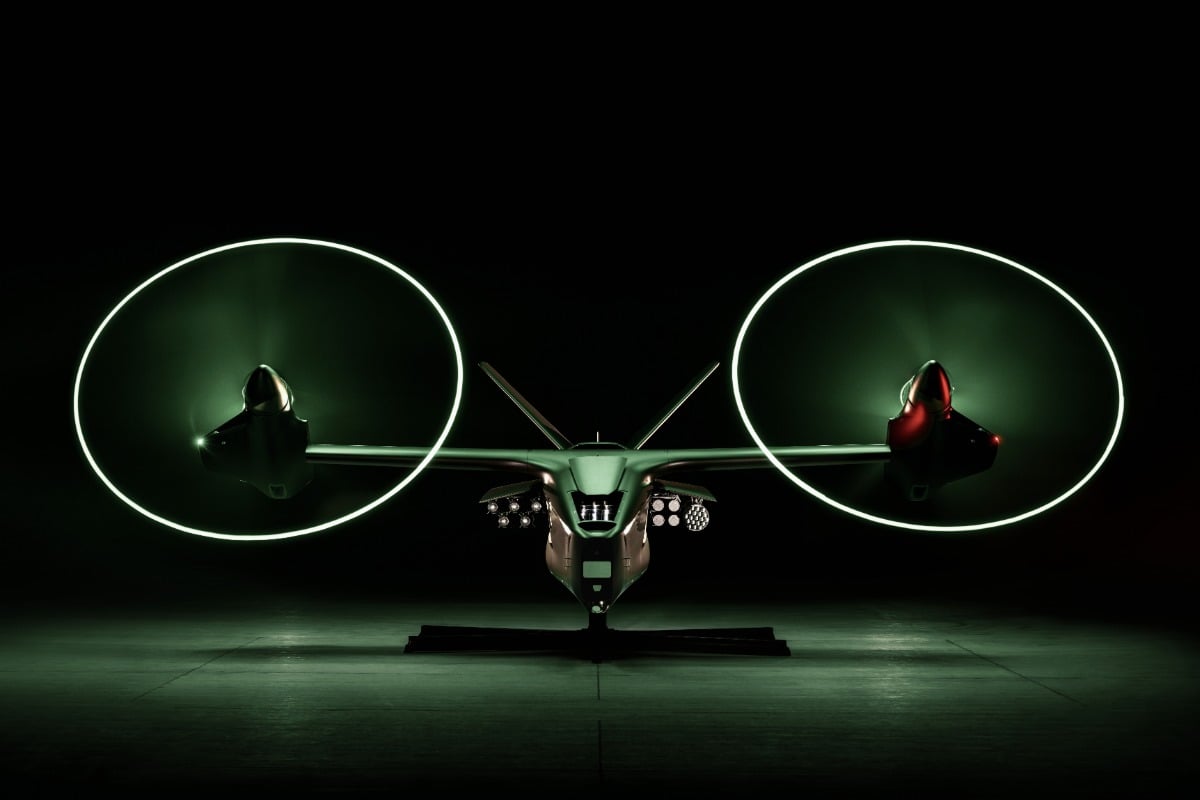
At the Farnborough International Air Show, Anduril Industries introduced Thunder, a massive Group 5 autonomous attack rotorcraft. It isn't a small reconnaissance drone or a suicide quadcopter. It's a full-sized, hybrid-electric tiltrotor built to fly alongside AH-64 Apaches and soak up the lethal risks that traditional crewed aviation can't handle anymore.
The concept isn't just about adding another cool aircraft to the hangar. It marks a total shift in how military forces plan to fight near the ground.
The Fatal Problem Facing Traditional Attack Aviation
For four decades, attack helicopters ruled near-surface combat. They flew fast, hid behind treelines, and knocked out armored columns with guided missiles.
That playbook is dead.
When air defense systems cost a few thousand dollars and fill the skies in swarms, sending two pilots in a multimillion-dollar helicopter into low-altitude terrain is a losing trade. Ground forces can spot crewed rotorcraft kilometers away using thermal optics and acoustic sensors. Radar-guided air defenses leave tiny windows for pilots to pop up, fire, and hide before taking incoming fire.
Traditional military procurement tried to fix this by adding defensive suites and stealthy coatings to existing helicopters. But retrofitting legacy airframes only gets you so far. You still have human beings sitting in a cockpit, requiring heavy armor, life support systems, and massive safety margins.
Remove the pilots from the front line, and the math changes instantly.
How Thunder Packs an Apache-Level Punch Without the Pilot
Most military drones are small, fragile, or slow. Thunder is none of those things.
Anduril co-developed the platform with Archer Aviation, pulling electric propulsion and rotor design straight out of commercial electric vertical takeoff and landing (eVTOL) projects. But instead of running purely on batteries, Thunder uses a series hybrid-electric powertrain. An internal combustion engine charges the system, while variable-speed electric rotors handle flight.
That tiltrotor design gives it two distinct advantages. First, it takes off and lands vertically without a runway. Second, once it transitions to wingborne cruise, it flies at speeds exceeding 200 knots—matching or beating the cruise speeds of modern attack helicopters.
Here's what Thunder brings to the fight:
- Heavy Payload Capacity: Thunder hosts internal modular bays in the nose and main body. The main bay can carry up to ten AGM-114 Hellfire or Joint Air-to-Ground Missiles (JAGM), sixteen launched effects like the Altius-600, or seventy-six 70mm rockets.
- Massive Range: Thanks to its hybrid powertrain and efficient wing-borne flight, it offers a operational range measuring thousands of nautical miles, making self-deployment across vast oceans a reality.
- Low Acoustic Footprint: By varying rotor RPM during low-altitude ingress, the aircraft reduces its sound signature, allowing it to sneak up on targets far better than a traditional dual-rotor helicopter.
- Modular Logistics: It packs flat into a standard ISO shipping container. You can ship it by cargo truck, rail, ship, or transport plane without needing complex assembly crews on arrival.
I've watched defense hardware announcements for years, and companies usually hide firepower specs behind vague marketing lines. Laying out exact missile counts right out of the gate shows Anduril isn't pitching a concept model—they're pitching an operational weapon system aimed straight at active military budgets.
Autonomy Means Intent, Not Joysticks
If a drone requires an operator staring at a screen with a joystick, it isn't an autonomous wingman—it's just a remote-controlled plane that drains manpower.
Thunder runs on Anduril's Lattice for Mission Autonomy platform. This software handles collision avoidance, formation flying, terrain awareness, and sensor fusion without human micro-management.
Instead of flying the drone, a human pilot in an accompanying Apache simply issues high-level commands. Think of it like managing a tactical team rather than playing a video game. The pilot orders the formation to scout a ridge line, and the autonomous tiltrotors figure out how to navigate the terrain, position their sensors, and report back.
Shane Arnott, senior vice president of programs and engineering at Anduril, pointed out that the goal is to let Thunder fly super low and fast near terrain while sensing obstacles dynamically. The human stays in the loop strictly for weapon release decisions.
Pairing three Thunder aircraft with a single Apache triples the available firepower of an attack team without adding a single pilot to high-threat airspace. If an enemy air defense battery opens fire, it hits a $10 million autonomous drone instead of a $30 million crewed helicopter housing two trained soldiers.
Commercial Tech Beats Traditional Defense Procurement Timelines
The traditional defense sector takes 15 to 20 years to build a new military aircraft from scratch. Anduril and Archer took a completely different path by adapting Archer's commercial eVTOL airframe technology, cutting development timelines drastically.
Chris Brose, Anduril's president, noted that Thunder draws heavily on lessons observed directly from combat in Ukraine. Development has been quietly underway for roughly three years, with flight software testing active for two. Full-scale surrogate test vehicles have already flown, and Thunder's official first flight is slated for 2027.
By piggybacking on commercial supply chains built for civil air taxis, Anduril secures lower production costs and faster manufacturing scalability. That's something traditional defense primes struggle to match when every part is custom-machined in tiny batches.
Practical Takeaways for Defense Strategy
- Rethink Manned Formations: Militaries must transition from treating uncrewed platforms as secondary reconnaissance assets to treating them as primary force multipliers that fly ahead into contested airspace.
- Prioritize Modular Payload Bays: Buying single-purpose aircraft limits tactical flexibility; platforms must adopt open architectures that swap missiles for electronic warfare suites or counter-drone gear depending on the daily mission.
- Invest in Intent-Based Software: Ground and air crews don't have the bandwidth to fly extra aircraft manually; software must absorb flight operations so humans focus purely on tactical command.
The shift away from crewed close-air support isn't coming in a few decades—it's happening right now. Companies that build autonomous, high-payload systems that plug into existing combat units will dominate the future of tactical flight.
To get a better sense of how Anduril builds compact, autonomous VTOL platforms that use AI-driven flight controls for field operations, check out the Anduril Ghost X Modular System.
This video demonstrates the tactical design, modular rail payload system, and autonomous flight capabilities that form the baseline engineering philosophy behind Anduril's larger platforms like Thunder.