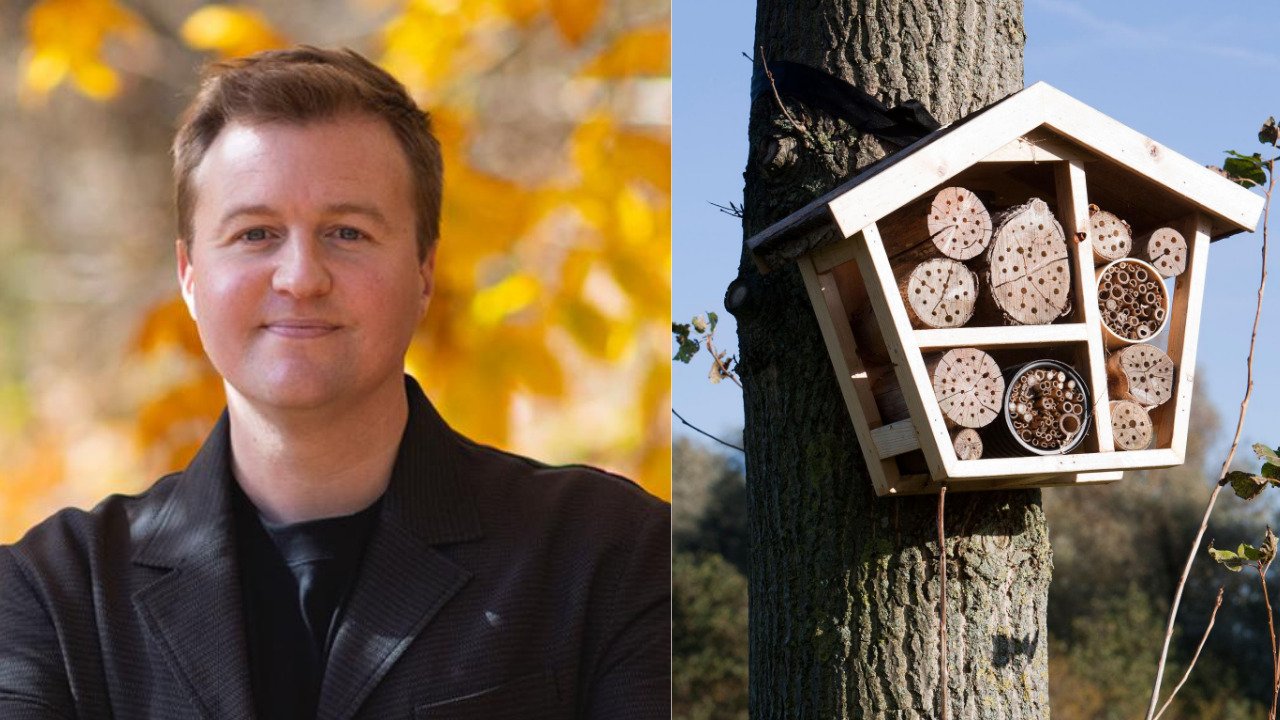
You bought that little wooden block with the drilled holes because you wanted to save the bees. It hangs on your garden fence, a miniature apartment complex for nature’s best pollinators. You feel good every time you look at it. You think you’re fixing a broken ecosystem right in your backyard.
You’re probably not.
Most backyard bee hotels aren't the conservation lifelines they're marketed to be. Instead, many of them function as fast-food drive-thrus for invasive species, parasites, and predatory wasps.
This isn't a cynical guess. It is the result of rigorous, multi-year scientific tracking. When urban ecologist J. Scott MacIvor and his team at York University and the University of Toronto decided to actually look inside these structures, they found a reality that turned the popular narrative of urban insect conservation completely upside down.
The Toronto Experiment That Exposed the Truth
For a long time, city planners and backyard gardeners assumed that putting up a bee hotel was an inherently good deed. Nobody had actually bothered to run a large-scale check on who was checking into these rooms.
MacIvor and co-author Laurence Packer set up an extensive experiment to change that. Over three consecutive years, they deployed 200 bee hotels annually across Toronto and its surrounding areas, creating a massive dataset from nearly 600 total deployments. They didn't just watch the holes from a distance. They collected the nesting tubes at the end of every season, kept them in cold storage to simulate winter, and then incubated them until the adult insects emerged. They counted, sexed, and identified every single occupant. They examined more than 27,000 insects.
The results were a massive wake-up call.
Instead of a thriving sanctuary for struggling native bees, the hotels were overwhelmingly dominated by other insects. Native wasps took up almost three-quarters of the hotels every single year. When it came to the actual bees using the structures, non-native, introduced species completely dominated the headcount. Introduced bees nested at roughly a third of the sites, representing almost half of all the bees recorded.
The data painted a stark picture of unintended consequences. The researchers wrote in their published paper in the journal PLOS ONE that these hotels appeared to preferentially increase populations of wasps rather than those of native bees. The structures were actively reshaping the local insect community, but not in the way anyone intended.
Meet the Secret Guests Inside Your Hotel
To understand why this happens, you have to understand the difference between the bees we see in media and the bees that actually need our help.
When most people think of bees, they picture honey bees. They imagine big, social colonies with queens, workers, and honeycombs. Honey bees are actually managed agricultural livestock, and they make up only a tiny fraction of the world’s bee species. About 90% of the roughly 20,000 bee species on Earth are completely solitary.
Solitary bees don't live in hives. A single female builds her own nest, lays her eggs, and provisions each cell with a ball of pollen and nectar. In the wild, these cavity-nesting species—like mason bees and leafcutter bees—look for hollow plant stems, old beetle burrows in dead wood, or tight rock crevices.
Bee hotels try to mimic these natural cavities by bundling paper tubes or drilling holes into hardwood blocks. The problem is that solitary bees aren't the only creatures looking for a good tunnel.
The Wasp Takeover
Solitary wasps love these tubes. Unlike yellowjackets or hornets, these solitary wasps aren't looking to sting you at your backyard barbecue. They are mostly docile predators that hunt small invertebrates like spiders, aphids, and caterpillars, stuffing them into the tubes to feed their own larvae.
Biologists like Peter Hallett have pointed out that these wasps are actually highly beneficial for your garden because they act as natural pest control. They belong in the ecosystem. The issue is that when you build a massive aggregation of tunnels, the wasps often outcompete the native bees for the space. If your goal was to specifically help declining native pollinators, you're mostly just breeding a healthy population of predatory wasps.
The Rise of Invasive Species
The Toronto study revealed another troubling trend. Non-native bee species, which were accidentally introduced to North America from Europe and Asia, absolutely love artificial hotels.
These introduced species are often tougher, more aggressive, and less picky about their environment than our native pollinators. They adapt to urban environments incredibly fast. The data showed that these introduced bees had significantly lower rates of parasitism compared to native species. They were also more efficient at provisioning their nests, meaning they successfully raised more female larvae per tunnel than the native bees did.
By hanging an unmanaged bee hotel, you might accidentally be providing a premium breeding ground for invasive insects that outcompete the fragile native bees already struggling to survive in your neighborhood.
Why Artificial Condos Become Death Traps
In nature, solitary bees nest in isolation. A female might find a hollow stem here and another one a few yards away. They are scattered across the landscape.
When you buy a massive, commercial bee hotel with dozens or hundreds of holes packed tightly together, you create an unnatural density of hosts. It is the insect equivalent of a crowded cruise ship.
[Natural Nesting]  -> Scattered, hidden holes in twigs -> Low disease spread
[Bee Hotel Condo]  -> Hundreds of packed tubes          -> Easy target for parasites
This high density triggers several major ecological problems that can decimate the very insects you are trying to protect.
The Parasite Magnet
Parasites aren't stupid. Parasitic wasps, mites, and flies spend their lives searching for bee nests to exploit. In a natural setting, finding a single hidden bee nest in a dead tree takes work. When a parasite stumbles upon a bee hotel containing fifty occupied tunnels side by side, it hits the jackpot.
The Toronto study confirmed that native bees nesting in these hotels suffered heavily from parasitism. A tiny parasitic wasp can easily move down a row of tubes, drilling through the walls or slipping into the openings to lay its own eggs inside the bee larvae cells. Instead of a nursery, your hotel becomes a buffet for parasites.
Mold and Disease Outbreaks
Many cheap, commercially manufactured bee hotels are poorly designed. They use plastic tubes, glass straw linings, or non-breathable materials because they look neat or are cheap to produce.
Plastic and glass trap moisture. When a bee seals her nest with damp mud or chewed leaves, that moisture has nowhere to go. The interior of the tube turns into a humid sauna, creating the perfect environment for lethal fungi like chalkbrood. The mold sweeps through the tightly packed tubes, killing entire generations of developing bees before they ever have a chance to chew their way out in the spring.
The Scale Problem
Many commercial products feature holes that are way too shallow. A female solitary bee determines the sex of her eggs as she lays them. She lays female eggs at the back of the tunnel where they are safest, and male eggs near the front where predators are more likely to strike. If a tube is too short—often less than five or six inches deep—the bee won't lay female eggs at all. You end up producing an artificial population of entirely male bees, which does absolutely nothing to help the long-term survival of the species.
Rethinking Backyard Conservation
If you want to keep a bee hotel, you have to treat it like a pet, not a piece of garden furniture. You can't just hang it up and walk away forever. Unmanaged hotels do more harm than good.
To run a safe, effective bee hotel, you must commit to regular maintenance and proper design standards.
Ditch the Giant Condominiums
Smaller is always better. Avoid the massive structures sold at big-box home improvement stores that contain hundreds of holes, pinecones, bark pieces, and bamboo sticks all crammed together. Those multi-textured "insect hotels" are marketing gimmicks. They attract spiders and earwigs that eat the bees, and they make parasite transmission incredibly easy. Stick to small blocks with no more than 10 to 15 holes, or use small, isolated bundles of paper tubes. Spread them out across your yard instead of clustering them in one spot.
Use the Right Dimensions and Materials
Make sure the holes are drilled into solid, untreated blocks of hardwood like oak, maple, or ash. Avoid pressure-treated wood, which contains toxic chemicals that kill larvae. The holes must be smooth inside; splintered wood can tear a bee’s delicate wings.
Ensure the depth of the holes is at least five to six inches. The diameter should vary between one-quarter of an inch and three-eighths of an inch to accommodate different species of native bees. Never use plastic tubes. Stick to breathable paper liners or cardboard tubes that can be easily removed and replaced.
Perfect Your Placement
Where you hang the hotel matters just as much as how it is built. Bees are cold-blooded insects. They need the morning sun to warm up their flight muscles. Mount your hotel facing east or south so it catches the early light.
Keep it steady. Do not hang it from a tree branch where it will swing wildly in the wind; bees will abandon a nest that moves too much. Fix it securely to a solid wall, fence post, or shed at about eye level. Make sure there is a slight overhanging roof to protect the tubes from driving rain.
The Mandatory Winter Cleanout
This is where most gardeners fail. You cannot leave the same tubes out year after year. In the autumn, once the holes are sealed with mud or leaves, you need to take the hotel down or remove the paper liners.
Store the occupied liners in a cold, unheated garage or shed to protect them from woodpeckers, mice, and extreme winter storms while still allowing them to experience natural winter temperatures. In early spring, place the tubes inside a dark "emergence box" with a single small exit hole. Hang this box next to a clean hotel loaded with brand-new, fresh paper tubes. As the adult bees emerge from the old tubes toward the light, they will find the clean, sterile hotel ready for the new season, breaking the cycle of disease and mites.
Better Ways to Help Without the Work
If managing an insect apartment complex sounds like too much chores, don't buy one. You can do far more for native pollinators by simply doing less yard work. Nature didn't need plastic tubes and drilled blocks before we arrived, and it doesn't fundamentally need them now.
Leave the Dead Wood
Instead of cleaning up every fallen branch, leave a log pile in a sunny corner of your yard. Dead trees and decaying logs are the original bee hotels. Beetle larvae bore tunnels through the wood, and when they leave, native solitary bees move right in. It is completely free, perfectly balanced, and doesn't concentrate the insects into an artificial death trap.
Stop Cleaning Your Garden in Autumn
Many native bees and beneficial insects overwinter inside the hollow stems of perennial plants like raspberries, sunflowers, and coneflowers. When you cut your garden down to the ground in October to make it look tidy, you are throwing away next spring's pollinators. Leave the dead stalks standing through the winter. Cut them back in late spring instead, leaving the bottom 8 to 12 inches of the stems intact. New growth will quickly hide them, and native bees will use those old cut stems to lay their eggs all summer long.
Provide Bare Soil
While bee hotels target the minority of bees that nest above ground, roughly 70% of our native bee species actually live underground. Mining bees, bumblebees, and sweat bees dig tiny tunnels directly into the dirt.
If your entire yard is covered in thick turf grass, heavy landscape fabric, or deep layers of wood mulch, these ground-nesting bees cannot access the soil. Leave a few sunny, south-facing patches of your garden completely bare. Skip the mulch in those areas. It costs nothing, requires zero maintenance, and provides essential habitat for the vast majority of our native pollinators that a wooden hotel could never help.
Plant Real Food
A hotel is useless if there is nothing to eat nearby. The absolute best way to support native biodiversity is to replace portions of your lawn with native flowering plants. Choose a variety of species that bloom at different times from early spring to late autumn to ensure a continuous supply of pollen and nectar. Native bees evolved alongside native plants; they need them to thrive.
Step away from the garden center gadgets. If you aren't willing to carefully clean and manage an artificial bee hotel every winter, pull it down. Let your garden grow a little wilder instead. Plant a native wildflower, leave some bare dirt, and let nature take care of the rest.