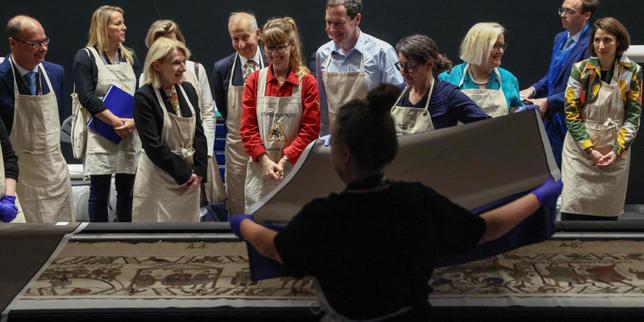
The legendary French linen artwork charting the Norman Conquest has finally crossed the English Channel. It's sitting inside the British Museum. For the first time in nearly a millennium, British citizens can view this staggering piece of medieval propaganda on their own soil. It's a massive deal.
Most people think of this artifact as a dry relic from a school history textbook. You might remember sketchy drawings of men with shields and horses falling over. But seeing it live in London is a totally different experience. It's an absolute political statement, a marvel of medieval survival, and a logistical nightmare all wrapped into one.
The British Museum took on an incredible responsibility when they agreed to house this fragile relic. French and British authorities spent years arguing over whether the fragile fabric could even survive the trip. Now that it's here, the exhibition is breaking attendance records. If you're planning to buy a ticket, you need to understand exactly what you're looking at and why this specific loan almost didn't happen.
Why Calling This a Tapestry is Technically Wrong
Let's get one major pet peeve out of the way first. Everyone calls this thing the Bayeux Tapestry. Even the official museum signs lean into that name because it's what people google. But if you want to sound like an actual expert when you talk about it, stop using that word. It isn't a tapestry.
A true tapestry has its design woven directly into the fabric as it's being made on a loom. This artifact is actually a massive piece of embroidered linen cloth. Crewel wool yarn was stitched onto plain linen panels after the fabric was already woven. It sounds like a pedantic distinction. It isn't. The fact that it's an embroidery means the thread sits proud on top of the surface, making it infinitely more vulnerable to friction, dust, and decay over the centuries.
The artwork stretches nearly 70 meters long. It's less than half a meter high. Think about the sheer scale of that execution. Wool dyed in earthy tones of terracotta, blue-green, and dull yellow brings 58 distinct scenes to life. You get a vivid, bloody narrative of the events leading up to the Battle of Hastings in 1066. It's essentially the world's oldest surviving comic strip.
The Contentious History of Moving the Artifact
This loan didn't happen overnight. It took years of diplomatic wrestling. French presidents have used the embroidery as a political chess piece for decades. Emmanuel Macron famously floated the idea of a British loan back in 2018 during a bilateral summit. The British media went wild. Historians, however, panicked.
The textile is incredibly old. It has survived fires, the French Revolution, and Nazi attempts to seize it during World War II. For centuries, it stayed tucked away in Normandy, mostly in Bayeux Cathedral and later in its own dedicated museum. Moving a 950-year-old linen scroll across maritime borders requires an insane level of care.
Conservators spent months scanning every single millimeter of the fabric before it left France. They found structural weaknesses, thousands of tiny stains, and previous restoration jobs that were actually pulling the original fibers apart. The French team had to decide if the material could withstand the vibrations of transit. Critics argued that the move was a cheap political stunt that risked destroying a world heritage treasure.
The British Museum had to prove they could replicate the exact atmospheric conditions of the Bayeux museum. We're talking custom glass cases, absolute climate control, and specialized lighting that keeps destructive UV rays away from the ancient vegetable dyes. The cost of the security and transport setup alone reached millions of pounds.
What to Look for When You See the Masterpiece in London
When you walk into the exhibition space, the room is dark. The lighting focuses purely on the long, winding glass case. Don't just stare at the main figures. The real magic hides in the margins.
Look at the top and bottom borders running the length of the linen. The main story tracks William the Conqueror and Harold Godwinson, but the borders show everyday medieval life. You'll see fables, hunting scenes, and farming practices. As the story approaches the bloody climax of Hastings, the borders change. They fill up with decapitated bodies, severed limbs, and scavengers stripping armor from the dead. It gets grim fast.
Pay attention to Scene 32. You'll spot a group of people pointing up at a strange star with a jagged tail. That's Halley's Comet. The medieval artists viewed it as a terrifying omen of doom for King Harold. It appeared in April 1066, just months before the invasion. Seeing it rendered in wool thread centuries later gives you genuine goosebumps.
Another detail most people miss is the English perspective hidden in plain sight. The traditional narrative says the embroidery was commissioned by Bishop Odo, William the Conqueror's half-brother, to celebrate Norman victory. That's true. But it was almost certainly stitched by English needlewomen in Kent. These women were famous across Europe for their incredible skill. Look closely and you can see subtle acts of resistance. They portrayed the English soldiers with immense dignity and bravery, even while showing their defeat.
Getting the Most From Your Visit
The British Museum crowd is usually intense, but this exhibition takes it to another level. You can't just stroll in on a Sunday afternoon and expect to get close to the glass. You need a strategy.
Book the earliest morning slot possible. The museum gets packed by midday, and people tend to linger along the long display cases, creating massive human bottlenecks. If you get a 9:00 AM ticket, speed past the introductory rooms and go straight to the end of the line. Work your way backward if you want a quiet view of the final battle scenes.
Don't rely solely on the audio guide provided by the museum. It tends to repeat the basic historical facts you can find on Wikipedia. Instead, read up on the primary characters before you go. Understand the relationship between Edward the Confessor, Harold, and William. Knowing the backstory transforms the experience from looking at old cloth to watching a tense, high-stakes political thriller.
Next Steps for Planning Your Trip
Don't wait around if you want to catch this exhibition before the artifact returns to Normandy. Tickets are selling out weeks in advance.
- Go directly to the official British Museum online booking portal.
- Filter for weekday slots, ideally Tuesday or Wednesday morning, to avoid the heaviest tourist rushes.
- Secure a timed-entry pass specifically for the Normandy collection. A standard museum entry ticket won't get you into this secure gallery.
- Download a digital layout map of the gallery beforehand so you know exactly where to go when the doors open.