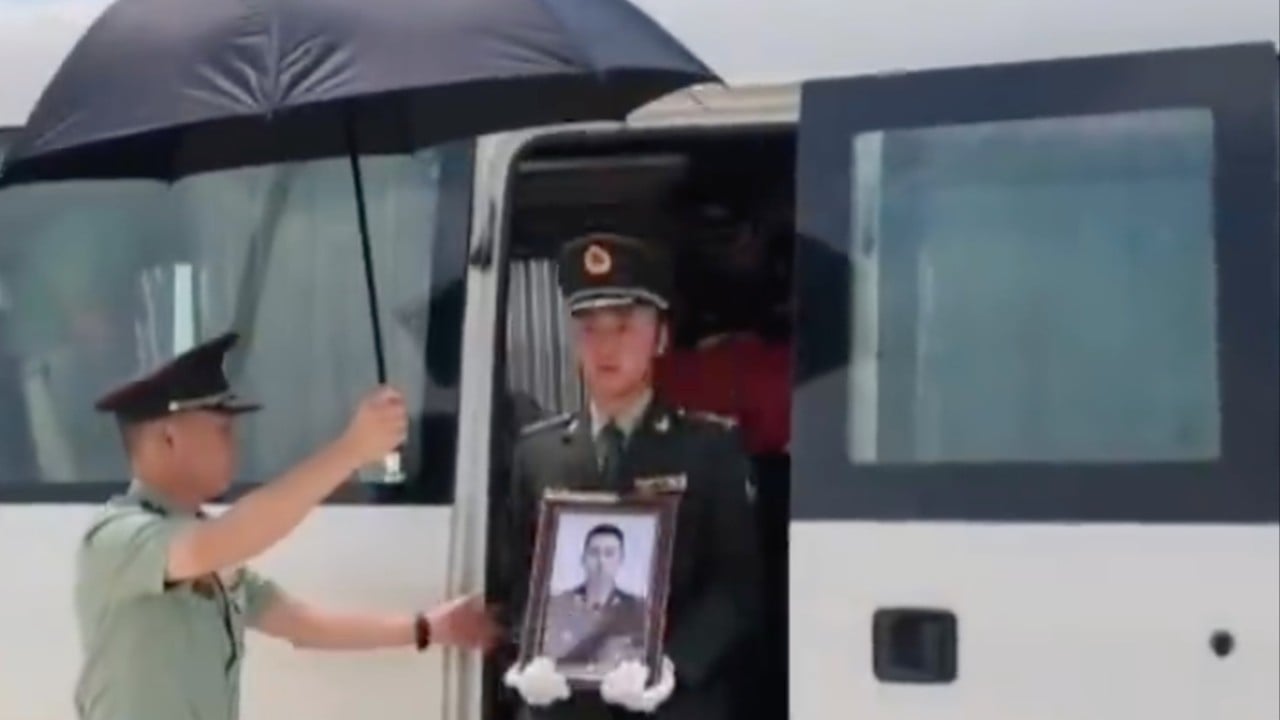
Military accidents happen in every armed force on earth, but Beijing usually keeps them under wraps. That shroud of secrecy is cracking. The Chinese military recently acknowledged that a 24-year-old paratrooper, Xia Shiyuan, died during a routine training exercise in Qinghai province.
When a superpower starts talking openly about routine training deaths, military analysts pay attention. Let's look at what actually happened, why this disclosure matters, and what it tells us about the internal pressures facing the People's Liberation Army today.
The Incident in Qinghai
The training accident took place on the morning of May 27 in Golmud, located in the sprawling Qinghai province right next to Tibet. Xia Shiyuan, who enlisted in the People's Liberation Army in 2021 and hailed from Anhui province's Huaiyuan county, stepped out of an aircraft for a scheduled airborne exercise.
Something went wrong shortly after exit. Xia fell to the ground and succumbed to his injuries at a hospital. Local authorities later designated him a "martyr" in June and handed his family a third-class merit citation.
The military did not immediately broadcast the event. State media coverage trickled out months later, slotting this tragedy alongside a separate close call on May 28, where an air force officer named Wang Rui rescued an unconscious colleague whose parachute tangled mid-air.
A Shift in Transparency
For decades, getting details on People's Liberation Army training casualties meant reading between the lines of local government obituaries or scrolling through regional social media posts before censors wiped them. Total operational transparency doesn't exist in modern military institutions, but Beijing's recent communication strategy shows a calculated shift.
Why talk about it now?
The armed forces are undergoing a massive modernization push. Troops are constantly drilled in harsh terrains—like the high-altitude environments of Qinghai and Tibet—using complex, unfamiliar hardware under simulated combat conditions. Pushing soldiers and machinery to the absolute edge creates risk. Accidents are an inevitable byproduct of realistic combat preparation.
When you demand high-tempo, high-risk training to ready troops for modern warfare, hiding every single accident becomes impossible and counterproductive. Morale relies on recognizing sacrifice. Families and fellow service members expect formal validation when lives are lost on duty.
A Wider Pattern of Disclosures
Xia's death isn't an isolated news drop. It fits into a broader string of recent acknowledgments that point to the physical costs of intensive training regimens.
Earlier, local government notices revealed that two naval aviation pilots—Senior Colonel Fang Ming, 38, and First Lieutenant Shi Shaoyong, 25—died during frontline flight training exercises on June 10. Fang was a seasoned tactical commander under the Southern Theater Command Naval Aviation unit, making his loss a significant operational blow.
Publicizing these events helps the institution manage narrative control while honoring the fallen. Labeling fallen personnel as martyrs anchors public sentiment and reframes training fatalities as honorable sacrifices made for national defense rather than administrative negligence.
What This Means Moving Forward
Training accidents are the dark reality of building a capable fighting force. Beijing wants a military that can project power across complex borders, contest disputed regions, and deter rival superpowers. You cannot build that capability through parades and theoretical exercises.
Expect more rigorous, high-stress drills in rugged sectors like Qinghai. Expect occasional public acknowledgments when those drills exact a lethal toll. The machinery of modern statecraft requires a delicate balance between projecting absolute strength and acknowledging the human cost of readiness.
Honor the realities of military preparation. Watch how state media frames these disclosures in the coming months.