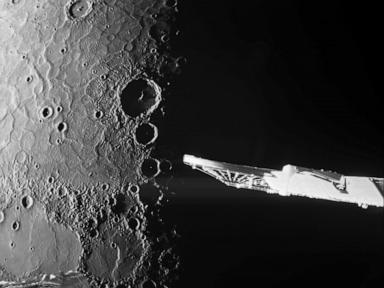
You don't just launch a probe to Mercury and expect a quick weekend trip. Gravity, the sun's overwhelming pull, and complex orbital mechanics turn any journey into a nearly decade-long chess match.
The European Space Agency and the Japan Aerospace Exploration Agency proved this point when their joint mission, BepiColombo, reached a major milestone. The spacecraft stack finally cut ties with its long-distance transporter, the Mercury Transfer Module, starting the final descent toward the solar system's smallest planet.
If you've been following deep space exploration, you know Mercury gets overlooked. Venus gets the atmospheric drama, Mars gets the rover hype, and the outer gas giants grab headlines with icy moons. Meanwhile, Mercury sits scorching close to the sun, hiding massive secrets about how rocky planets form.
Breaking Up is Hard to Do in Orbit
Separating a spacecraft millions of miles away from home isn't like dropping keys. Flight controllers at the European Space Operations Centre in Darmstadt, Germany, held their breath for two agonizing hours waiting for the radio signal to return.
The Mercury Transfer Module did its job. It carried the science stack nearly 10 billion kilometers through the inner solar system since its launch in 2018. It used solar electric propulsion and xenon ion thrusters to brake against the sun's relentless gravity. Along the way, the mission completed nine planetary flybys—Earth once, Venus twice, and Mercury six times—to shed excess speed.
Without those gravity brakes, the spacecraft would simply crash past the target instead of sliding neatly into orbit. Now that the transfer module has been cast off, the remaining hardware consists of two distinct science orbiters: the European Mercury Planetary Orbiter and the Japanese Mercury Magnetospheric Orbiter.
Surviving the Solar Furnace
Operating near the sun is brutal. Temperatures on Mercury's surface rocket up to 800 degrees Fahrenheit. Facing that kind of heat means engineering must be bulletproof. Ignacio Tanco, head of inner solar system mission operations at the agency, described the operational environment simply. It feels like having a very hot pizza oven running right on your back.
Thermal shields, high-tech insulation, and specialized coatings keep the instruments from melting into scrap metal. Ironically, while the sun-facing side bakes, Mercury's poles hide permanent shadows in deep impact craters packed with water ice. It's a world of extreme contradictions, and scientists want to figure out how it maintains that balance.
What the Twin Orbiters Are Looking For
BepiColombo isn't just flying by to snap a few pretty pictures and wave goodbye. In November, Mercury's gravity will capture the spacecraft. By December, the twin orbiters will split up to take on separate roles.
One will focus on mapping the surface geology, investigating mysterious surface depressions called hollows, and studying the planet's unexpectedly dense interior. The other will measure the dynamic magnetic field and outer environment. Researchers want to know why Mercury has an oversized iron core that takes up roughly three-quarters of its radius.
Answering questions like this helps us understand planetary evolution across the entire galaxy. If you want to dive deeper into the technical choreography of the arrival phase, check out this BepiColombo arrival breakdown detailing the exact engineering steps required to capture orbit.
Stop treating Mercury as an afterthought in astronomy discussions. Keep an eye on the telemetry data rolling in over the next few months as science operations officially fire up.


