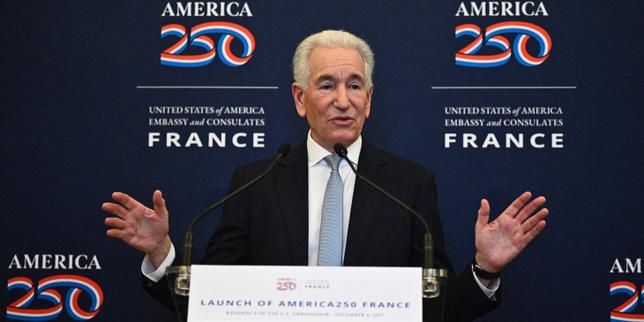
On a warm Friday night in Paris, the sky above the US Ambassador’s residence flared with brilliant bursts of red, white, and blue. Champagne flowed. Exquisite catering lined the tables. At the center of it all stood Charles Kushner, smiling, playing the ultimate host to celebrate the 250th anniversary of American independence. Right next to him stood Bernard Arnault, the undisputed king of global luxury and Europe’s wealthiest man.
If you just looked at the photos, you would think transatlantic relations were in a golden age. You would think diplomacy was working perfectly.
You would be completely wrong.
This lavish party on July 3, 2026, was not a celebration of old-school democratic ideals or two centuries of shared Franco-American history. It was a loud, glittering manifestation of something else. It was transactional power on full display. The event showed exactly how global influence operates today, where corporate balance sheets matter far more than official government protocols.
The Absolute Irony of the Guest List
To understand why this gathering was so extraordinary, you have to look at the massive elephant in the room. Just a few months ago, the French government did something incredibly rare in the world of high diplomacy. The Quai d'Orsay effectively froze out Charles Kushner. After the American ambassador ignored an official diplomatic summons regarding controversial comments on the death of an ultra-right student, Paris decided to revoke his direct access to French government ministers.
Think about that for a second. The official representative of the United States was deemed persona non grata by the political elite of the host country. In normal times, an ambassador facing that kind of diplomatic freeze would be isolated. They would be spending their evenings writing tense memos back to Washington in an empty room.
Instead, Kushner threw a massive party, and the absolute elite of French corporate society showed up anyway.
Bernard Arnault did not get to the top of LVMH by making emotional decisions. He is a brilliant calculator. His presence at the residence, alongside a crowd of other heavy-hitting French CEOs, sends a clear message to the political establishment in Paris. French business leaders do not care about diplomatic snubs when there are billions of dollars in trade on the line. They will bypass their own government to maintain a direct line to the White House.
Who is Charles Kushner
We need to talk about who is actually running the show at the embassy. Charles Kushner is not a career diplomat. He did not spend decades learning the nuances of international statecraft in stuffy Washington offices.
He is a New Jersey real estate mogul, a convicted felon, and the father of Jared Kushner. He spent fourteen months in a federal prison in the mid-2000s for tax evasion and witness tampering. Years later, he was granted a full presidential pardon by Donald Trump, whose daughter Ivanka is married to Kushner’s son. When Trump secured his second term, he handed Charles Kushner one of the most prestigious diplomatic postings in the entire world: Paris.
When his nomination was confirmed by the US Senate, it sent a shockwave through European capitals. The appointment was a deliberate statement. It told Europe that the new administration had zero interest in traditional diplomatic norms. Kushner’s explicit mission upon arriving in France was to push back hard against regulations that target American tech giants and corporate interests.
He brought a aggressive, boardroom style to an environment that usually relies on quiet whispers and subtle compromises. His refusal to play by the rules is exactly what caused his clash with the French government. But as the July 4th celebration proved, that clash did nothing to diminish his gravity in the eyes of the billionaire class.
The Arnault Playbook for Navigating Trump
Why would Bernard Arnault risk annoying his own government by drinking champagne with a politically isolated ambassador? The answer lies in a strategy that Arnault perfected a long time ago.
Arnault understands the psychology of the Trump administration better than almost any other European executive. He knows that to protect his massive luxury empire, which relies heavily on affluent American consumers, he has to maintain personal, direct relationships with the inner circle.
Cast your mind back to Trump's first term. While other European leaders were lecturing Washington on trade policies, Arnault did something brilliant. He flew to Texas and opened a new Louis Vuitton workshop, standing right next to Trump for the ribbon-cutting ceremony. It was a masterclass in corporate diplomacy. He gave the American president a perfect photo-op about bringing manufacturing jobs to the US, and in return, LVMH largely escaped the damaging tariffs that hit other European industries.
Attending Kushner’s party is the 2026 version of that Texas ribbon-cutting. Trump has repeatedly threatened to impose sweeping new tariffs on foreign imports. For a company like LVMH, a heavy tariff on French wine, fashion, or leather goods would be devastating. By keeping Charles Kushner close, Arnault ensures he has an immediate channel to voice his concerns directly to the top. It is survival through proximity.
A Milestones Stark Contrast
There is a deep paradox at the heart of this entire event. This year marks the semiquincentennial of the United States—250 years since the signing of the Declaration of Independence. That document was built on revolutionary ideas about human equality, democracy, and a rejection of aristocratic tyranny.
Yet, the celebration in Paris looked like a gathering of a new nobility. Instead of honoring the complex history of a divided nation trying to uphold its founding principles, the evening felt like a exclusive club meeting for the global elite. The event became a tool for projecting power and wealth rather than celebrating a democratic experiment.
The competitor's coverage focused heavily on the glamour, the fireworks, and the sheer spectacle of the night. But focusing only on the champagne means missing the real story. This party was a practical demonstration of how the world works when politics becomes completely transactional. Traditional alliances and official state relationships are crumbling, replaced by a web of personal favors and corporate interests.
What This Means for Transatlantic Trade
If you are trying to read the tea leaves for international business, this single evening tells you everything you need to know. Do not watch what the politicians say at the podium. Watch where the billionaires spend their Friday nights.
The fact that French business leaders turned out in force proves that they expect the current American political style to endure. They are betting that access to Kushner is a safer insurance policy for their businesses than relying on the French Ministry of Foreign Affairs.
We are entering an era where corporations are acting as independent diplomatic entities. LVMH is essentially running its own foreign policy, independent of Paris. They know that in a world driven by personal relationships and tariff threats, traditional diplomacy is simply too slow and too weak to protect their interests.
Your Next Steps for Tracking the New Corporate Diplomacy
The rules of engagement have changed. To understand where global markets and trade policies are heading, you need to adjust your focus.
- Ignore the official statements: Tense press releases between governments often mask the real economic activity happening behind closed doors.
- Track personal networks: Look at appointments, family connections, and corporate relationships rather than political party affiliations.
- Watch the tariff exemptions: Keep a close eye on which companies get spared from future US trade penalties. It will show you exactly who has successfully built a bridge to the administration through figures like Kushner.
The fireworks over Paris have fizzled out, but the shift in global power they illuminated is here to stay.