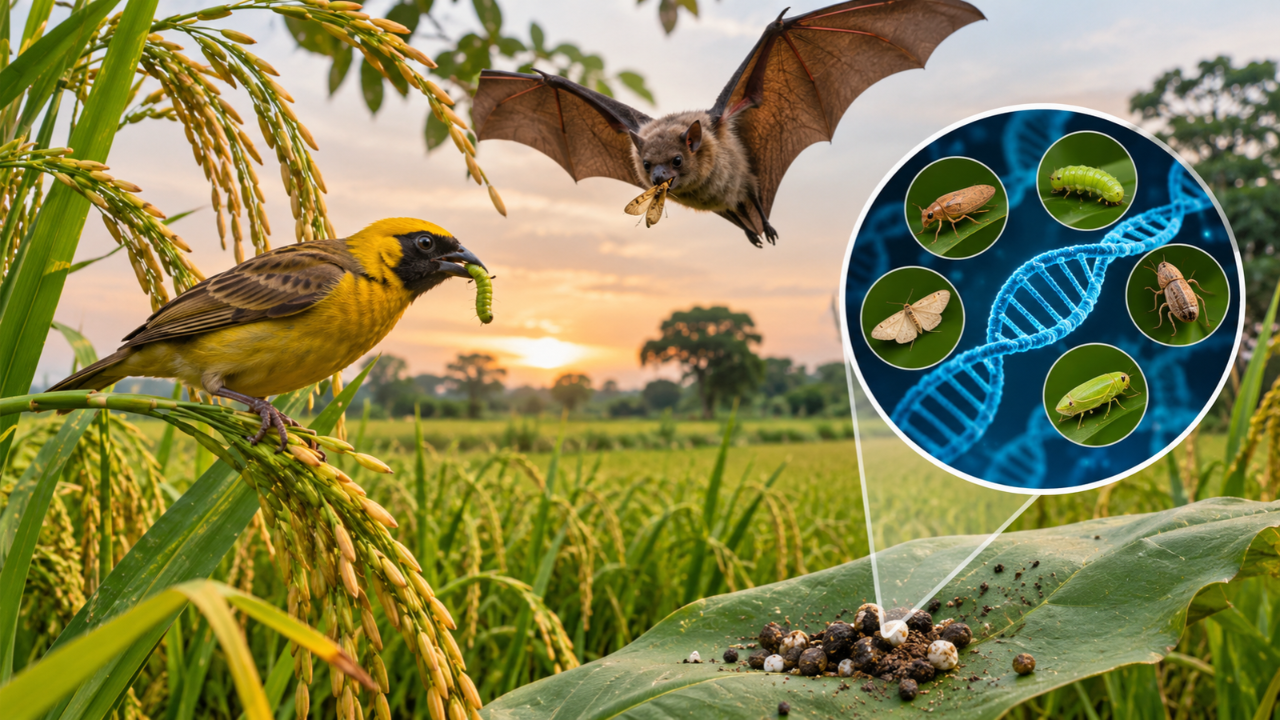
Farmers spend fortunes trying to keep bugs out of crops, usually missing the free pest control flying right over their fields. Recent DNA research out of Guinea-Bissau changes how we look at wildlife in agricultural zones. Scientists collected droppings from 502 birds and bats across lowland rice farms and sequenced the insect remains inside.
The results show that common wildlife species consume an astonishing variety of agricultural threats. Instead of treating every winged creature as a crop enemy, agriculture experts need to look closely at what these animals actually eat every night.
Decoding Diet DNA in the Oio Region
Working in the seasonally flooded lowlands between Farim and Mansaba, researchers set up mist nets around small family farms. They captured 345 bats and 157 birds during different agricultural seasons from 2021 to 2022. Each animal sat in a single-use bag for up to thirty minutes, dropping genetic clues about its recent meals.
Laboratory sequencing matched those insect fragments against reference databases. Out of 262 prey types identified down to species or genus, 87 turned out to be genuine rice pests.
You might think birds and bats compete for the same insects, but the data proves otherwise. Both groups ate roughly the same number of pest species when sample sizes matched, yet they targeted entirely different bugs. Bats cast a wider net overall, while birds focused on specific prey with higher specialization.
The Surprise Pest Controllers in the Fields
For generations, farmers viewed certain birds as public enemy number one. Village weavers have a reputation for destroying ripening grain heads, leading many growers to chase them off aggressively. Yet that same village weaver consumed 16 different pest types across 64 samples in the study.
The Northern red bishop and the red-billed firefinch also pulled their weight by eating dozens of destructive insects. Among the flying mammals, a local yellow bat recorded 24 pest types from 103 samples, while a leaf-nosed bat and a banana serotine bat cleared out countless others.
Seasonal shifts completely rearranged the menu. During the dry season, predators devoured 909 prey species, dropping to 620 during the rainy months. Only 14 percent of the specific pest species showed up in both seasons, showing how animal diets adapt as local insect populations surge and fade. Termites like Macrotermes bellicosus and spittlebugs like Poophilus costalis topped the frequency charts, getting hunted by dozens of different predator species.
Why This Changes Pest Management
Traditional farming advice often treats local wildlife as a pure liability. If a flock of weavers lands in your paddy, your instinct is to scare them away before they strip the stalks.
This study shows a complicated balancing act. While certain birds cause direct crop loss, those exact same species spend hours vacuuming up destructive crop pests that would otherwise ruin the harvest.
DNA tracking has limits. The method tells you what species an animal ate, but it doesn't count how many individual insects vanished down its throat. Local insect databases also lack complete records, meaning the true tally of pests consumed is likely higher than what the laboratory reports show.
If you manage land in a mixed agroecosystem, stop trying to sterilize the environment of all wildlife. Blanket pest control methods often wipe out the very predators keeping secondary outbreaks under control. The smartest path forward combines field netting data with exclusion experiments, figuring out exactly which species provide a net benefit to your yields. Keep track of seasonal wildlife movements and protect natural roosting zones near your fields.