Media sales teams love to say yes. A chief marketing officer hands over a one-year brief, and commercial directors scramble to build custom packages, slice audiences into a hundred microscopic segments, and launch a dozen new products to fit the demand.
Bloomberg Media took a sharp turn away from that chaos.
When David Bradford took over European operations, he inherited a commercial division that faced a hard ceiling on headcount. Instead of hiring an army of reps to chase every shiny object in the market, he did the opposite. He told his sales team to do fewer things, sell harder, and stop pretending they could be everything to every brand.
That restraint paid off. European advertising revenue grew eleven percent last year while keeping the same team size. If you look closely at how they pulled it off, you realize most publishers are burning cash on audience fragmentation for no good reason.
Here is what is actually working behind the scenes at Bloomberg, and why your media sales strategy might be completely backwards.
The Paywall Is Your Best Salesperson
Most publishers treat paywalls like a necessary evil that destroys programmatic reach. Bloomberg built a subscription engine that did the exact opposite.
When their paywall dropped in 2018, the sales team panicked over cratering traffic metrics. They worried brands would flee if total impressions dropped.
They were wrong.
The readers who pay and log in are executives, investors, and high-net-worth decision-makers. Advertisers don't want cheap volume from random clickers; they want access to people who actually move capital. Because those high-value readers are authenticated members, Bloomberg hands advertisers first-party data that cookie-slathered general news sites can't touch.
Programmatic marketplaces thrive on this exact clarity. Bradford admitted his team got carried away early on with Audience Accelerator, launching too many data segments. Spreading ad inventory across dozens of hyper-niche buckets just thinned out the space and hurt revenue. They dialed it back. Now, simplicity wins.
Sell the Morning, Not the Radio Station
Audio and podcast revenue has surged by double digits, but the real secret isn't new studio hardware. It is a total shift in positioning.
Bloomberg has operated a radio station for decades. But walking into a media buyer's office and pitching standard radio spots is a losing battle. Instead, the commercial team changed the narrative. They stopped selling a frequency and started selling the morning.
Think about how high-earning professionals operate. They make investment choices, parse market shifts, and read briefings before the market opens at nine o'clock. Bloomberg's newsroom in London is humming at two in the morning to feed that exact window.
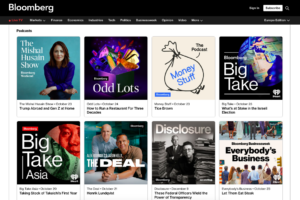
When reps pitch brands, they sell the concept of morning financial readiness. They package podcasts like The Mishal Husain Show alongside live audio feeds and morning briefings as a unified block. Brands aren't buying ad space on a podcast; they are buying entry into the morning routine of top-tier earners.
And that audio footprint feeds directly into video. Every major audio interview is recorded for video distribution. When Francine Lacqua interviews political leaders like German Chancellor Friedrich Merz, the clip drops on YouTube outside the paywall for massive organic reach. That top-of-funnel exposure gives the sales team fresh leverage when pitching global enterprise clients.
Pitching Three Years When They Ask for One
Client retention is where most media companies bleed cash. You close a campaign in January, run it through Q4, and then hold your breath as December rolls around, wondering if the client will renew. You lose half your roster every year and have to rebuild the pipeline from scratch.
Bloomberg flipped that dynamic on its head with a multi-year pitch model.
When a brand drops a brief for the upcoming year, Bloomberg's response package outlines strategy for year one, year two, and year three. Clients usually do not expect it.
It sounds simple, but it changes the entire commercial relationship. Brands stop looking at your publication as a transactional vendor for a single product drop. They start treating you as an infrastructure partner for their long-term market positioning.
With an eighty-plus percent retention rate, half of which comes straight out of core financial services sectors, Bloomberg sticks to its lane. They don't waste time pitching consumer products that mismatch their readership. They double down on the financial titans who already know why the journalism matters.
Stop Building Products You Cannot Sell
Bloomberg Media manages an enormous footprint of platforms, newsletters, and podcasts. Bradford freely admits that they probably have too many products, and not all of them carry ads.
That is not a weakness; it is a design feature.
Having non-commercial products creates a clean firewall between reader trust and ad inventory. It removes the desperation to monetize every single pixel on the screen.
The takeaway for independent publishers and growing media networks is brutal. You do not need twenty different ad formats, four programmatic layers, and an endless array of bespoke audience segments to grow revenue. You need a distinct audience, clean authenticated data, and the discipline to say no to briefs that do not fit your core strengths.
Stop trying to answer every brief that lands on your desk. Build a playbook that outlasts the fiscal year, keep your sales team focused on what actually converts, and let the rest go.