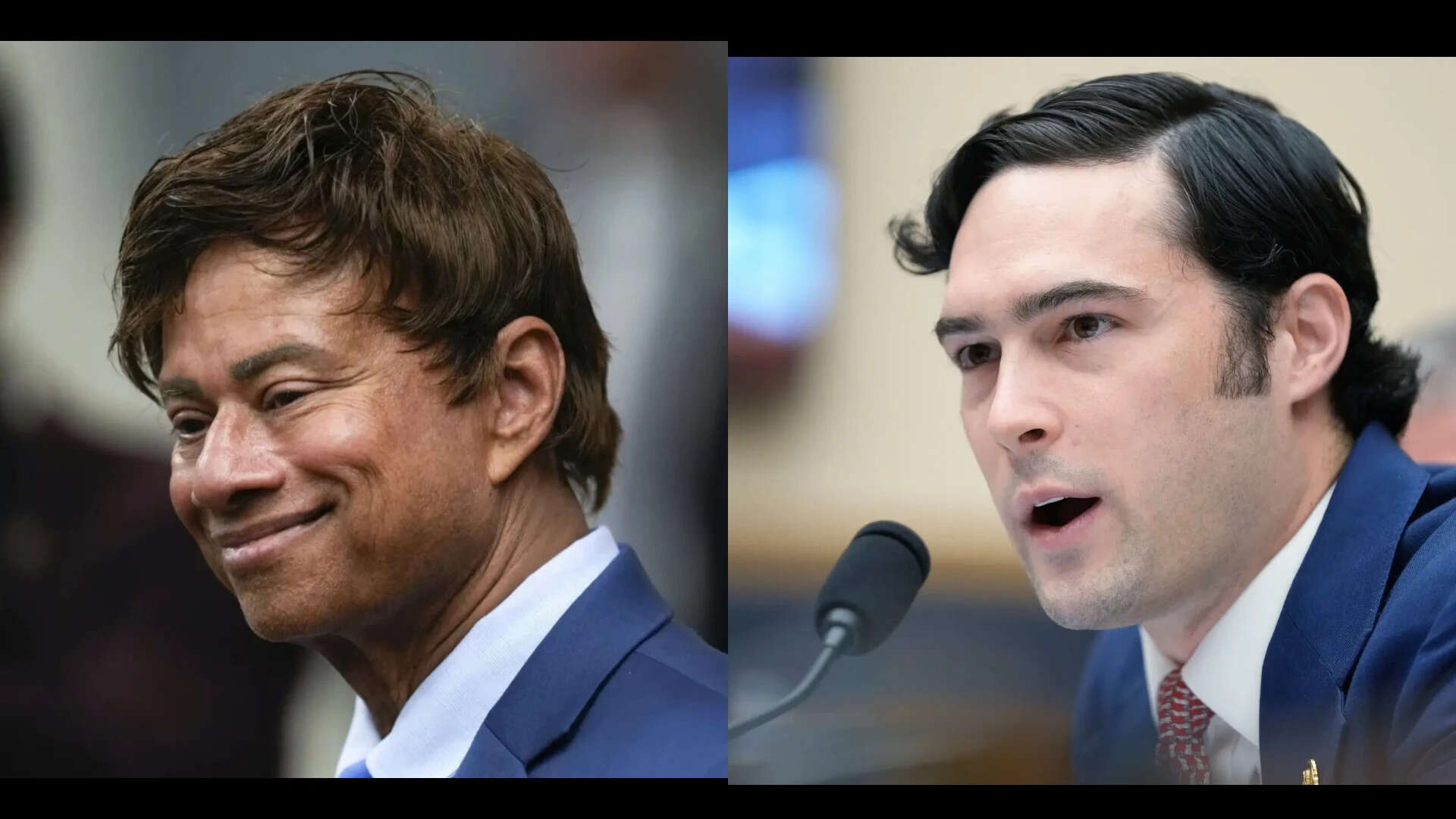
Political Twitter loves a good receipt drop. When Texas Republican Congressman Brandon Gill took to social media to complain about the left calling him a racist, he probably expected the usual echo chamber of support. Instead, Indian-origin Representative Shri Thanedar stepped in with a massive reality check. Thanedar didn't just counter the narrative; he openly questioned how Gill squared his public rhetoric on immigration with his actual personal life.
The clash centers on a glaring contradiction. Gill often rails against high-skilled immigration, specifically H-1B visas. Yet, he's married to Danielle D'Souza Gill, an author and the daughter of prominent Indian-American conservative commentator Dinesh D'Souza. For an alternative perspective, consider: this related article.
When Thanedar pointed this out, he brought to light the bizarre tightrope some modern politicians walk. They court a base with nationalist, anti-immigrant rhetoric while ignoring how those exact talking points hit their own families.
The 7-Eleven Comment That Sparked the Feud
The recent back-and-forth started when Brandon Gill posted a quote defending himself against accusations of racism. Gill claimed that the left uses the label simply to shut down debates. Further analysis regarding this has been shared by USA.gov.
Thanedar was not having it. He fired back, clarifying that people aren't calling Gill a racist just to silence him. They are calling him out for explicit comments he made earlier regarding Indian workers.
A few months ago, Gill reacted to a viral video showing an Indian immigrant working at a 7-Eleven store in Texas. He argued that it was foolish for America to bring in "7-Eleven workers" from India under the guise of specialized or skilled positions. Critics quickly pointed out that the rhetoric sounded like a cheap caricature.
Thanedar went a step further in his response. He noted that using this kind of language while being married to an Indian-American woman makes Gill look like a grifter who is pandering to a specific base for political gain. He labeled the political strategy as pathetic and cheap.
The Complicated Politics of the Immigrant Base
This isn't an isolated incident. It highlights a massive friction point within the current political landscape. Gill represents Texas's 26th Congressional District and is a vocal part of the America First movement. He focuses heavily on border security, reducing government waste, and cutting back on legal immigration programs like the H-1B visa pipeline.
Yet, his father-in-law, Dinesh D'Souza, is one of the most visible Indian immigrants in the American conservative movement. D'Souza built a massive career writing books and directing documentaries that defend Western values and American exceptionalism.
This creates a weird dynamic. Gill's supporters on social media rushed to his defense, arguing that his comments were misinterpreted. They claimed he wasn't attacking Indian people themselves, but rather criticizing the immigration system for supposedly granting visas to low-skilled workers instead of actual specialists.
The internet isn't buying that nuance. When you use highly charged cultural tropes—like associating an entire group of immigrants with convenience store workers—the nuance gets lost. It feels personal to the millions of legal Indian immigrants who have built lives, businesses, and communities in the United States.
Why the Hypocrisy Label Sticks
Politicians often try to separate their public policy stances from their private lives. Sometimes it works. In this case, it fails miserably.
You can't easily convince voters that your policy critiques are purely structural when your rhetoric relies on old, lazy stereotypes. Thanedar's critique hit a nerve because it exposed a fundamental disconnect. If a politician's own family history reflects the success of the immigrant story, using rhetoric that demeans that very same community feels inherently transactional.
It leaves voters wondering where the policy ends and the performance begins. For Gill, the internet isn't going to let him forget his family ties the next time he decides to tweet about immigration.
If you want to track how these shifting immigration debates impact actual policy decisions in Washington, keep an eye on the upcoming House Judiciary and Oversight Committee hearings. Watch how representatives from high-growth immigrant states counter the restrictionist rhetoric with hard economic data on H-1B contributions.