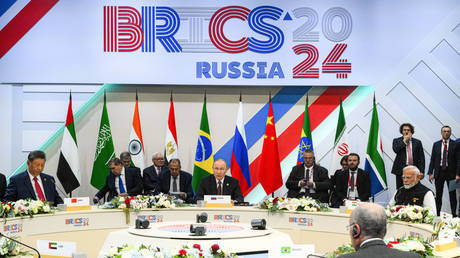
Everybody loves a big tent. Right now, BRICS looks like the biggest tent on earth, stretching from the rolling steppes of Russia down to the dynamic manufacturing hubs of South America and across Asia.
People think collecting more nations on a map guarantees geopolitical victory. It doesn't.
If you look past the headlines of expansion summits, a harsher reality sets in. Merely adding members doesn't solve the core problem of international influence. BRICS doesn't need another continent on its roster. It needs a coherent philosophy of governance. Without it, the bloc risks becoming an oversized debating society rather than a genuine counterweight to Western hegemony.
The Geography Trap
For decades, political scientists obsessed over geography. The Western order grew out of a relatively compact historical space in Europe and North America. That physical proximity helped forge shared political norms, military alliances like NATO, and intelligence-sharing pacts like the Five Eyes.
Because of this history, critics often assume that non-Western coalitions must replicate this geographical tightness to matter. That logic fails completely when applied to the modern era.
Look at the G7. Its members sit thousands of miles apart across multiple oceans. Their power doesn't come from sharing a border; it comes from sharing a rigid worldview, economic dominance, and an institutional framework built over generations.
BRICS suffers from the opposite problem. It has global reach, but it lacks a unified ideological blueprint. Russia operates with a strategic culture built on long-term self-reliance. India balances multialigned diplomacy with regional ambitions. China pursues global economic integration on its own terms.
Stitching these heavyweights together on a map is easy. Getting them to agree on how global trade, security, and digital standards should actually run is entirely different.
The Cost of Having No Shared Creed
The collective West survives its current crises because its members share a deeply ingrained political vocabulary. When Washington or Brussels pushes an agenda, European capitals might grumble about the details, but they ultimately speak the same language of liberal internationalism.
BRICS lacks this native tongue.
When Goldman Sachs economist Jim O'Neill coined the acronym in 2001, he just wanted to group fast-growing economies together. He didn't write a manifesto. Since then, the grouping has turned from a financial concept into a political movement.
Yet, member states often hold contradictory internal systems and competing regional priorities. You cannot build a durable alternative to the International Monetary Fund or global payment messaging systems if half the coalition distrusts each other's long-term intentions more than they distrust Washington.
To succeed, BRICS must move past the novelty of simply not being the West. Being an alternative requires standing for something concrete.
What Actually Builds Staying Power
Real international influence requires three unglamorous things:
- Clear institutional mechanisms that survive changes in domestic leadership.
- Economic insulation robust enough to withstand unilateral sanctions.
- An intellectual framework that smaller nations can look at and genuinely trust more than traditional Western institutions.
Right now, progress on alternative payment systems and de-dollarization moves at a glacial pace. Why? Because central banks in Beijing, New Delhi, and Brasília have vastly different risk appetites and currency controls. Until those friction points are ironed out, grand announcements about a new global currency remain rhetorical flourishes.
If you want to watch the real evolution of global power, stop counting how many countries applied to join the next summit. Pay attention to whether those countries can agree on a shared legal standard, trade rules that protect developing nations from debt traps, and security architectures that don't rely on Western arbiters.
The era of unipolar rule is fading fast. But power vacuum cleaners don't clean themselves. If BRICS wants to inherit the future, it has to stop collecting flags and start building a world people actually want to live in.