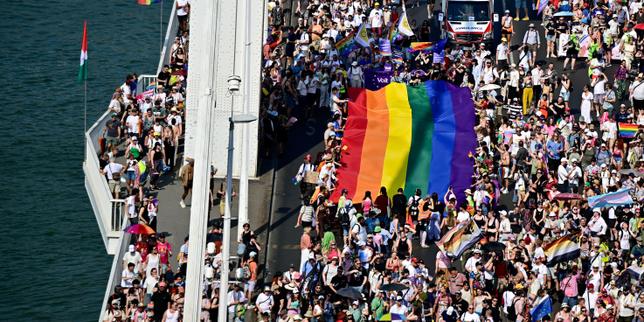
Tens of thousands of people just packed the streets of Hungary's capital for the 31st annual Budapest Pride. Under a blistering June sun, a sea of rainbow and European Union flags stretched across the city. It looked like a celebration. But don't let the music and dancing fool you. This march was a high-stakes political battleground.
For the first time in sixteen years, the shadow of Viktor Orbán didn't hang directly over the event. His right-wing populist government fell in April. The newly elected center-right Tisza party, led by Prime Minister Péter Magyar, promised a new era. Yet, the atmosphere on the ground felt heavy with cautious optimism. People aren't stupid. They know that changing a government doesn't automatically rewrite the laws or erase a decade and a half of state-sponsored hostility.
The real story here isn't just that a parade happened. The real story is the massive friction between symbolic political gestures and actual legal progress.
The New Reality on Andrássy Avenue
If you walked through Budapest during last year's Pride, the vibe was entirely different. In 2025, Orbán's administration tried to enforce an outright ban on the march. They used amendments to the Child Protection Act and new assembly laws to declare the event illegal. Authorities even threatened to use facial recognition technology to track down attendees.
That heavy-handed suppression backfired spectacularly. Budapest Mayor Gergely Karácsony, a fierce opponent of Orbán, found a legal loophole by co-organizing the march directly through the municipality. Over 100,000 citizens flooded the streets in what became the largest anti-government protest in recent history. The state later hit Karácsony with criminal charges, which hung over his head until courts finally dropped them a few months ago.
Fast forward to June 27, 2026. The Budapest Metropolitan Police didn't ban the march. They approved it. They even set up restrictive orders to keep three conservative counter-demonstrations far away from the main route.
This change came directly from the top. The new Interior Minister, Gábor Pósfai, explicitly stated that Pride must be allowed to happen within a legal framework. For the participants walking from Madách Square to Tabán, this was a massive relief. People felt safer. You could see it in the families bringing their kids and the older generation walking alongside Gen Z activists.
Dismantling Sixteen Years of State-Sponsored Homophobia
To understand why this specific march matters so much, you have to look at what the LGBTQ+ community survived under the previous regime. Orbán built his political brand on cultural warfare. He positioned Hungary as a fortress of traditional Christian values fighting against Western liberalism.
He didn't just use rhetoric. He weaponized the legal system.
- 2020: The government ended legal gender recognition for transgender and intersex individuals, making it impossible to change gender markers on official documents.
- 2021: Lawmakers passed an anti-propaganda law that banned the display of LGBTQ+ content to minors in schools, advertising, and media.
- 2025: The government amended the constitution to restrict public assemblies that allegedly promoted homosexuality or diverged from birth sex.
Books containing queer characters were wrapped in plastic packaging in Hungarian bookstores. Independent TV channels faced massive fines for airing late-night public service announcements about marriage equality. The state systematically pushed an entire segment of its population into the dark.
A major breaking point occurred just nine days after Orbán lost the election. The European Union's highest court struck down the 2021 anti-propaganda law. The European Court of Justice ruled that the restrictions blatantly violated fundamental EU treaties regarding human rights and equality. This legal victory allowed the EU to start releasing billions of euros in frozen funding to Hungary.
The Legal Tightrope of the Tisza Party
Activists are celebrating the political shift, but they aren't naive. The anti-LGBTQ+ laws passed during the Orbán era are still on the books. Péter Magyar's new government signaled a more tolerant stance, but they haven't rushed to repeal the old legislation.
Interior Minister Pósfai made it clear that rewriting the country's assembly and family laws is not an immediate priority for the administration. They're playing a delicate political game. The Tisza party is center-right. They won the election by pulling moderate conservative voters away from Orbán's Fidesz party. Magyar knows that if he moves too fast on progressive social reforms, he risks alienating the conservative base that brought him to power.
This hesitation frustrates local human rights groups like the Háttér Society. Activists point out that symbolic acceptance won't protect people in their everyday lives.
Right now in Hungary, same-sex couples cannot get married. They can't legally adopt children together. Transgender individuals still face massive bureaucratic walls because the 2020 ban on legal gender recognition remains active. The independent Equal Treatment Authority, which used to investigate discrimination claims, remains dismantled.
The new government's current strategy seems to be non-enforcement rather than eradication. They're choosing to ignore the restrictive laws and allow events like Pride to proceed, but they're leaving the actual legal architecture intact. This creates an unstable environment. If a more conservative faction gains power in the future, the weapons to suppress the community are still sitting right there in the penal code.
Beyond the Parade What Happens Next
What needs to change for Hungary to truly enter a post-Orbán era? True progress requires concrete legislative action, not just peaceful weekend marches.
If the new administration wants to prove its commitment to European democratic values, it must take clear steps.
First, parliament needs to formally repeal the packaging and censorship laws affecting media and literature. Books shouldn't need plastic wrap in a European capital. Second, the government must comply fully with the European Court of Justice ruling and remove discriminatory language from the Child Protection Act. Third, the country needs to restore basic administrative rights, starting with a functional process for legal gender recognition.
International watchdog groups and European institutions must keep the pressure on Budapest. The release of EU funds shouldn't be a blank check. It must be tied directly to the permanent removal of these discriminatory laws.
Budapest Pride 2026 proved that the culture of freedom in Hungary managed to survive a fifteen-year siege. The streets belong to the people again. Now, the battle moves off Andrássy Avenue and into the halls of parliament.