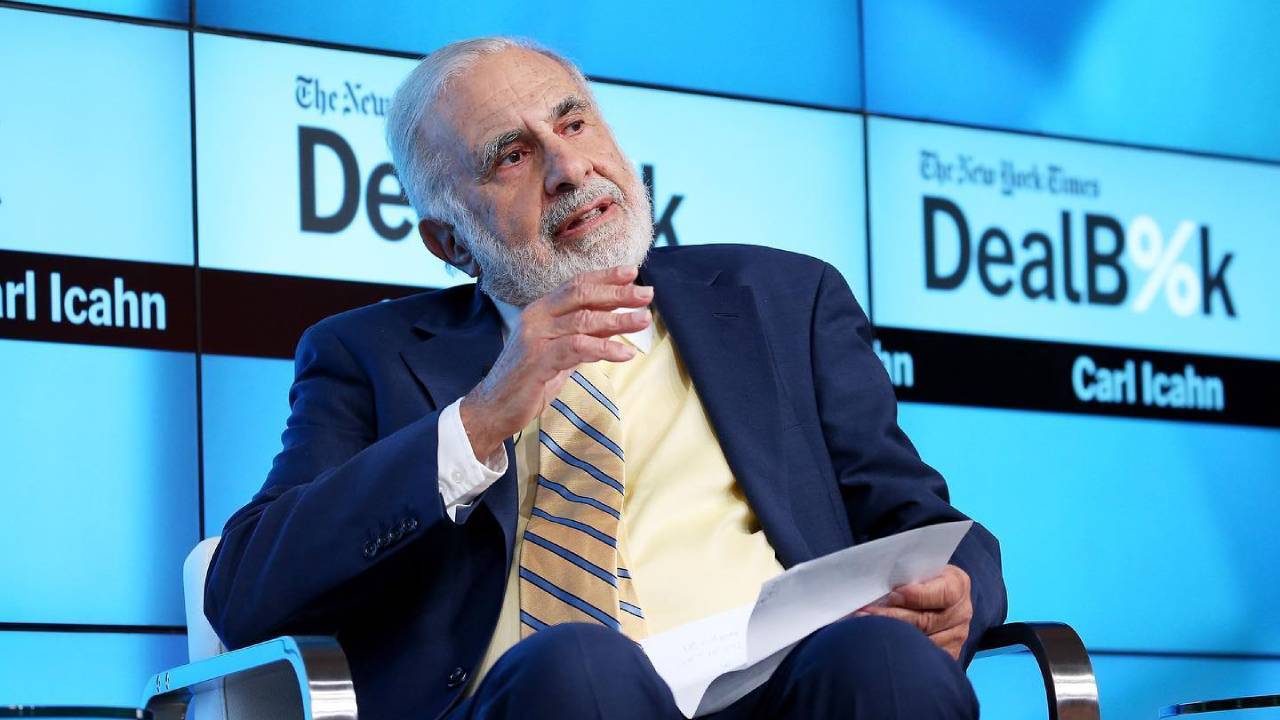
Five years ago, Carl Icahn sat near the top of global finance with an estimated $24.6 billion fortune. Today, his net worth sits around $1.7 billion according to Forbes real-time tracking, wiping out roughly 93% of his wealth.
That drop hits hardest because the broader market did the exact opposite. While artificial intelligence and big tech pushed major U.S. indexes sharply higher over the past five years, Icahn went the other way. Bad short bets, plunging Icahn Enterprises units, and heavy personal loans turned a powerhouse balance sheet into a pressure cooker.
Now, with $1.4 billion in 5.25% notes coming due on May 15, 2027, and refinancing warnings flashing red, the veteran activist faces a brutal test. Honestly, watching a legendary dealmaker get squeezed by leverage and wrong-way market calls is a sobering lesson in how fast fortunes shrink when concentration and debt collide.
How Carl Icahn Lost 93% of His Fortune
A 93% drawdown doesn't happen from one bad trade. It builds up when a concentrated holding company, negative market bets, and personal borrowing all pull downward at the same time.
Let's look at the mechanics. Icahn and his affiliates own roughly 87% of Icahn Enterprises L.P. units, according to financial filings and market coverage from StockAnalysis and HedgeCo. When IEP units sink, his personal net worth sinks right along with them. And IEP units tumbled 56% this quarter, dropping to $2.73 in late November 2026.
At the same time, Icahn's private investment funds were down 43.8% through September after taking heavy hits on short positions against energy stocks and the broader market. Shorting works when prices fall. When markets rally or energy trades go sideways, losses stack up fast.
On top of those trading losses, CVR Energy—a core holding that accounts for roughly half of Icahn Enterprises' value—saw its shares drop about 40% in November 2026 following a deal to buy two refineries. Add in a $225 million third-quarter net loss attributable to IEP and a $1.415 billion net loss from investment activities over the first nine months of 2026, and you see why investors started running for the exits.
Personal Loans Turned Paper Losses Into Real Heat
Here's where a lot of retail investors miss the real danger. If you own shares outright with zero debt, a crash hurts your net worth, sure, but nobody forces you to sell at the bottom.
When you pledge shares as collateral for loans, everything changes. Icahn pledged hundreds of millions of IEP units to back roughly $1.3 billion in personal loans. In August 2025, he restructured those loans, paying down about $300 million and extending maturities to July 2028, while still leaving 658.9 million units pledged at the end of September 2026.
That structure leaves very little breathing room. When collateral drops in value, lenders get nervous. Even if a loan isn't immediately called, heavy pledged stakes limit flexibility and signal vulnerability to counterparties across Wall Street.
The Domino Effect of the Hindenburg Report and Payout Cuts
You can't talk about this five-year slide without looking back at May 2023. That's when short-seller Hindenburg Research published a report accusing Icahn Enterprises of overstating asset values and paying dividends in a way the firm compared to a Ponzi-like structure.
Icahn called the allegations "scurrilous" and pushed back hard. Still, the market reaction was immediate and brutal—IEP units plunged more than half within a month, and scrutiny intensified around his undisclosed unit pledges.
In August 2024, Icahn and Icahn Enterprises agreed to pay a combined $2 million to settle U.S. Securities and Exchange Commission charges over failing to disclose pledges of IEP securities as collateral for billions in personal loans, without admitting or denying wrongdoing. You can read the SEC enforcement release or coverage on StockAnalysis for the regulatory timeline.
Then came the cash reality check. Icahn Enterprises slashed its quarterly distribution twice:
- Cut from $2.00 to $1.00 per unit in August 2023.
- Cut again from $1.00 to $0.50 per unit in November 2024.
For years, IEP's fat payout attracted income-hungry investors. Once those cuts hit, that investor base shrank, removing a major pillar of demand under the unit price.
The $1.4 Billion May 2027 Debt Wall
Right now, the biggest immediate worry isn't a single stock price—it's the clock. Icahn Enterprises faces $1.4 billion in 5.25% notes maturing on May 15, 2027, as part of roughly $4.4 billion in total debt.
In its third-quarter 2026 Form 10-Q filed in early November, the company warned there can be no assurance it will refinance those May 2027 notes on acceptable terms or at all. Bond traders didn't wait around to see how that plays out. Yields on the May 2027 notes jumped from roughly 6% three months earlier to over 14%, while some 2029 bonds surged past 30%.
When bond yields spike above 14% or 30%, the market is basically saying: we want equity-like compensation because credit risk is high. Rolling over debt at punitive rates eats up cash flow fast.
Cash Reserves vs. Fire-Sale Risk
To be fair, Icahn Enterprises isn't sitting with zero cash. At the end of September 2026, the holding company reported about $921 million in cash plus roughly $1.4 billion tied up in its investment funds, stating that liquidity is sufficient to cover obligations for at least the next 12 months.
The company has also been trimming assets. It sold Pep Boys for around $700 million over the summer of 2026. Yet management has warned that rushing to sell more assets quickly could trigger steep losses.
That's the classic activist dilemma in reverse. Icahn built his career forcing other companies to unlock value or sell assets on his terms. Now his own holding company has to manage liquidity while markets know it needs cash.
Why This Collapse Surprised So Many Market Watchers
In December 2013, Icahn's net worth peaked around $26.1 billion, placing him near the top of global wealth rankings. By 2021, Forbes still had him at $24.6 billion and ranked him 26th richest in the world. By September 2026, his estimated $4.2 billion on the Forbes 400 left him off the list for the first time in 39 years, before dropping further to around $1.7 billion by late November 2026.
Other wealth trackers put the late-November figure slightly lower—around $1.3 billion to $1.5 billion—depending on valuation dates and how private assets or liabilities are modeled. Different methodologies always produce slightly different numbers, which is worth keeping in mind whenever you read net worth headlines.
Still, the contrast with his longtime rival Bill Ackman (estimated around $9.2 billion) and with the broader market's AI-fueled climb makes the story sting even more. From 1980s corporate battles like TWA to his 2013 CNBC clash with Ackman over Herbalife, Icahn spent decades projecting unstoppable leverage and conviction. Conviction is great when you're right. When you're short a surging market and carrying heavy debt, conviction just makes you hold on longer.
What Everyday Investors Can Take Away From Icahn's Slide
You don't need a multi-billion-dollar holding company to learn from what happened here. In fact, regular investors make smaller versions of these same mistakes every single year.
First, don't fight broad market momentum with unhedged shorts. Betting against a strong market—especially one driven by secular growth themes like artificial intelligence—can bleed a portfolio dry faster than people expect.
Second, watch out for high yield masking structural stress. A huge dividend or distribution looks great on a screen until cash flows tighten and payouts get cut. Always check whether distributions are backed by durable earnings and free cash flow rather than balance-sheet engineering.
Third, be careful borrowing against volatile assets. Margin loans and pledged shares feel harmless when prices are climbing. When prices drop sharply, leverage turns a bad year into a financial squeeze.
If you're reviewing your own portfolio this week, do a quick stress test:
- Check your largest single position and ask what happens to your plan if it drops 40% to 50%.
- Review any margin or collateralized loans to see where your safety cushion sits in a downturn.
- Look past headline dividend yields and check whether cash generation actually covers the payout.
Markets reward discipline over ego every time, no matter how big your name is on Wall Street.