We have spent the past hundred years building maps of life on Earth, assuming our core conservation zones were locked in place. That assumption is dead wrong.
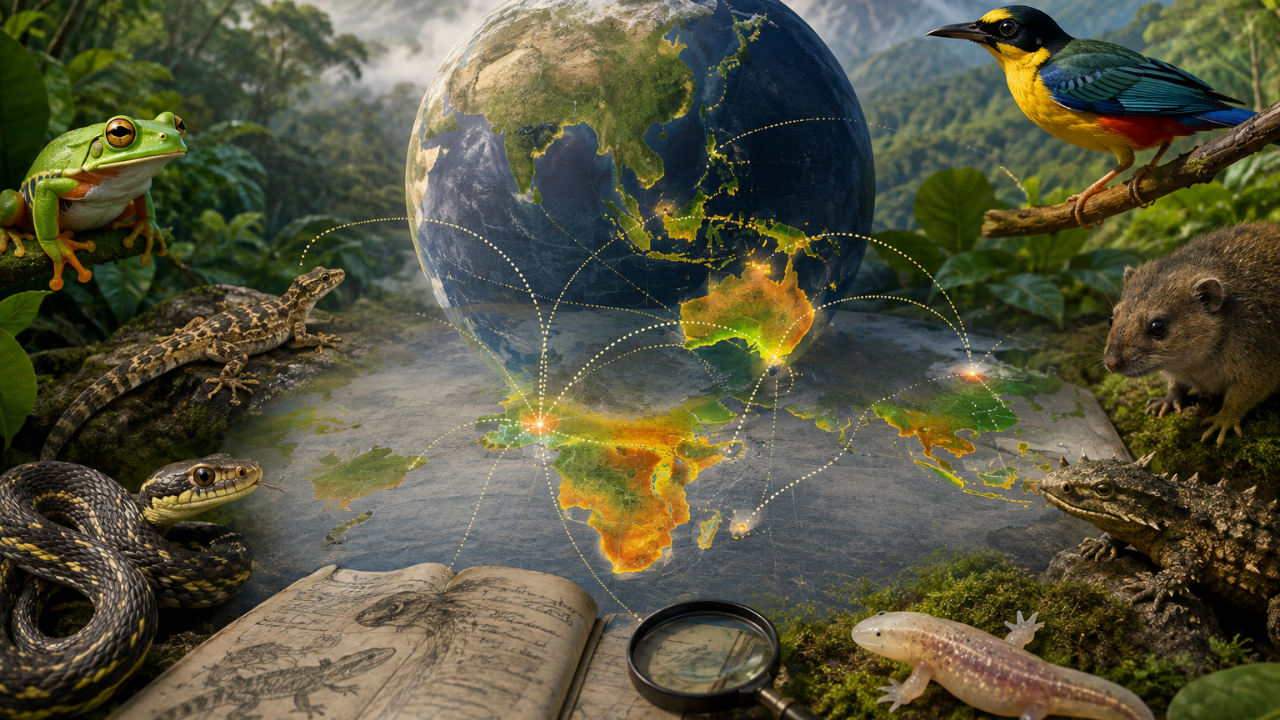
When researchers looked at how a century of taxonomic discoveries between 1920 and 2020 changed global biodiversity models, the results blew open standard ecological thinking. Published in Ecology Letters, the study examined terrestrial vertebrate records to see how newly named species alter our definition of global diversity hotspots. While birds and mammals stayed relatively predictable, reptiles and amphibians threw a massive wrench into traditional mapping.
Over 20% of reptile diversity centres and nearly 32% of amphibian diversity centres actually shifted locations across that century. If you thought we already knew where the most critical biological zones lived, you missed how incomplete our planetary inventory really is.
The Problem With Incomplete Inventories
Conservation planning relies on knowing where rare species cluster. We look at range-weighted rarity—identifying areas packed with species found nowhere else—and draw lines on a map. Then we pour money and protection into those boundaries.
The catch? Those boundaries depend entirely on what science has actually named and described.
If a region holds dozens of undescribed reptiles or amphibians hiding in plain sight, our maps paint a false picture. When taxonomists finally describe those creatures and map their ranges, the hotspots move. Places we ignored a few decades ago suddenly pop up as vital centers of biological rarity.
Look at Australia and Southeast Asia. As researchers categorized new species in these regions, their standing on the global biodiversity scale climbed. They weren't suddenly getting colonized by new animals. We were just finally catching up to what was already crawling, slithering, and hopping through the undergrowth.
Why Cold-Blooded Animals Rewrite the Rules
Birds are mobile. They cross borders, fly over mountain ranges, and draw neat, predictable lines across global climate gradients. Mammals share similar consistency in how their environmental drivers map out.
Reptiles and amphibians don't play by those rules. Because their body temperatures depend completely on their surroundings, their presence ties tightly to microclimates and regional moisture.
When the study tracked how environmental drivers shifted alongside a century of new species discoveries, a clear trend emerged. The apparent influence of temperature dropped, while precipitation took center stage for reptiles and amphibians.
Think about what that means for field science. If your baseline inventory is missing half your species, your models tell you temperature dictates everything. Once you factor in a complete roster of animals, the data shifts to water availability. Incomplete data doesn't just give you a blurry picture. It gives you the wrong story entirely.
Emergent Versus Historical Hotspots
To make sense of how these maps keep changing, researchers categorized biodiversity centers into three distinct buckets:
- Stable centers: Regions that stayed crucial for biological rarity across the entire century-long comparison.
- Historical centers: Places that looked like major biodiversity capitals in 1920 but lost relative weight as discoveries shifted elsewhere.
- Emergent centers: Zones that barely registered a century ago, only to explode onto the conservation map after taxonomic breakthroughs.
This classification exposes the fragility of static environmental management. A forest or wetland might get written off as a low-priority zone simply because nobody spent decades cataloging the micro-fauna living beneath the leaf litter.
Taxonomy isn't just dusty museum work. It dictates where enforcement officers patrol, where governments build reserves, and which habitats get bulldozed for development.
What This Means for Global Conservation
We love clean, permanent answers. Ecologists want a definitive map of Earth so we can slap a fence around the most important pieces and call it a day.
Earth refuses to cooperate.
Taxonomic work involves relentless fieldwork, genetic sequencing that splits one known species into five cryptic ones, and endless hours parsing subtle physical differences. Every time a research team splits a population or uncovers a cryptic species, the distribution maps redraw themselves.
If you are working in conservation or environmental policy, stop treating species lists as final documents. They are living drafts. Funding needs to target not just high-profile charismatic megafauna, but the underfunded taxonomic foundations supporting reptile, amphibian, and invertebrate science.
The hotspots aren't just moving across the planet. They are moving because our vision is finally clearing up. Stop trusting outdated maps to save tomorrow's wildlife.