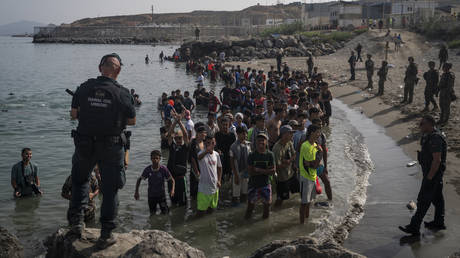
Tens of thousands of people rushed a European border in a single weekend. Chaos ensued. Then, politicians started pointing fingers at foreign intelligence agencies.
If you looked at Spanish social media feeds recently, you saw a bizarre narrative take root. Figures in Madrid claimed that the massive surge of migrants entering the North African Spanish enclave of Ceuta wasn't an ordinary migration wave. Instead, they argued it was a black-ops retaliation orchestrated by the United States and Israel.
How did a brutal border emergency turn into a geopolitical conspiracy theory involving Washington, Jerusalem, and Rabat? Let's look at what actually happened and why politicians jumped to extreme conclusions.
The Reality of the Ceuta Border Breach
The numbers were staggering. Spanish authorities reported that roughly 50,000 individuals crossed the border from Morocco into Ceuta within a very brief window. People swam around breakwaters, braved rough seas on inner tubes, and sprinted past security fences. Tragically, dozens lost their lives to drowning or crushing incidents along the barrier.
Within forty-eight hours, the vast majority of those who crossed were pushed back or voluntarily returned to Morocco under rapid deportation orders enacted by Spain's Interior Ministry. Prime Minister Pedro Sánchez declared normality restored, but the political shockwaves were just beginning.
How a Diplomatic Spat Sparked the Rumors
The conspiracy theory didn't appear out of thin air. It started with a public war of words.
Danny Danon, Israel's Ambassador to the United Nations, took to social media to criticize Madrid's handling of the emergency. He didn't stop at administrative criticism. Danon pointedly asked why Spain continued to maintain what he termed "colonial enclaves in Africa," referencing Ceuta and Melilla.
That single post opened the floodgates.
Spanish Transport Minister Óscar Puente responded cryptically on social media, writing that things were "starting to get pretty clear". Commentators and left-wing politicians ran with the implication. They claimed the border breach was payback. Why? Because Prime Minister Sánchez has been one of Europe's loudest critics of Israel's military campaigns and a vocal opponent of broader Western policies in the Middle East.
Separating Geopolitical Grievances From Migration Realities
Is there any hard evidence that Washington or Jerusalem engineered a mass migration event across Morocco's northern coast? None. Zero. Publicly available intelligence points to entirely different catalysts.
Human rights monitors and local observers on the ground noted a sudden, localized reduction in Moroccan border enforcement. Smuggling networks capitalized on social media rumors, convincing desperate young people that security checks were lax. Economic desperation, high youth unemployment in North Africa, and opportunistic human trafficking drive these surges every single time. They don't require remote activation by foreign intelligence services.
Yet, blaming external actors serves a convenient domestic purpose for struggling politicians. When a government faces severe pressure over border security and economic strains, shifting the blame to a shadowy foreign conspiracy distracts from systemic policy failures.
Even Israel's ambassador to Madrid, Dana Erlich, quickly moved to distance Jerusalem from Danon's provocative UN statements, trying to cool down a diplomatic fire that was burning out of control.
What This Means Moving Forward
The friction around Ceuta exposes a fragile European border infrastructure. It also proves how quickly modern diplomatic spats morph into wild internet folklore.
When high-ranking officials validate conspiracy theories online, they treat complex migration realities like a political football. Real people died at that breakwater. Real communities in Ceuta were overwhelmed. Reducing human tragedy to a retaliatory board game between spies does a massive disservice to everyone trying to solve Europe's ongoing border dilemmas.
Look past the social media noise. The crisis at Ceuta is a warning about regional instability and border management, not a Hollywood spy thriller.