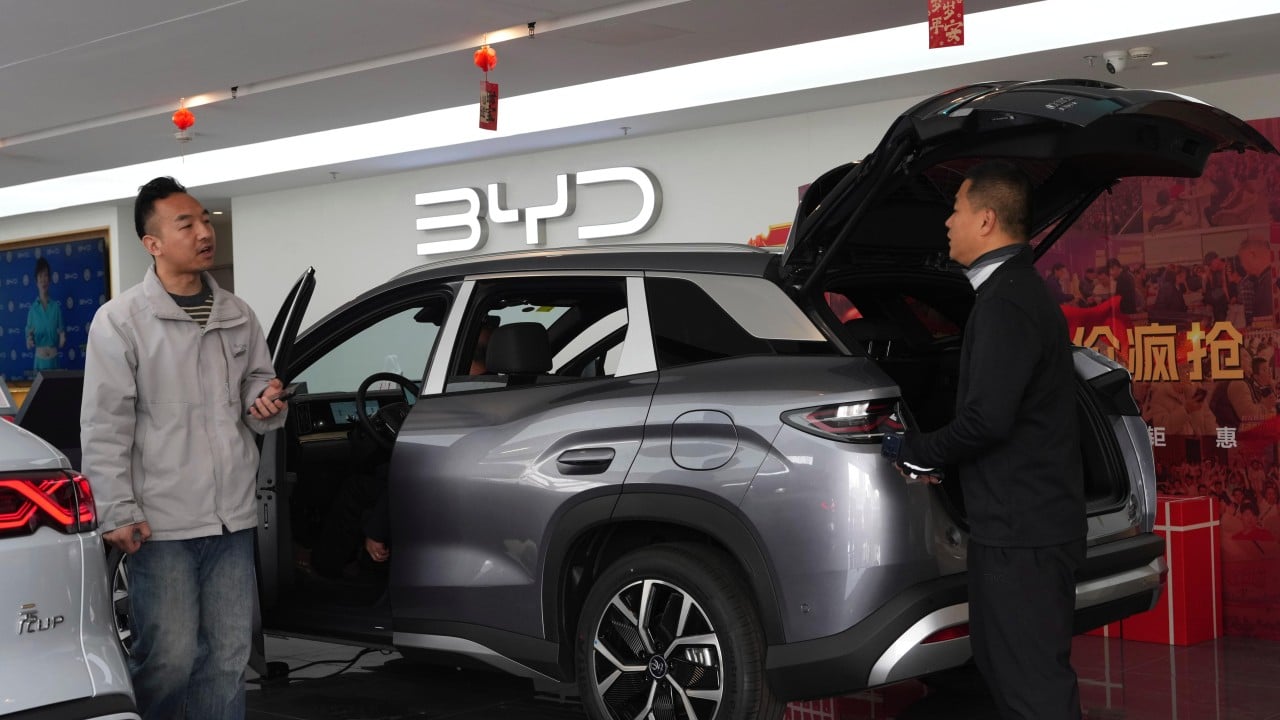
China’s electric vehicle adoption rate is on track to top 70% of monthly passenger car retail sales for the first time in November 2026, yet the headline makes the market look much healthier than it actually is. Buyers aren't rushing into EV showrooms on a wave of booming consumer confidence. Instead, gasoline cars are imploding so fast that plug-in vehicles capture a bigger slice of a shrinking pie.
If you've watched China's auto market closely over the last few years, you already know how surprising 2026 has been. Earlier in the transition, electric vehicle share climbed while total sales expanded or held steady. Now the math works differently. According to China Passenger Car Association (CPCA) estimates, November 2026 new energy vehicle (NEV) retail penetration is projected to hit about 70.6% on roughly 1.15 million NEV units out of 1.63 million narrow passenger vehicles overall. Even in the first half of November, NEV retail penetration reached 73.2%, well above October's record monthly high of 67.5%.
Still, look closely at the volume numbers behind that milestone. Cumulative passenger NEV retail sales through early November 2026 were down roughly 13% year-on-year, while total passenger car sales across January to October 2026 dropped 22.5% to 15.1 million units. Petrol cars took the heaviest hit by far, sliding about 33% over that ten-month stretch to roughly 6.2 million units, and plunging 44% year-on-year in October alone to 534,000 units.
That distinction matters enormously. A 70% share inside a contracting market is a structural tipping point, not a victory lap for domestic demand.
Why China EV Adoption Is Surging While Total Car Sales Fall
People searching for news about China's EV adoption rate crossing 70% usually want two answers right away. First, is demand for electric cars really booming? Second, why are overall car sales dropping at the same time?
The short answer is that weak household spending and cooling incentives are squeezing everyone, while buyers who still step into a dealership overwhelmingly skip internal combustion engines. China's National Bureau of Statistics data shows auto retail sales fell 15.5% in January through October 2026 and dropped 21.4% in October alone. When consumers tighten their belts, hesitating on a depreciating gas car that costs more at the pump starts to look like a bad bet.
Policy shifts are adding friction too. Purchase subsidies have shrunk sharply compared with a year earlier—for instance, a buyer looking at a 100,000-yuan EV now sees a 12,000-yuan purchase subsidy, down 40% year-on-year—while a 5% purchase tax has returned after an earlier exemption, with a move toward the standard 10% rate scheduled as incentives wind down. In my experience covering automotive cycles, tapering subsidies almost always create a messy transition window. Early-year pull-forwards, cautious shoppers, and dealer pushback collide before a new baseline settles in.
A CPCA dealer survey around mid-November 2026 showed most leading automakers running behind their monthly targets, particularly on gasoline models, with dealers reluctant to load up on extra inventory. Meanwhile, factory output hasn't been idle because exports have acted as a giant pressure-release valve. While domestic retail demand softened, Chinese vehicle exports jumped 65.8% in the first nine months of 2026 to 8.21 million units according to the China Association of Automobile Manufacturers (CAAM), and NEV exports surged in October. Energy price shocks tied to geopolitical conflict in the Middle East—including the US-Israel conflict with Iran earlier in 2026—also helped push overseas buyers toward electric models, particularly in markets like Europe.
Public charging buildouts and lower running costs keep keeping plug-in cars in pole position even when monthly sales dip year-over-year. When a shopper compares a gas sedan with falling resale value against an electric or plug-in hybrid model with cheaper per-kilometer energy costs, the internal combustion option loses ground fast.
The Brutal Squeeze on Petrol Cars and Legacy Automakers
If you want to understand who is really bleeding in China's auto market right now, look at internal combustion engine (ICE) cars and traditional foreign joint ventures. Petrol cars haven't just lost market share—they've suffered a steep volume collapse. October's 44% year-on-year drop in gas car sales marked the tenth straight month of year-on-year decline for NEV retail sales as well, showing how broad the domestic demand slump is, even as gas cars absorb the sharpest blow.
Legacy foreign brands have felt that squeeze acutely. International automakers—including stalwarts like Volkswagen and Toyota—saw their combined share of mainland car deliveries drop below 30% in the third quarter of 2026, down from 34.6% a year earlier, according to reporting cited across industry coverage. Domestic Chinese brands, by contrast, captured roughly 62.67% of domestic passenger-car retail sales across January through August 2026.
I've watched legacy joint ventures struggle with this exact trap for years. Decades ago, foreign brands ruled Chinese cities because their engineering, brand cachet, and combustion powertrains set the standard. Once software, battery supply chains, and fast electrification became the main battleground, those old advantages stopped protecting margins. Even strong individual foreign brands like Volkswagen and Toyota—which held around 7.17% and 7.00% of passenger-car retail share respectively across January–August 2026—face steep pressure when joint-venture petrol volume falls sharply. In August alone, FAW-Volkswagen retail sales fell 35.8% year-on-year and SAIC-Volkswagen dropped 42.7%.
At the same time, don't assume every domestic EV maker is cruising effortlessly. Even market leader BYD saw domestic sales drop 45.9% year-on-year in the first half of 2026 according to China EV DataTracker, and Tesla saw October China sales plunge 66% even as CEO Elon Musk pledged to keep raising Shanghai plant output. Meanwhile, broader groups like Geely have gained ground—Geely Holding Group reached 7th globally by market share in H1 2026 at 4.6%, while Chery hit 9th at 4.1%—proving that winners and losers are diverging sharply inside China too.
What Most People Get Wrong About NEV Numbers
A common mistake when reading headlines about China's 70% EV adoption rate is treating "NEV" as a synonym for pure battery-electric vehicles (BEVs). In Chinese industry data, new energy vehicles include battery electrics, plug-in hybrids (PHEVs), and extended-range electric vehicles (EREVs). Mixing those categories up leads to sloppy conclusions about charging habits, battery demand, and how fast pure gas engines are disappearing.
Another misconception is assuming high domestic penetration automatically means domestic factories are running flat-out for local buyers. In 2026, automotive manufacturing value added rose just 0.9% in October—the slowest pace since pandemic disruptions in 2022—because soft home demand dragged down overall vehicle production to 26.4 million units over January–October (down 4.1% year-on-year), even as NEV production climbed 12.7% to 14.5 million units. Exports and overseas expansion are carrying a massive share of the growth story.
What This Means Beyond China
Honestly, if you run an auto business, invest in mobility stocks, or track global energy demand, you can't afford to treat China's numbers as a local quirk. Between January and September 2026, Chinese automakers sold 11.58 million EVs across domestic and overseas markets, representing 63% of global EV sales. When the world's largest auto market crosses 70% plug-in share in a single month, global supply chains for batteries, power electronics, and refining feel the shockwaves.
Still, there are real caveats and debates worth keeping in mind. Monthly penetration spikes—like hitting 70.6% in a CPCA forecast or 73.2% in early-month retail tracking—can bounce around with seasonal promotions, policy adjustments, and model launch cycles. Plus, wholesale figures from CAAM and retail figures from CPCA measure different slices of the pipeline and don't always move in lockstep week to week. Watching multi-month trends and export mix gives you a much truer picture than celebrating or panicking over a single monthly print.
Practical Next Steps for Analysts, Buyers, and Operators
If you're tracking this shift for work, investing, or strategy, start with concrete moves rather than broad guesses:
- Track CPCA retail vs. CAAM wholesale and export splits: Don't rely on a single headline number. Compare monthly retail penetration against export volume so you know whether growth is coming from Chinese driveways or foreign ports.
- Watch dealer inventory and subsidy calendars: Pay attention to dealer stock levels and purchase tax transitions, since incentive step-downs and discounting wars distort short-term pricing power.
- Benchmark legacy ICE exposure: If you follow or work with traditional automakers, look at how fast their combustion revenue is shrinking in China and whether their local EV lineups actually have scale—not just show-car concepts.
- Separately model BEV and hybrid demand: Check how pure battery-electric models and plug-in or range-extended hybrids are performing relative to each other before projecting component or fuel demand.