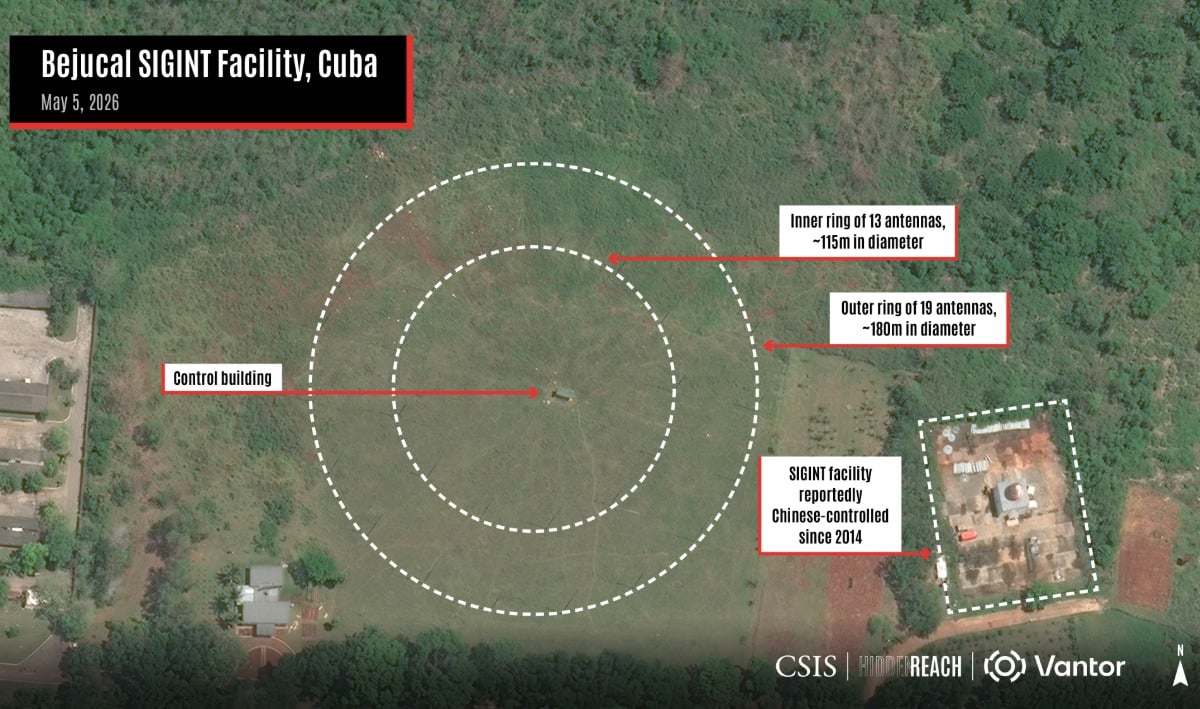
Ninety miles. That is all the distance separating the southern tip of Florida from a massive electronic vacuum cleaner designed to suck up American military secrets. While most people look at the Caribbean and think of white-sand beaches, intelligence agencies are staring at recent satellite imagery of the hills near Havana. The reality is stark. The notorious China-linked spy site in Cuba is now fully operational, and it represents a massive upgrade in Beijing’s ability to eavesdrop on the United States.
For years, rumors of Chinese electronic surveillance from Cuban soil circulated through Washington. Skeptics dismissed it as old-school Cold War paranoia or recycled fears from the 1962 missile crisis. But new commercial satellite imagery analyzed by the Center for Strategic and International Studies (CSIS) shows that the construction at the Bejucal signals intelligence facility is finished. This is not a future threat. It is happening right now, in mid-2026.
If you think this is just another diplomatic spat, you are missing the bigger picture. This facility targets the heart of the American defense infrastructure. The southeastern seaboard of the United States contains major military hubs, space launch facilities, and combatant command headquarters. By turning on this listening post, Beijing basically just parked a surveillance van in America's front yard.
The Massive Antenna Array at Bejucal
The centerpiece of this newly operational facility is a massive Circularly Disposed Antenna Array, commonly called a CDAA. To understand why this matters, you have to look at how old-fashioned radio towers work versus this new setup. Old systems used linear grids that had a tough time pinpointing where a signal originated. A CDAA arranges dozens of antennas in a giant circle to intercept high-frequency signals from any direction simultaneously.
Satellite imagery shows that workers converted an old linear grid into a giant circular array featuring 32 distinct antennas. It consists of 19 outer antennas and 13 inner ones. It is significantly larger and far more capable than any listening system Cuba has ever operated on its own.
What does this thing actually do? It intercepts signals intelligence, or SIGINT. Every time a U.S. military jet takes off from a Florida base, every time a naval vessel communicates with a command center, and every time electronic data beams across the southeastern United States, it leaves an electronic footprint. The Bejucal array catches these waves. It gives operators the ability to triangulate exactly where a signal is coming from and potentially crack open the data inside.
Tracking the Two Main Spy Facilities
Bejucal gets the most attention because it sits in the northwest part of the island, perfect for spying on Florida. The site is a historical ghost. It is the exact same location where the Soviet Union stored nuclear warheads during the 1962 missile crisis. The ground changes, but the geography of conflict stays the same. Workers spent the last couple of years laying underground cables connecting the 32 antennas directly to a central electronic control facility. According to recent analysis, the trenching is filled, the wires are hot, and the system is actively monitoring the skies.
But Bejucal is only half the story. Intelligence analysts have been tracking a second major site near El Salao, located in southeastern Cuba, roughly 70 miles from the U.S. Naval Base at Guantanamo Bay.
The story at El Salao is completely different, showing that international espionage is often messy and unpredictable. Construction there started back in 2021 with grand plans for another massive circular antenna array. Workers built a central command building and laid foundations for an inner ring of 16 antennas. But recent imagery from May 2026 shows that progress at El Salao has slowed to a crawl. Grass is growing over the graded areas. No actual antennas have been set up around the central structure.
Instead of abandoning it, the operators did something strange. They repaved and shifted an access road so it runs directly through the center of the unfinished antenna array. Running a paved road through the middle of an active radar or antenna field is bizarre because it ruins the symmetry needed for accurate collection. It means El Salao is stalled or being repurposed, while Bejucal is carrying the heavy operational load.
What Washington Gets Wrong About the Threat
A lot of the political commentary out of Washington treats this like a brand-new surprise. That is a mistake. The White House confirmed that Chinese intelligence operatives have been using facilities on the island since at least 2019. It didn't start yesterday. It evolved over a decade of quiet financial transactions.
Some military analysts argue that China doesn't need a physical site in Cuba because they have advanced spy satellites. That argument ignores the physics of electronic warfare. Satellites move fast, passing over a target for minutes at a time unless they sit in high geostationary orbits, which are too far away to catch weak radio signals. A ground-based station in Cuba stays put. It listens 24 hours a day, 365 days a year, capturing low-frequency and high-frequency military communications that satellites simply miss.
The financial reality explains why Cuba is doing this. Havana is broke. Severe economic mismanagement combined with intense U.S. pressure has left the island with failing power grids and food shortages. Beijing steps in with billions of dollars in hosting payments. For the Cuban regime, renting out a few hills to Chinese intelligence technicians is an easy way to keep the lights on in Havana.
The Geopolitical Fallout and Next Steps
This operational site is already causing severe waves in Washington. In May 2026, the White House issued an aggressive executive order hitting the Cuban government with harsh new economic sanctions. The administration explicitly named the hosting of foreign adversary facilities targeting U.S. national security as the driving reason for the penalty.
The political pressure is real. Intelligence personnel from foreign nations inside Cuba have nearly tripled since 2023. This creates a difficult situation for American defense planners. Because Cuba relies on Chinese money to survive, diplomatic complaints won't change anything.
The U.S. military cannot simply go in and knock down the antennas. Instead, the pentagon must adapt by shifting to heavily encrypted, low-profile communication methods across all Florida-based commands. Security teams must assume that any unencrypted radio transmission or electronic signature originating in the American southeast is being captured, logged, and analyzed by teams working out of Bejucal.
If you want to track the immediate security situation, watch the Pentagon's electronic warfare spending. The true battle won't be fought with missiles, but with frequency hopping, advanced encryption, and signal jamming designed to turn the multimillion-dollar Bejucal array into a very expensive piece of useless metal.
For a closer look at the actual layout of these facilities and how they operate on the ground, check out this video breakdown detailing the Secret Spy Base in Cuba. It offers an excellent visual analysis of the satellite imagery and radome structures being used just off the American coast.

:max_bytes(150000):strip_icc()/opera-garnier--paris--france--europe-173294974-5a2d8e5b4e4f7d0037eef37d.jpg)