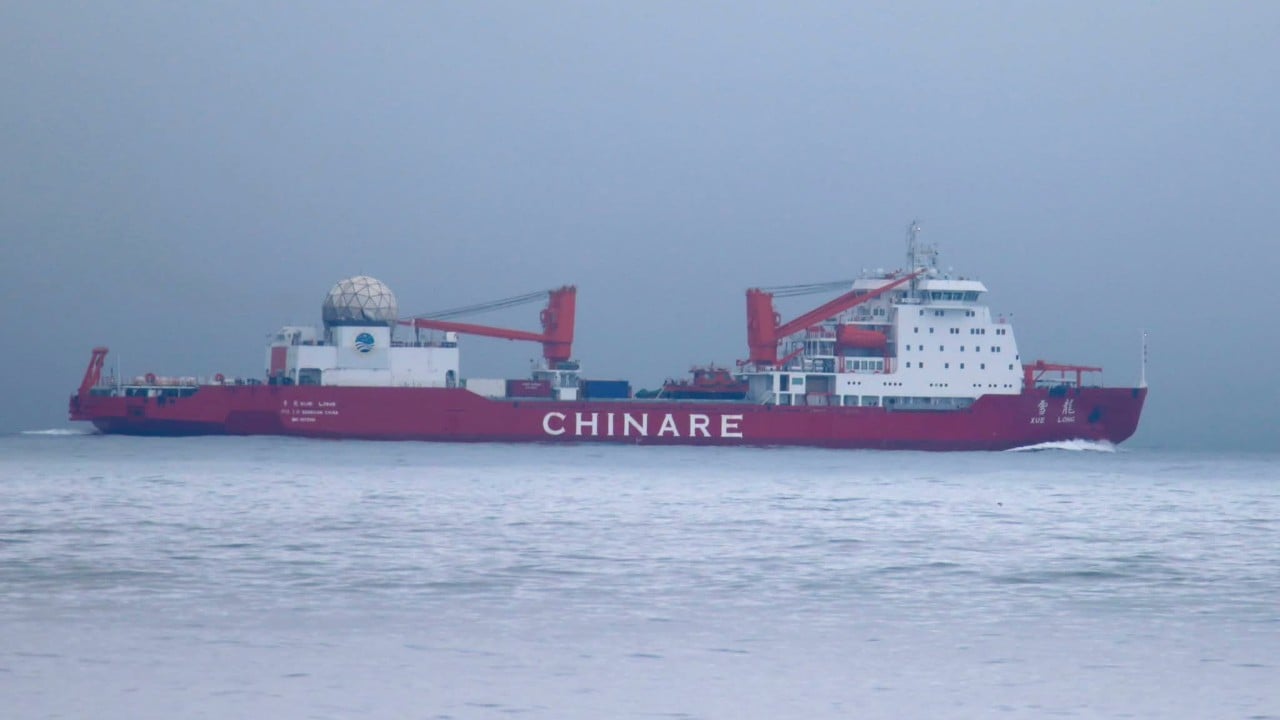
When China launched its 16th scientific expedition into the Arctic Ocean with a fleet led by the icebreakers Xue Long and Xue Long 2, Beijing framed the mission as a purely scientific effort to study melting sea ice and global climate change.
Washington isn't buying it.
As those research ships slipped past Alaska through the Bering Sea, the US Coast Guard dispatched the cutter Munro under Operation Frontier Sentinel to shadow their every move. American officials aren't just worried about research vessels taking water samples. They know that every sonar ping measuring ice thickness also maps the seabed for submarine warfare. Every meteorological balloon tracks atmospheric conditions that dictate missile trajectories. In the freezing waters of the high north, science and military power are two sides of the same coin.
Why is a country thousands of miles from the Arctic Circle spending billions to explore the far north, and why does every polar expedition spark an immediate security reaction in Washington?
The Dual Use Dilemma of Arctic Ocean Research
Scientific exploration has always served as a front for national power. When a research vessel drops hydroacoustic sensors into the Bering Sea, it claims to measure water temperature and salinity. That's true, but those same sensors collect vital hydrographic data.
Submarines rely on exact oceanographic profiles to hide. Temperature shifts, salt density, and seabed topography determine how sound travels underwater. If you want to run stealth submarine patrols through Arctic choke points, you need the exact underwater map that research ships gather.
China's 16th Arctic scientific expedition deployed 361 scientists across multiple vessels. On paper, they're studying climate anomalies, atmospheric conditions, and polar geology. In reality, the technical gear aboard ships like the Xue Long 2 does double duty. Bathymetric sonar systems chart deep ocean trenches. Acoustic arrays map the seafloor around American exclusive economic zones.
Washington views these missions through a simple lens. Data gathered under the banner of civilian research feeds directly into military planning. You can't separate polar ecology from undersea warfare when the exact same bathymetric charts guide both marine biologists and nuclear attack submarines.
Russia and China Joining Forces in Northern Waters
If China were acting entirely alone in the high north, Washington might treat these polar expeditions as a manageable security issue. What really rattles the Pentagon is Beijing's deepening partnership with Moscow.
Russia holds thousands of miles of Arctic coastline along the Northern Sea Route. For decades, Moscow guarded those waters fiercely, refusing to let foreign ships transit without strict control. Sanctions and war changed that calculation. Starved of Western capital and specialized offshore equipment, Russia opened its Arctic doors wide to Chinese money and shipbuilders.
Joint naval patrols around Alaska aren't hypothetical anymore. Russian and Chinese warships regularly conduct joint maritime drills near the Aleutian Islands, passing right through the Bering Strait. Moscow provides the geographical access and heavy icebreaking support, while Beijing brings deep pockets, advanced sensor tech, and expeditionary resources.
That partnership turns northern shipping lanes into a shared strategic theater. China's vision of a Polar Silk Road—a network of commercial shipping routes connecting East Asia to Europe through melting Arctic ice—is moving from paper to real water. For the US military, a Sino-Russian bloc controlling the top of the globe represents the biggest shift in northern security since the Cold War.
How Washington Is Fighting Back
American policymakers are scrambling to catch up. For years, the United States treated Arctic defense as a secondary concern, leaving its icebreaking fleet to decay down to just two aging vessels. One spent more time undergoing repairs in dock than breaking ice.
That complacency ended fast.
Congress and the White House hit the gas on the ICE Pact initiative, a multi-billion-dollar effort to build a brand-new fleet of 11 Arctic Security Cutters. To speed things up, Washington took the unusual step of partnering with Finnish shipbuilders at Helsinki Shipyard alongside domestic yards in Louisiana and Texas. The goal is simple: get physical hull presence back into frozen waters before Beijing and Moscow dominate the region completely.
On the policy side, Capitol Hill introduced the Arctic Security and Diplomacy Act. This law tightens the screws on foreign scientific research inside the US Exclusive Economic Zone and over the extended continental shelf. Under the proposed rules, Chinese state-affiliated research vessels can't just declare a scientific mission and sail through. They face strict pre-approval requirements and mandatory data-sharing rules aimed at shutting down covert mapping operations.
The Coast Guard isn't waiting for new ships to finish construction either. By stationing high-end national security cutters in Alaska and running constant tracking missions, the US is making it clear that no foreign icebreaker moves through northern choke points unobserved.
Why the Central Arctic Ocean Matters Right Now
The rush for control isn't just about military posturing. It's about access. As polar ice retreats at record rates, the Arctic Ocean is transforming from an impassable frozen cap into a dynamic maritime corridor.
Shortened trade routes through the Arctic cut transit times between East Asian ports and Western Europe by up to 40 percent compared to traditional routes through the Malacca Strait and Suez Canal. For an export-heavy economy like China's, securing reliable access to northern trade routes reduces vulnerability to maritime blockades in southern flashpoints.
Underneath the ice lies another prize. The seabed holds vast untapped reserves of natural gas, oil, critical minerals, and massive fish stocks. Under international law, nations with Arctic coastlines claim territorial rights based on their continental shelves. China has no Arctic coast, yet it officially declared itself a "near-Arctic state" years ago to justify its seat at the table.
By maintaining a continuous, high-profile research presence, Beijing builds a track record of activity. It wants a direct say in polar governance, international seabed mining regulations, and Arctic Council decision-making. Every completed expedition gives Beijing stronger political leverage when rules for the high seas are written.
The Blurred Line Between Science and Defense
It's easy to view this friction as simple paranoia. Some security analysts argue that over-militarizing scientific research harms global climate studies. After all, understanding polar ice melt is vital for global climate modeling, sea-level predictions, and environmental protection.
That argument misses how modern intelligence gathering works. Dual-use technology means a marine sensor dropped to track meltwater currents collects acoustic profiles of passing vessels at the exact same time. Autonomous underwater gliders deployed to study plankton drift can easily log undersea cable locations and magnetic anomalies.
Beijing knows this. Washington knows this. Even Moscow stays slightly nervous about Chinese scientific mapping along its northern shores, despite their public alliance. When state-backed entities fund polar science, civilian data gathering and national intelligence targets merge completely.
The Arctic is no longer an isolated wilderness frozen in time. It's an active arena of global power competition where scientific expeditions serve as the tip of the strategic spear.
What to Watch Next in Arctic Competition
The battle for influence across the polar north will only intensify over the coming years. Keep an eye on these specific moves to see where the conflict heads:
- Track the ICE Pact Deliveries: Watch how fast the US Coast Guard accepts its first Arctic Security Cutters into service from Finnish and American shipyards. Speed of delivery dictates whether Washington can close the operational gap near Alaska.
- Monitor Joint Russia-China Patrols: Pay attention to combined naval transits through the Bering Strait. Increased frequency signals deeper integration between Russian territorial access and Chinese naval assets.
- Follow Congressional Research Restrictions: Watch the passage of the Arctic Security and Diplomacy Act. Strict enforcement will trigger formal diplomatic protests from Beijing over scientific access in international and EEZ waters.
- Watch Commercial Transit Counts: Check annual statistics on commercial cargo ships taking the Northern Sea Route during summer thaw months to measure how fast the Polar Silk Road is becoming a commercial reality.
Understand that every headline about a polar research vessel is really a story about control over the trade routes, seabed data, and military high ground of tomorrow.