You can spend a lifetime exploring underground ecosystems and still miss creatures hiding in plain sight. Scientists recently discovered China’s first known freshwater cave snail, but there is a major catch. Only three living adults have ever been found.
That single detail turns a standard wildlife discovery into a race against time. Named Erhaia dijiang and documented in the journal Subterranean Biology by Yue-Ming He and colleagues, this tiny creature represents a massive milestone for East Asian biospeleology. Yet, its precarious existence proves how little we actually know about the subterranean worlds right beneath our feet.
Anatomy of an Underground Ghost
Life inside a dark mountain cave looks nothing like life on the surface. Erhaia dijiang belongs to a specialized group of organisms known as troglobionts. These animals are built entirely for permanent darkness.
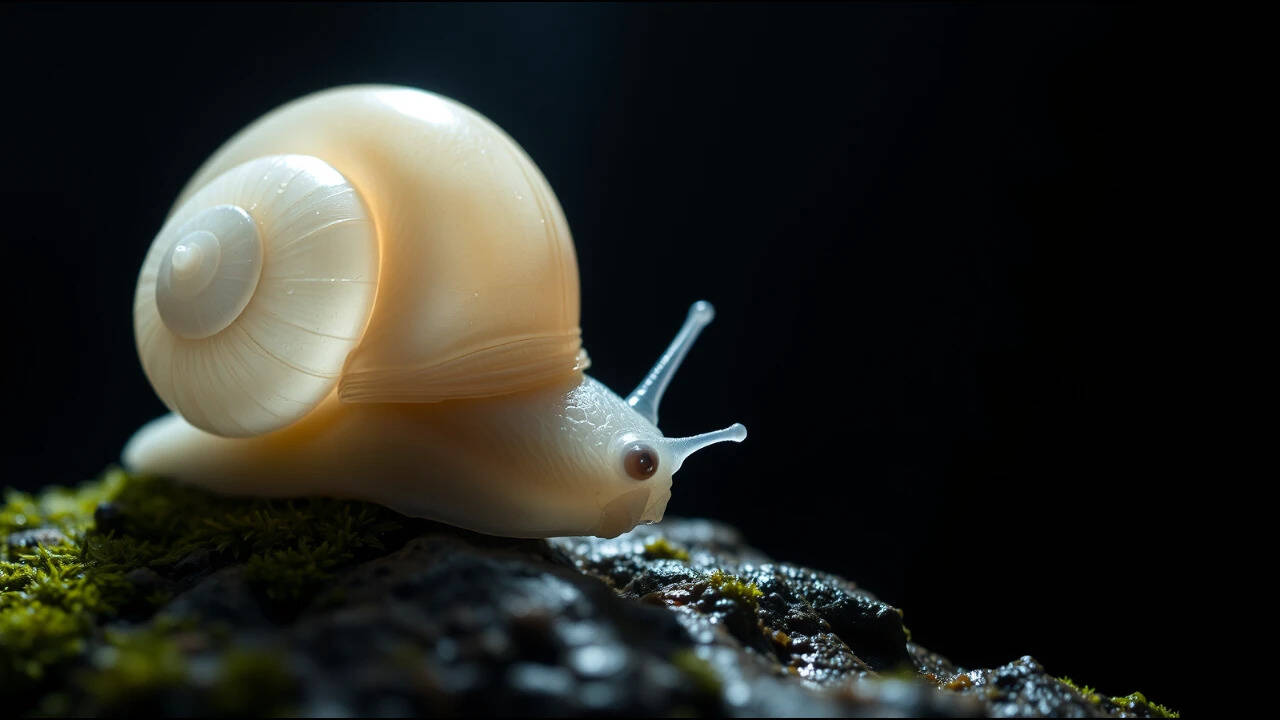
When sunlight never touches your habitat, eyes are an evolutionary waste of energy. Over countless generations, this freshwater cave snail lost its vision structures completely. Its body lacks pigmentation, leaving behind a translucent shell so thin you can see the delicate tissue underneath.
When researchers exposed the captured specimens to light during laboratory observations, the reaction was immediate and aggressive. The snails scrambled frantically to find narrow spaces beneath rocks, proving they cannot handle exposure to brightness.
The species earned its striking scientific name from ancient mythology. Researchers named it after Di Jiang, a faceless mountain god described in the classic text Classic of Mountains and Seas, matching an animal whose head shows zero trace of eyes or facial features.
Living at High Altitude Karst Systems
Finding this freshwater cave snail happened in the Hongta District of Yuxi City, tucked away in Yunnan Province. What makes the location remarkable isn't just the darkness, but the altitude.
The cave sits 2,062 meters above sea level. That makes it the highest recorded elevation for any cave-dwelling member of the family Erhaiidae.
Karst landscapes operate like biological islands. Water slowly dissolves soluble rock underground, carving out isolated networks of caves, hidden streams, and pools. Populations trapped inside these natural silos get cut off from the outside world for centuries. They evolve along hyper-specific paths that make them utterly dependent on one microscopic ecosystem.
Inside the cave, the environment remains shockingly stable. The water stays close to 20 degrees Celsius, flowing in shallow depths of less than one meter over gravel and broken stone. The snails graze on diatoms spread across submerged rocks.
Even when heavy seasonal rains push violent currents through the cave system, flushing a few unfortunate snails toward the mouth, the animals refuse to leave their subterranean home. Surveys of nearby surface streams turned up zero individuals. They stay firmly within two meters of the cave entrance, highlighting a fatal flaw: the outside world is basically toxic to them.
The Three-Adult Problem
A species cannot survive on three individuals alone. During field surveys conducted in August 2025, scientists recovered just three living adult snails alongside a single empty shell.
Even more alarming, researchers spotted zero juveniles. Without a younger generation growing up to replace the adults, the long-term outlook for Erhaia dijiang looks grim.
Because the entire global population lives inside one single cave system, a localized disaster could wipe out the entire species overnight. Industrial pollution, agricultural runoff, or minor tourist disturbances could seal their fate before biologists even figure out how they reproduce.
Protecting What We Cannot See
Underground freshwater ecosystems across East Asia remain drastically under-explored compared to surface habitats. Scientists are now pushing for wider, systemic surveys of other karst caves across China to check if Erhaia dijiang hides elsewhere, or if similar ghost species are quietly going extinct before discovery.
If you care about biodiversity, the takeaway is simple. Funding and protecting underground watersheds matters just as much as saving rainforests. Support local speleological societies and conservation groups that push for strict environmental protections around karst zones. Stop treating caves as blank spaces on a map, because every lost cave system takes entire evolutionary lineages down with it.