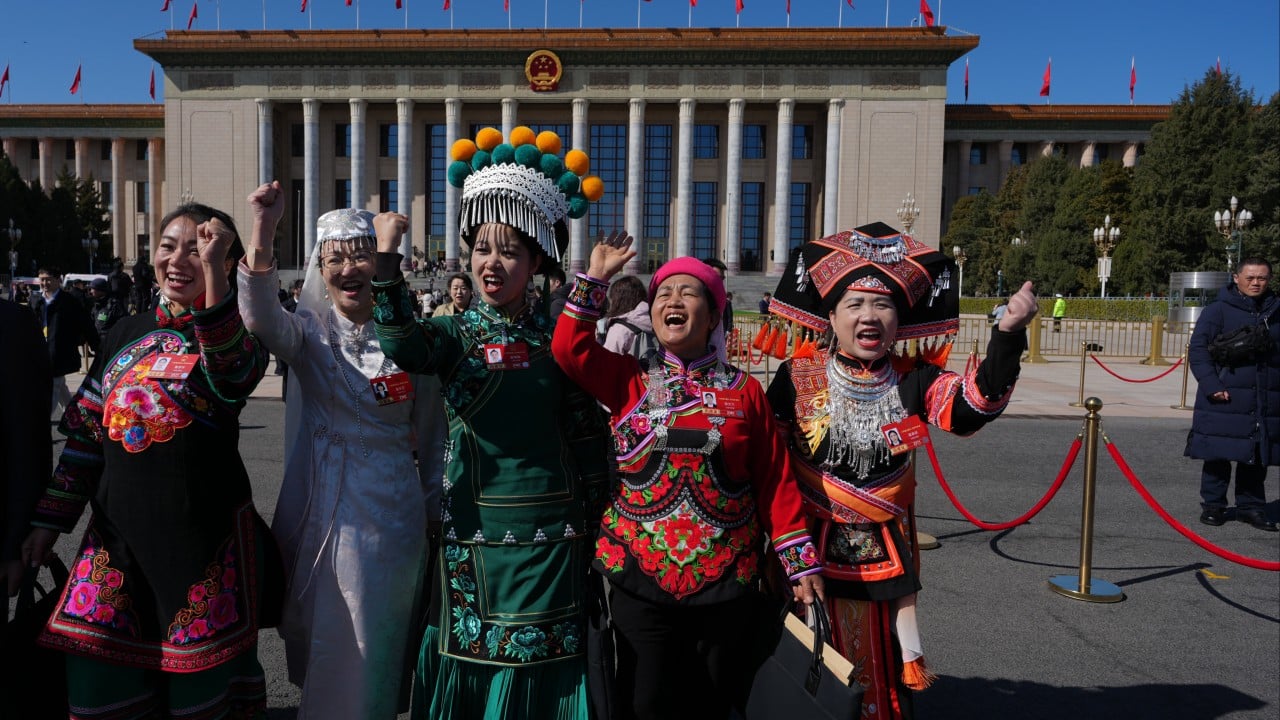
Beijing just tore up its own playbook on how it handles ethnic minorities. On July 1, 2026, China's ethnic unity law officially went into effect. On paper, the Law on Promoting Ethnic Unity and Progress sounds like standard political filler. The government claims it is all about social cohesion, shared prosperity, and national stability.
Don't buy the official spin.
This legislation marks the final, official death blow to any remaining illusion of ethnic autonomy in China. It formalizes a aggressive shift away from accommodation toward forced cultural erasure. For decades, the Chinese Communist Party maintained a system that theoretically respected different ethnic identities. That era is over. The new legal reality demands absolute alignment with Han-dominated culture and total political submission to the Party.
If you want to understand why this matters, look at what the law actually commands. It doesn't just encourage people to get along. It mandates compliance. It weaponizes the legal system to erase cultural differences in Tibet, Xinjiang, and Inner Mongolia. Even more alarming, it claims jurisdiction over anyone on earth who criticizes China's treatment of minorities.
The Total Destruction of Ethnic Autonomy
To understand how radical this shift is, you have to look at history. After 1949, China adopted a system inspired by the Soviet Union. The state recognized 56 distinct ethnic groups and established autonomous regions. In 1984, Beijing passed the Regional Ethnic Autonomy Law. That old framework wasn't perfect, but it explicitly warned against majoritarian Han chauvinism. It protected the rights of minorities to use their own languages and run local schools.
The 2026 law completely reverses that philosophy. The old language protecting minority cultures is gone. Instead, the text focuses on a single concept: zhulao. The word means to forge or cast metal. The law explicitly commands officials to forge the communal consciousness of the Chinese nation. You don't forge something by celebrating its unique qualities. You melt it down and reshape it into a single, uniform block.
This is the legal manifestation of what scholars call second-generation ethnic policies. The goal is straightforward. Eliminate differences. Erase regional identities. Create a single, homogenized population that puts the state above all else.
Erasing Language at the Preschool Level
The practical execution of this law is brutal. One of the primary targets is language. The legislation formalizes rules that make Mandarin the absolute standard for education, business, and public administration.
It targets the youngest children first. The law mandates preschool education in Mandarin across minority regions. Think about what that means in practice. Children in Tibet or Xinjiang are separated from their native tongues before they even learn to read. By the time they grow up, their native language becomes a secondary relic, unusable in professional or public life.
The law also dictates visual conformity. Government offices, schools, and private businesses must give prominent display to Chinese characters over local scripts. In places like Inner Mongolia, where protests erupted a few years ago over language policy, this law provides a definitive legal mandate to wipe minority scripts from public view.
This open warfare on language directly violates China's own constitution. Article 4 of the Chinese Constitution states clearly that all ethnic groups have the freedom to use and develop their own spoken and written languages. The new ethnic unity law ignores this entirely. Legal scholars like Magnus Fiskesjö have pointed out that this law openly contradicts the nation's founding legal document. When a secondary law overrides constitutional protections, it shows exactly where the Party's priorities lie. Control matters more than the constitution.
Slogans Disguised as National Law
The very structure of this law reveals its true purpose. Usually, Chinese legislation follows a predictable, functional path. It uses standard legal categories and dry administrative terms. This statute throws that convention out the window.
Instead of normal legal framing, the chapters are organized around political slogans pulled directly from Xi Jinping Thought. It even includes a narrative preamble, a bizarre rhetorical device used only a handful of times in modern Chinese legislative history.
This is a dangerous trend. The line separating Party ideology from state law has vanished completely. The state apparatus is now explicitly tasked with enforcing the ideological whims of a single leader.
When political slogans become the law of the land, enforcement becomes completely unpredictable. The law bans acts that undermine ethnic unity or create ethnic division. What does that actually mean? The text never defines those terms. It leaves them intentionally vague. Under this framework, speaking a minority language in an unauthorized setting or advocating for local cultural preservation can be interpreted as creating ethnic division. It turns peaceful cultural expression into a serious state crime.
The Global Reach of Beijings New Enforcement
The most shocking element of China's ethnic unity law is its explicit extraterritorial reach. A specific clause in the legislation states that individuals can be held legally liable for violating the law even when they are completely outside of China's borders.
Vice-minister of justice Hu Weilie openly defended this clause, calling it legitimate and necessary. Human rights organizations are terrified of what comes next. Amnesty International warned that this provides a new legal foundation for transnational repression.
The Party already tracks diaspora communities. It harasses activists in Washington, London, and Berlin. It threatens the families of Uyghurs and Tibetans who speak out online. This new law codifies those intimidation tactics into national policy.
Taiwan has already sounded the alarm. The island's Mainland Affairs Council warned its citizens that traveling to China is now significantly more dangerous. Deputy minister Liang Wen-chieh noted that Beijing will use this law to fabricate charges against Taiwanese citizens or anyone globally who shows solidarity with oppressed groups. If you tweet something critical of Beijing's policies in Xinjiang while sitting in New York, China now considers you a criminal under this domestic statute.
What the Ground Reality Looks Like
This isn't an abstract policy debate. The groundwork for this national law has been tested for years. Provincial authorities implemented trial versions of these regulations in Xinjiang back in 2015, and in Inner Mongolia in 2021. We already know what the results look like.
Consider the cases of prominent intellectuals who tried to walk the fine line of nominal autonomy. Ilham Tohti, a renowned Uyghur economist, spent years working within the Chinese academic system to advocate for better economic conditions for his people. He was sentenced to life in prison. Rahile Dawut, an ethnographer who dedicated her life to documenting Uyghur folklore and cultural traditions, disappeared into the state's detention apparatus.
These individuals weren't separatists. They weren't calling for the overthrow of the state. They were simply celebrating and documenting their culture. Under the new national framework, their life's work is explicitly criminalized. The law views the preservation of a distinct cultural identity as an inherent threat to the state.
UN Human Rights Chief Volker Türk has called for the immediate repeal of the law, noting that it severely restricts freedoms of language, education, religion, and expression. Beijing predictably dismissed the criticism, hiding behind the rhetoric of poverty alleviation and national integration.
Moving Forward and Mitigating Risks
The international community cannot treat this as just another standard piece of Chinese bureaucracy. It is an aggressive rewrite of domestic and international legal norms.
If you manage an international organization, a university, or a business with ties to China, you need to adjust your operations immediately to protect vulnerable populations.
First, look at your digital security protocols. Diaspora communities and international researchers are at heightened risk of surveillance and digital targeting under this law. Switch all communications involving sensitive cultural, educational, or regional research to end-to-end encrypted platforms. Do not store identifiable data of individuals located in minority regions on servers that can be accessed by mainland entities.
Second, re-evaluate corporate social responsibility policies. If your supply chain or operations run through regions governed heavily by this law, understand that compliance with local "ethnic unity" initiatives likely means participating in programs that suppress minority identity. Perform rigorous, independent audits to ensure your local entities are not complicit in forced cultural assimilation programs.
Third, academic institutions must step up protection for international students and faculty. Since the law claims global jurisdiction, students from minority backgrounds or those studying Chinese politics face genuine danger if their classroom discussions or research papers are leaked. Implement strict confidentiality rules for academic forums and protect the anonymity of researchers addressing these topics.
Beijing has made its intentions perfectly clear. The old era of nominal ethnic tolerance is dead, replaced by a legal machine designed to enforce total cultural conformity. Pretending this is just a minor policy update is a luxury the world can no longer afford.