Space isn't just about launching anymore. It's about catching. On July 10, 2026, China pulled off an engineering feat that completely alters the global space race. They didn't just clone what Elon Musk's company did a decade ago. They chose a radically different path.
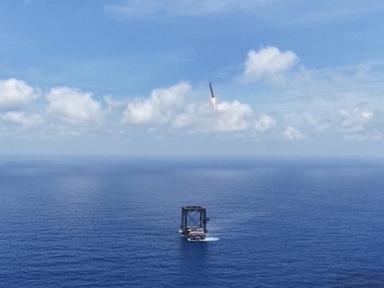
The state-run China Aerospace Science and Technology Corporation successfully grabbed the first stage of its brand-new Long March 10B rocket out of the sky. The 63-meter-tall booster didn't deploy heavy landing legs to touch down on a concrete pad or a flat drone ship. Instead, it guided itself back down through a controlled descent and got trapped by a massive net system on an offshore recovery vessel named Linghangzhe.
This happened at 12:15 p.m. Beijing time, lifting off from the Hainan commercial space launch site. Six minutes after separating from its upper stage, the booster became the first Chinese orbital-class rocket stage to be safely recovered for reuse.
Most Western media outlets simply framed this as Beijing trying to catch up to the American lead in space travel. That misses the point entirely. This wasn't a copycat mission. It represents a serious shift in engineering philosophy that could change the economics of launching payloads into orbit.
The Engineering Behind the Net
Building a rocket that lands on its own legs is brutally difficult. Just look at the long trail of exploded hardware left behind during early trials in the American private sector. But catching a rocket with a net brings a completely different set of structural advantages and guidance challenges.
When a booster uses landing legs, those legs represent dead weight during the climb to space. You have to carry heavy hydraulic systems, metal struts, and deployment mechanisms all the way up. Every pound of landing gear you add is a pound of actual payload you can't carry for your paying customers.
By removing the legs, the Long March 10B stays lean. It relies on small landing hooks built into the upper fuselage. The heavy lifting is done by the recovery ship. The net system absorbs the kinetic energy of the descending multi-ton metal cylinder.
The margin for error here is razor-thin. A rocket landing on a wide drone ship has a few meters of leeway to slide or correct its stance. The net capture system requires absolute precision. The booster must hit a specific coordinate within centimeters while its engines throttle down to zero. It's the equivalent of throwing a dart across a football field and hitting a moving wedding ring.
If you get the guidance wrong by a fraction of a degree, the rocket hits the edge of the ship or tears right through the net, resulting in a spectacular explosion. China managed to nail it on the very first try with an orbital-class vehicle.
How It Compares to Western Hardware
Let's look at the numbers. The Long March 10B can carry roughly 16 metric tons to low-Earth orbit. That puts it squarely in the medium-lift category, serving as a direct competitor to the workhorse of modern spaceflight, the Falcon 9.
The American model has a massive head start. Private operators in the U.S. launch roughly three times a week, reusing individual boosters more than twenty times. That frequency crushed the global commercial market and forced everyone else to adapt or go broke.
While the U.S. relies heavily on private companies pushing the boundaries, China relies on a hybrid model. The China Academy of Launch Vehicle Technology developed the Long March 10B for commercial aerospace applications, but they work with the backing of state infrastructure. The sudden surge in aerospace stocks across Chinese markets after the announcement shows how much domestic industry hopes to gain from this.
The international playing field is getting crowded. Blue Origin finally flew its New Glenn vehicle late last year. Rocket Lab fishes its smaller Electron boosters out of the Pacific after parachute descents. Japan's space agency is actively testing its own reusable prototypes.
China's choice to go with a maritime net capture bypasses a lot of the patents and established engineering pipelines held by American firms. They didn't try to build a better version of someone else's system. They built an entirely different recovery infrastructure.
The Hidden Economics of Saltwater
You might wonder why they went to the trouble of building a complex maritime net system instead of just flying the rocket back to a solid pad on land. The answer comes down to geography and physics.
Launching from an island like Hainan means you fly over open water. It's safer. If something breaks during the first few minutes of flight, the debris falls into the ocean rather than onto a village. But flying a rocket booster all the way back to the launch pad requires keeping an enormous amount of fuel in reserve. You have to completely reverse the rocket's forward momentum.
Dropping the booster down along its natural ballistic trajectory onto a waiting ship saves that fuel. More fuel for the trip up means you can carry heavier satellites.
The historical problem with ocean recoveries has always been the water itself. When a rocket splashes down into the ocean, the saltwater destroys the complex engine valves, rusts the structural metals, and wrecks the delicate guidance electronics. Refurbishing a water-logged booster can cost almost as much as building a brand-new one from scratch.
The net on the Linghangzhe ship solves this. It keeps the engine section dry. By suspending the rocket mid-air before it touches the deck, the recovery team prevents the hard impact forces that can warp the fuselage, while keeping the vehicle safe from salt spray. It accelerates the turnaround time required to inspect the engines, bolt the booster onto a new second stage, and roll it back out to the pad.
What Happens Next in Orbit
Don't expect China to start reusing this exact booster next week. This test proved the recovery system works under live conditions, but the real work begins now. Engineers have to tear that recovered first stage apart to check for micro-cracks in the metal, heat damage on the engine nozzles, and structural fatigue.
The ultimate goal isn't just cheap commercial satellite launches for things like China's planned megaconstellations to rival Starlink. This technology is a direct stepping stone toward their broader lunar ambitions. A variant of this vehicle will likely help hoist components for a crewed moon mission before the decade ends.
If you are tracking the aerospace sector, stop waiting for other countries to copy the standard landing leg playbook. Watch how the maritime net system handles rougher seas during upcoming winter flights. Keep an eye on the turnaround times between this specific booster's inspection and its eventual second flight. True operational maturity only comes when the same piece of metal flies twice.
To get a better sense of how this mechanism operates in real-time, you can see the actual capture sequence caught on film during the live maritime test. Check out this Long March 10B Net Recovery Video to watch the booster drop into the offshore platform's net system.
The era of discarding expensive rocket engines into the ocean is officially dead for every major global power. The competition is no longer about who can build the biggest rocket, but who can catch them the fastest.