Washington wants you to believe that the global race for artificial intelligence is already decided. They think that by locking down advanced graphics chips and blocking tech exports, they've successfully walled off the future. They're wrong.
While American tech firms are building increasingly expensive, closed-door proprietary software, Beijing is pulling off a massive pivot. They aren't just trying to catch up to OpenAI or Google anymore. They're changing the rules of the entire game.
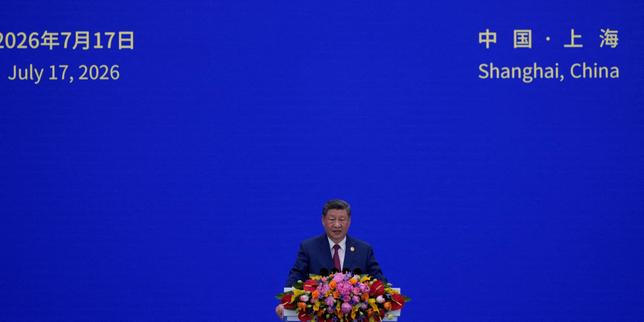
At the World AI Conference in Shanghai, Chinese President Xi Jinping laid out a grand strategy that should make every Western policymaker sweat. It centers on open source, open weights, and a deep alliance with the Global South.
The message is clear. If the United States wants to treat AI as an exclusive weapon of national security, China will package it as a global public utility.
The Symphony Versus the Solo Performance
Xi didn't mince words during his speech in Shanghai. He dropped a classic Chinese proverb to drive the point home. A single string cannot make music, and a single tree does not make a forest. He explicitly argued that AI development shouldn't be a solo performance by a single country, but a symphony of international cooperation.
It sounds poetic. It's actually a direct shot at the Biden administration’s export controls and sanctions.
For the past few years, the US strategy has focused on cutting off China's access to high-end Nvidia chips. The goal was to starve Chinese labs of the computing power required to train frontier models. It didn't work out as cleanly as planned. Instead of rolling over, Chinese tech ecosystems adapted. They built their own compute alternatives and optimized their software to squeeze every drop of performance out of less advanced hardware.
Now, China is turning those constraints into an ideological weapon. Xi slammed what he called overstretching the national security concept in the field of AI. He warned that placing one country’s security above that of others creates new historical injustices. By framing American export restrictions as neo-colonial gatekeeping, Beijing is positioning itself as the champion of technological equity.
Setting Up a New World AI Order
This isn't just empty political rhetoric. Beijing backed up the talk with concrete institutional architecture.
During the conference, twenty-nine countries signed a historic founding agreement to establish the World Artificial Intelligence Cooperation Organization, or WAICO. Headquartered right in Shanghai, WAICO is the planet's very first intergovernmental international organization dedicated entirely to AI governance and deployment.
Look at the roster of founding members. You'll see nations like Russia, Indonesia, Pakistan, Laos, Kazakhstan, Brazil, South Africa, Kenya, Malaysia, and Venezuela. Notice who's missing? The United States, the European Union, and their closest allies are completely absent from the table.
This is a classic geopolitical flanking maneuver. While Western leaders gather in Washington, Geneva, or London to draft restrictive regulatory frameworks focused on existential risk, China is building a parallel global structure. WAICO isn't built to restrict AI. It's built to distribute it.
The organization plans to base its framework on extensive consultation and joint contribution. They say they want a people-centered approach aligned with the UN Charter. But the quiet reality is simpler. If you control the technical and political standards of an emerging global technology, you control the economic architecture of the next century. China knows this. They want to write the rules before anyone else can.
The Massive Shift to Open Weights
To understand why this strategy is working, you have to look at what's happening under the hood of Chinese AI software. For a long time, Western tech giants assumed their closed, proprietary architectures like GPT-4 would give them an unassailable moat. China chose a different path. They embraced open weights.
When a company releases an open weights model, they're essentially handing over the trained brain of the AI. Anyone can download it. Anyone can run it on their own servers. Anyone can fine-tune it for their specific business needs without paying a continuous toll to a Silicon Valley giant.
Look at Moonshot’s Kimi K3 model. It just dropped with a staggering 2.8 trillion parameters, making it one of the largest open models ever released to the global public. Or look at ZAI, the company formerly known as Zhipu AI. Their new GLM-5.2 model is putting up performance numbers that rival the best closed models coming out of California, but at a fraction of the operational cost.
Data from global developer platforms like OpenRouter shows a quiet revolution happening. For the first time, the total utilization of Chinese open models by global developers has begun outpacing American alternatives in several high-growth categories. Why? Because they're cheap, they're highly capable, and they don't come with the baggage of Western political values embedded in their system instructions.
This creates a powerful feedback loop. When a developer in Jakarta, Nairobi, or São Paulo downloads a model like Kimi K3 to build a local application, they aren't just using Chinese tech. They're actively testing it, optimizing it, and building integration tools around it. All that free research and development flows right back into the underlying Chinese ecosystem, sharpening the tool at zero cost to Beijing.
Winning the Hearts and Wallets of the Global South
Silicon Valley loves to talk about democratization, but their subscription fees and massive API bills tell a very different story. For a developing economy, building a native AI stack from scratch is financially impossible. Buying proprietary access from American providers is a massive cash drain that locks them into a state of tech dependency.
China is offering an off-ramp.
Xi announced that over the next five years, China will provide developing nations with 5,000 specific opportunities in AI training and seminar programs. They're launching dedicated international AI application cooperation centers across major regional blocs, including ASEAN, the Arab League, the African Union, and BRICS nations.
They're even gifting specialized tools directly to these governments. Beijing is handing over a high-end, Chinese-developed AI meteorological forecasting system to 30 different countries to help them set up advanced early warning systems for climate disasters.
Think about how that lands politically. On one hand, you have Washington telling these countries what software they aren't allowed to buy because of security concerns. On the other hand, you have Beijing showing up with free training, open-source code, and infrastructure tools built to handle immediate local problems. It's an easy choice for most of the world.
The Real Risks of the Open Contre-Modèle
Don't fall into the trap of thinking this is pure altruism. China's open AI model is a highly calculated geopolitical strategy with its own set of strings attached.
First, there's the hardware tie-in. Even if the software weights are completely free and open, running a 2.8 trillion parameter model requires massive, specialized computing infrastructure. Most developing nations don't have that hardware sitting around. Who do you think is going to sell them the server racks, the data center infrastructure, and the network switches needed to run these models? Chinese telecom and infrastructure giants.
Second, there's the subtle issue of algorithmic sovereignty. Chinese officials frequently complain about the infiltration of Western values through American AI platforms. They hate that ChatGPT or Claude carries a distinctly American worldview regarding politics, history, and human rights.
By exporting their own models, Beijing ensures that the baseline data, historical narratives, and cultural guardrails are aligned with their own perspective. Xi noted that we should tend to the garden of civilizations with great care. Translation: use our models, and you won't have to worry about Western ideological lectures appearing in your enterprise applications.
Furthermore, true open source means giving users total visibility into the source code, training sets, and data pipelines. China’s models don't actually do that. They give you the weights—the mathematical outputs of the training process—but they keep the raw inputs and underlying training logic tightly guarded secrets. It’s open enough to be free of centralized American control, but closed enough to protect Beijing's core proprietary advantages.
What Happens Next
The AI cold war is no longer about who builds the single smartest chatbot in a vacuum. It's about who builds the global infrastructure that the rest of the empirical world runs on. If the West keeps relying solely on closed proprietary systems and defensive export bans, they risk waking up to find that the global south has already standardized its entire economic future on Chinese open-source architecture.
If you're a tech leader, strategist, or developer navigating this shift, you need to diversify your technical dependencies immediately. Stop assuming that American APIs are your only viable path forward. Begin auditing high-performance open-weights models like the GLM or Kimi series for non-sensitive, cost-critical operations. Track the technical standards emerging from WAICO, because those rules will govern market entry across ASEAN and African tech corridors over the next decade. The software ecosystem is splitting down the middle, and sitting idly on the sidelines is a guaranteed way to get left behind.