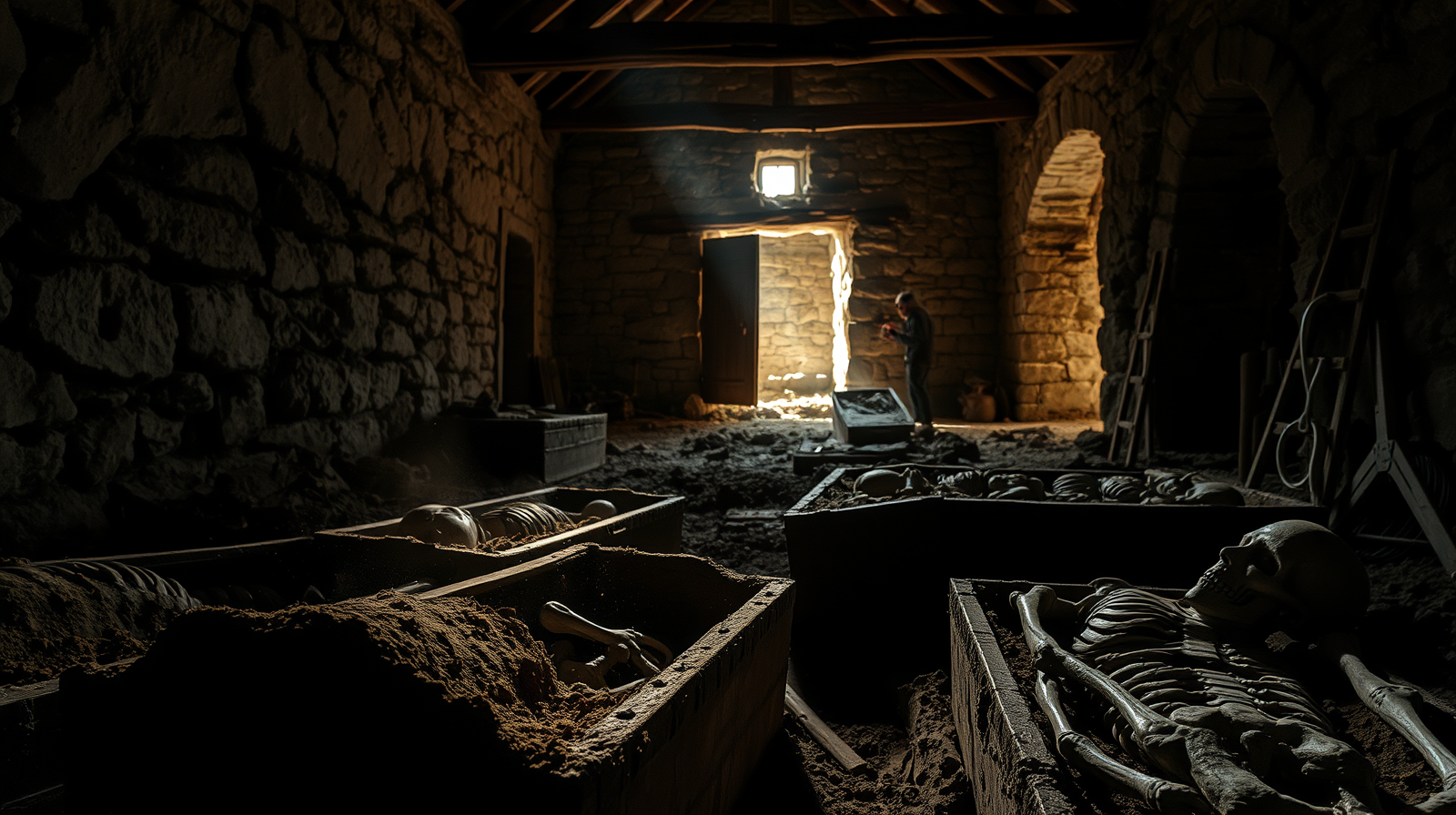
History loves a tidy narrative. We like to think we have early America completely figured out. Elite white colonists ended up in the fancy church brick chapels. Enslaved people and poor laborers were pushed to unmarked field graves. It is a clean, predictable binary.
Except history is rarely clean. Meanwhile, you can explore other developments here: Why Sheikh Hasina Is Gambling Everything To Return To Bangladesh.
A groundbreaking genetic study published in the journal Current Biology just threw a massive wrench into these assumptions. Researchers testing remains from the historic Brick Chapel cemetery in St. Mary’s City, Maryland, expected to map out the family trees of early English governors. They did that. But right alongside the colony's founding elite, they found something completely unexpected.
An eight-year-old boy of majority African ancestry was buried with the exact same high-status rituals as the wealthiest English settlers. To explore the full picture, check out the detailed article by Al Jazeera.
He didn't just happen to be in the dirt nearby. He was laid to rest inside the chapel cemetery itself. His body was wrapped carefully in a burial shroud. He was sealed inside a costly, gable-lidded wooden coffin. This wasn't a rushed, secretive burial. It was an intentional act of respect by a community that was, during the late 17th century, rapidly hardening its laws against Black people.
This single discovery completely upends what we thought we knew about early American social status. It shows that before racial chattel slavery became absolute law, the boundaries of class, race, and human connection were messy. They were deeply complicated. Honestly, they were far more fluid than most textbooks care to admit.
Decoding the DNA at Maryland's First Capital
St. Mary’s City was established in 1634. It served as the capital of the British colony of Maryland, founded largely as a haven for English Catholics escaping intense persecution back home. By 1667, these colonists built the Brick Chapel. For decades, archaeologists have known this site held the remains of Maryland’s early aristocracy.
The recent study brought together massive firepower from Harvard University, the Smithsonian Institution, and the consumer genetics company 23andMe. This wasn't your standard archaeological dig. The research team used advanced ancient DNA sequencing techniques to extract genetic material from decades of excavations at the chapel site. They cross-referenced these ancient genomes with a vast database of over nine million living people.
The results gave names to anonymous bones.
The science confirmed the identities of Philip Calvert, the fifth colonial governor of Maryland, along with his wife Anne Wolseley Calvert and their infant son. The data also managed to track down the final resting place of Thomas Greene, Maryland's second colonial governor. His burial site had been a total historical blind spot until now. Geneticists pulled this off by tracing shared segments of DNA between the historical remains and modern-day descendants who had taken commercial DNA tests. It is a stunning bit of historical detective work.
But the real shockwave came from the skeleton of the young child.
The genetic profile of the eight-year-old boy revealed he possessed majority African ancestry, mixed with roughly a quarter to a third European ancestry. The researchers didn't stop at DNA. They ran isotope analysis on his bones and teeth. Because water and food leave distinct chemical signatures in human tissue based on geography, isotopes can pinpoint exactly where someone grew up. The data proved the boy wasn't brought over on a ship from West Africa or the Caribbean. He was born right there in North America. He lived his short life in the colonies and died sometime between 1667 and 1704.
Shrouds and Gable Lids The Cryptic Privilege of a Forgotten Child
To truly understand why this kid's grave is causing such a stir, you have to look at how he was buried. In the 17th century, a funeral wasn't just a way to dispose of a body. It was a loud, public declaration of a person's worth, faith, and status.
The boy was wrapped in a traditional English shroud. He was placed inside a gable-lidded coffin. These specialized coffins required skilled carpentry and significant expense. They were reserved for people of means. Most importantly, he was buried within the consecrated ground of the Brick Chapel cemetery. This was the prime real estate of the afterlife, reserved for the colony's inner circle.
Compare this to how enslaved people were typically buried in early America. They were almost always buried in remote fields, woods, or designated slave cemeteries far away from white congregations. Their graves were rarely marked with stones. Coffins were a luxury they were almost never given.
So how did a child of African descent end up inside the elite Catholic inner circle?
We don't know his name. The written records of St. Mary's City are completely silent about him. Children in general were rarely recorded in colonial registries due to terrifyingly high infant and child mortality rates. If you were a child of color, your chances of appearing in an official colonial ledger were even lower.
The archaeological evidence strongly suggests this boy was not viewed merely as property. Someone with significant wealth and influence cared enough to give him an elite English burial. Was he the son of a wealthy white colonist and an African woman? His mixed ancestry suggests it. Did his father claim him and ensure he was raised—and buried—as a member of the family or an honored household member? It's highly probable.
The presence of this boy forces us to reckon with the reality that human relationships in the early colonial frontier frequently bypassed the strict racial codes that legal systems were trying to enforce.
The Harsh Reality of the Irish Servants
The boy's privileged burial looks even more radical when you compare it to two other graves found nearby. The same study analyzed the skeletons of two young men who died in their twenties during the earliest days of the settlement, between 1634 and 1667.
The contrast is brutal.
Their bones carried the unmistakable chemical signatures of recent immigrants from Ireland. They had spent their short lives in Maryland performing backbreaking, grueling physical labor. Their skeletons showed severe joint wear, malnutrition, and dental disease.
When they died, they didn't get shrouds. They didn't get coffins. They were buried haphazardly in shallow, unmarked graves.
These young men were almost certainly white indentured servants. During the 17th century, thousands of poor Europeans traded years of forced, unpaid labor for passage to the New World. Their daily lives were often just as miserable and violent as those of enslaved laborers.
Here we have a complete inversion of the traditional American historical arc. A young boy of African ancestry received a premier, high-status burial inside the elite chapel grounds. Meanwhile, two white European men were dumped into the earth like an afterthought.
This proves that early colonial society wasn't running on a simple black-and-white track just yet. In the mid-to-late 1600s, wealth, religion, family ties, and personal status could still outweigh skin color in specific, local instances.
The Blurred Lines of 17th Century Bondage
To make sense of these contradictions, you have to look at the exact window of time this boy lived and died. Between 1667 and 1704, Maryland was going through a dark legal transition.
In the early decades of the colony, the legal status of Africans was surprisingly ambiguous. Some arrived as enslaved life-long laborers. Others arrived under terms similar to white indentured servants. They could work off their time, gain freedom, buy land, and even sue white colonists in court. There are well-documented historical cases of free Black landowners in 17th-century Maryland and Virginia who owned servants themselves.
But as the tobacco economy boomed, planters demanded a permanent, hereditary workforce.
During the late 1600s, Maryland began passing a series of aggressive laws to systematically strip away the rights of Black people. They passed laws declaring that any child born to an enslaved woman would automatically be enslaved for life. They banned interracial marriage. They closed the legal loopholes that allowed Black colonists to claim freedom through Christian baptism.
This boy lived right as these doors were slamming shut.
His burial is a physical remnant of a brief, chaotic era before racial caste systems completely hardened. He might have been a free Black child belonging to a family of high economic standing. He might have been an indentured servant whose master held him in unusually high regard. Or he might have been the unacknowledged son of an elite family like the Calverts or the Greenes, given a quiet but deeply respectful farewell by a grieving parent who possessed the power to bend the rules.
Whatever the exact truth, his grave proves that the social boundaries of early Maryland were deeply unstable. Elite colonists were actively constructing a system of racial slavery with one hand, while occasionally burying a child of African descent with the highest honors of their society with the other.
Mapping the Future of Ancestry Tracking
This discovery isn't just a win for academic historians. It marks a massive shift in how we approach genealogy and the recovery of lost histories.
For a long time, Americans of African descent hit a brick wall when trying to trace their family trees. This is often called the 1870 barrier. Before the 1870 U.S. Census, enslaved individuals were rarely listed by name. They were merely tick marks, ages, and genders on property tax records or wills belonging to white enslavers. If the written archive deliberately erased your ancestors, traditional genealogy couldn't help you.
The methodology used in the St. Mary’s City study changes the entire equation.
By extracting high-quality ancient DNA and matching it against millions of profiles in commercial databases like 23andMe, scientists are bypassing the broken written record entirely. They are building a biological archive. This technique has already been used to connect thousands of living people to anonymous laborers buried at sites like the Catoctin Furnace ironworks in Maryland. Now, it is unlocking the secrets of the earliest colonial capitals.
If you want to understand how these discoveries change your own approach to history or genealogy, your next steps should be highly practical. Stop treating genetic testing as a mere party trick to find out what percentage of your ancestry is European or African. Look closer at the shared segment tools and historical match databases that companies are rolling out.
The data is out there. The bones of early America are finally talking, and they are telling a story that is far more radical, uncomfortable, and human than anything we imagined.


