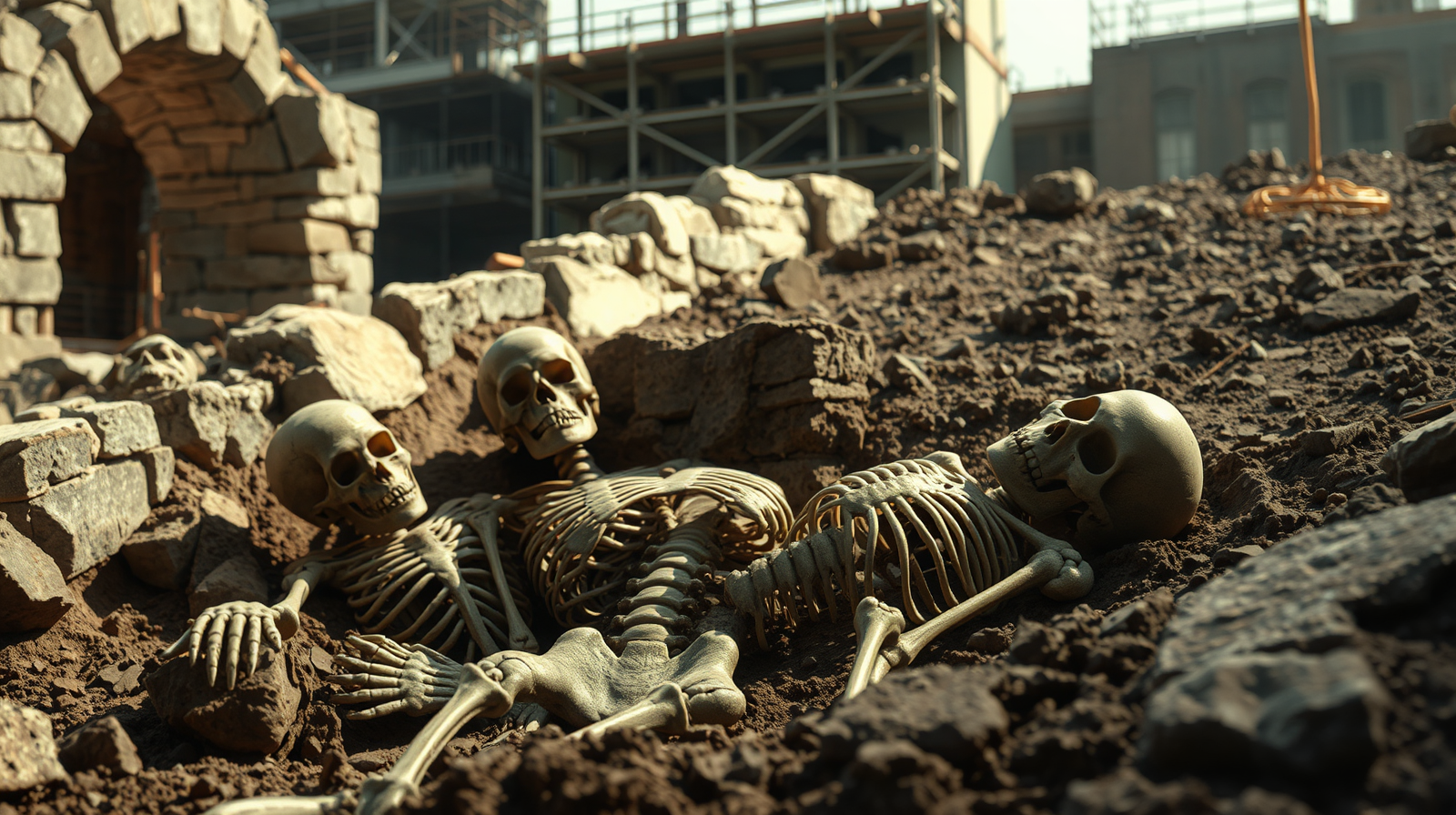
Construction crews digging at Spaanskasteelplein in Ghent, Belgium, expected to lay foundations for a modern apartment complex. Instead, their excavators struck something far darker. Deep beneath the soil, workers stumbled upon an entire medieval neighbourhood wiped off the map nearly five centuries ago, complete with stone church foundations, military quarters, and more than 200 skeletons stacked in orderly rows.
This wasn't a sudden plague pit or a battlefield grave. It was a parish cemetery tied to a forgotten residential district near St Bavo's Abbey. In 1540, Holy Roman Emperor Charles V ordered his troops to tear down every home, church, and hall in the area to build a massive fortress. For almost 500 years, the bodies of men, women, and children lay undisturbed beneath the stone walls of the Spanish Castle.
The Brutal Tax Revolt That Erased a Neighbourhood
To understand why 200 skeletons were trapped under a 16th-century military citadel, you have to look at the fierce political war between Ghent's residents and their own monarch.
Ghent was one of the richest and most stubborn cities in northern Europe during the Middle Ages. Its wealth came from a booming cloth trade, and its citizens were notoriously quick to rebel whenever royal authorities tried to squeeze them for money. In 1539, Charles V demanded heavy taxes from Ghent to fund his wars against France. The people refused to pay.
Rebellion broke out fast. Local guild members seized control of the city, ripped up treaty documents, and drove out imperial officials.
Charles V didn't take resistance lightly. Born in Ghent himself, the emperor marched into the city in 1540 with thousands of troops to restore total control. He crushed the rebellion, stripped Ghent of its historic privileges, and forced the city's leaders to march through the streets barefoot with nooses tied around their necks. That humiliation gave Ghent's residents their famous nickname: Stroppendragers, or noose-bearers.
Punishing the people wasn't enough for Charles V. He wanted absolute military control over the city to stop future uprisings. He chose a strategic neighborhood right next to St Bavo's Abbey and ordered every single structure demolished.
Thousands of civilians lost their homes overnight. Workers tore down houses, stone walls, and parish churches. Right over the destroyed neighborhood and its active parish graveyard, imperial engineers constructed a formidable military stronghold known as the Spanish Castle (Spaans Kasteel).
"The Spanish Castle served as an imposing garrison meant to keep watch over Ghent's rebellious citizens, sealing the earlier medieval settlement beneath its heavy walls for hundreds of years."
What Excavations at Spaanskasteelplein Actually Uncovered
When archaeologists joined the construction site at Spaanskasteelplein, they realized the Spanish Castle acted as a massive protective vault. Because the fortress stood on the site until its eventual demolition in the nineteenth century, modern urban development never disrupted the older layers beneath it.
The dig revealed a clear timeline of human history stacked in distinct layers.
+-----------------------------------------------------------------------+
|  Modern City Surface (Apartment Construction Site)                    |
+-----------------------------------------------------------------------+
|  19th-Century Demolition Layer (Sint-Macharius District)              |
+-----------------------------------------------------------------------+
|  16th-Century Military Fortress (Spanish Castle Garrison & Quarters)  |
+-----------------------------------------------------------------------+
|  13th-16th Century Medieval Parish (200+ Skeletons, Church, Cemetery) |
+-----------------------------------------------------------------------+
|  7th-11th Century Early Abbey Settlement (St Bavo's Abbey Foundations) |
+-----------------------------------------------------------------------+
|  Ancient Roman & Prehistoric Dirt (Ceramics, Flint Tools)             |
+-----------------------------------------------------------------------+
The Skeleton Field and Church Foundations
The discovery of more than 200 human skeletons threw light on the civilian life of medieval Ghent. Archaeologists didn't find mass graves filled with combat casualties. They found neat, parallel rows of graves containing adult men, adult women, and young children.
This arrangement is a classic sign of a civilian parish cemetery. Radiocarbon dating places these burials between the thirteenth and sixteenth centuries. The people buried here were regular inhabitants of the neighborhood surrounding St Bavo's Abbey. They worshipped in the stone church whose foundations were uncovered right next to the burial plots.
Bioarchaeologists are currently studying the teeth and bones recovered from the site. Early assessments show markers of physical labor, diet patterns, and common diseases of the era. The bones tell stories of hard manual work, seasonal hunger, and infectious illness in urban Flanders before the 1540 destruction.
A Waste Pit Packed with 16th-Century Garbage
Above the civilian cemetery lies the military layer built by Charles V's army. Lead archaeologist Robby Vervoort and his team uncovered stone walls belonging to the barracks where Spanish soldiers lived during the sixteenth century.
The biggest prize of the entire excavation wasn't gold or weapons. It was a deep, stone-lined cesspit used by the garrison.
For archaeologists, ancient toilets and waste pits are biological vaults. The cesspit contained discarded food scraps, broken dinnerware, and personal items dropped by soldiers stationed at the fortress.
Artifacts recovered from the waste pit include:
- Fine glass bowls and imported glassware
- Dark green glass wine bottle fragments
- Animal bones showing butchery marks from beef, pork, and poultry
- Seeds, fruit pits, and preserved plant pollen
Because the soil at Spaanskasteelplein remains saturated with groundwater, oxygen couldn't penetrate the pit. That lack of oxygen stopped decay-causing bacteria in their tracks. Organic materials like wood, seeds, and leather survived nearly 500 years in exceptional condition.
Archaeologists even found the remains of a wooden bridge that once crossed the castle's inner moat. The timber looks remarkably fresh because the wet earth locked out oxygen for centuries.
Deep History Beneath the Spanish Castle
The medieval neighborhood and the Spanish Castle aren't the only civilizations that left footprints at this site. Beneath the thirteenth-century graveyard, dig crews reached layers that go back much further.
The origin of this district traces back to the seventh century, when Saint Amand arrived in the area to convert local tribes and established what became St Bavo's Abbey. By the eleventh century, the abbey was a powerful religious center with a towering Romanesque church. Part of what historians consider Ghent's oldest standing stone wall still rests on the abbey grounds nearby.
Digging even deeper under the medieval abbey foundations, archaeologists recovered Roman ceramics, domestic pottery, metal trinkets, and prehistoric flint tools. Humans have lived, traded, worked, and died on this exact patch of land next to the Lys and Scheldt rivers for thousands of years.
Why This Ghent Discovery Changes Local History
You might wonder why finding another batch of skeletons in Europe matters so much. Historical sites get dug up across the continent every week, but the Spaanskasteelplein project is different for three key reasons.
1. It Proves Total Demolition Didn't Destroy History
When Charles V leveled the neighborhood in 1540, contemporary records claimed the district was completely wiped out and forgotten. Historians assumed that constructing a massive fortress with moats, bastions, and thick stone walls destroyed whatever came before it.
This excavation proves the opposite happened. The engineers used the crushed stone of the old buildings as backfill, effectively sealing the lower levels under meters of dirt and masonry. The fortress didn't erase history—it preserved it in a deep freeze.
2. It Provides a Direct Window Into Garrison Life
Written records tell us plenty about kings, generals, and major battles, but they rarely tell us what an ordinary line soldier ate on a rainy Tuesday in 1560.
By analyzing seeds, pollen, and animal remains from the Spanish Castle cesspit, researchers can reconstruct the exact diet and living conditions of foreign occupying forces in Flanders. They can see what crops were imported, how meat was distributed, and how soldiers lived inside an unpopular military outpost.
3. It Restores Identity to Ghent's Lost Citizens
The 200 skeletons buried beside the parish church represent the lost generations of Ghent. These weren't famous historical figures; they were weavers, bakers, blacksmiths, and their families.
By recovering their remains before residential construction proceeds, bioarchaeologists can analyze their DNA, reconstruct their physical health, and give proper attention to people whose quiet lives were disrupted by an emperor's decree five centuries ago.
What Happens Next at the Site
Excavation work at Spaanskasteelplein wrapped up in early March 2026 after months of intensive field work by archaeological teams.
With the historical artifacts cataloged and the human remains carefully removed for laboratory study, the land is officially cleared for its next chapter. Developers are moving forward with plans to build modern apartment buildings on the property, continuing the cycle of urban development that started centuries ago.
All recovered items—from the delicate glass bowls and wine bottles to the Roman pottery and flint tools—are undergoing conservation work. The human remains will be cataloged in scientific databases, allowing researchers across Europe to run isotope analyses and genetic sequencing.
If you plan to visit Ghent, you can explore the preserved ruins of St Bavo's Abbey nearby to see where this lost neighborhood once stood. The physical skeletons may be gone from the dirt, but the story of the city's rebellion and survival remains carved into the land itself.
To learn more about urban archaeology in Belgium, check the official updates from VRT NWS and the historical archives maintained by Visit Gent. If you're interested in medieval history, research the 1539 Ghent Revolt to understand how economic resistance reshaped northern European cities.