Fieldwork rarely goes according to plan. You pack your gear, map your coordinates, and expect mud, rocks, and maybe some routine soil samples. You certainly don't expect to stumble across prehistoric megafauna while checking on frog habitats.
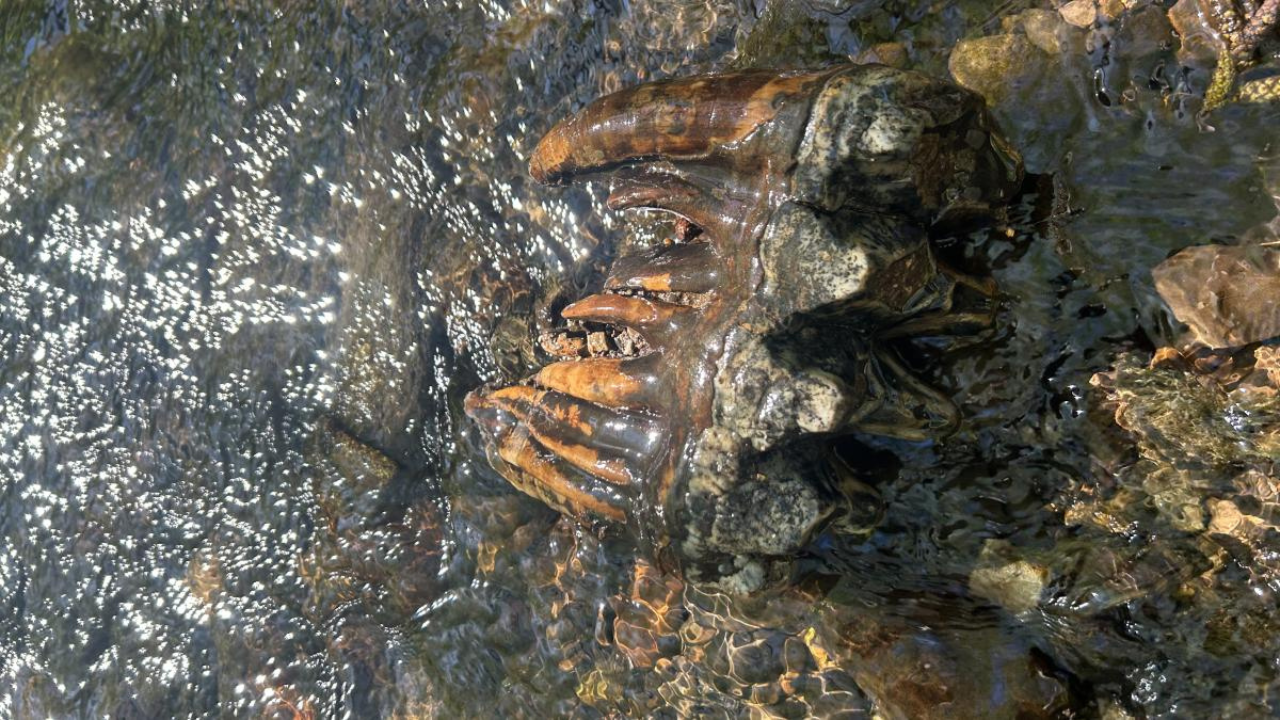
That is exactly what happened during a routine environmental survey in a San Mateo County open space preserve in California. Brigid Lynch, a geomorphologist working with Balance Hydrologics, was wading through a creek bed for a habitat restoration project aimed at helping threatened California red-legged frogs. Half-submerged in the water and muck sat an odd, ribbed object. It did not look like a normal river rock. It looked biological, old, and completely out of place.
Instead of packing it away or ignoring it as a weirdly shaped chunk of petrified wood, she took a photo. Then she opened her phone.
Google's reverse image search suggested something wild. It pointed straight to an Ice Age mastodon molar. A subsequent confirmation by paleontologist Wayne Thompson of Pacific Paleontology proved the algorithm right. It was an upper left molar belonging to a Pacific mastodon (Mammut pacificus), measuring roughly 8.5 inches long, 7 inches deep, and 3 inches wide.
Why This Specific Fossil Matters
Most amateur fossil hunters find broken shards, cracked enamel, or eroded fragments that require immense guesswork to identify. This find was different. The tooth retained both its pristine crown and its roots.
Wayne Thompson called it the most complete mastodon molar from the local area and the most spectacular he has ever laid eyes on. Complete teeth allow researchers to piece together diet, age, and environmental stress with high accuracy.
The Pacific mastodon wasn't just any large prehistoric beast. Formally recognized as a distinct species separate from the classic American mastodon in 2019 following extensive bone analysis in Southern California, these large herbivores roamed western North America during the Pleistocene epoch. They preferred browsing on leaves, twigs, and forest vegetation, steering clear of the open grasslands grazed by their woolly mammoth cousins.
Dating a Prehistoric Relic
How old is it, really? Experts estimate the specimen is at least 10,000 years old, marking the tail end of the Pleistocene before the epoch wrapped up roughly 11,700 years ago. However, exact dating has not been locked in yet.
Some estimates put the tooth anywhere between 50,000 and 100,000 years old. To settle the debate, researchers at Stanford University's Doerr School of Sustainability stepped in. They plan to run advanced analyses on the fossil to determine its precise age, decode the animal's diet, and reconstruct the ancient climate of the Bay Area.
Stanford isn't keeping the original specimen hidden away forever, either. The Midpeninsula Regional Open Space District, which manages the preserve, donated the fossil to the university for research. In return, Stanford is generating a high-precision 3D scan of the molar. This digital asset lets educators and conservationists study every ridge and root without risking damage to the fragile original artifact.
Why the Exact Location Is Staying Secret
If you are hoping to grab a shovel and retrace the geologist's steps this weekend, don't bother. The exact discovery site is being kept strictly confidential.
Land managers know what happens when fossil locations leak. Looters and unauthorized collectors move in quickly, destroying fragile stratigraphy and disturbing potential remains. Paleontologists suspect this isolated tooth recently broke free from an intact skull still buried somewhere upstream or buried deep within the creek bank. Leaving the site undisturbed protects whatever else might be hiding down in the sediment.
The Irony of Modern Conservation
There is a poetic irony in how this discovery unfolded. Lynch was knee-deep in water trying to protect a modern, highly vulnerable species—the California red-legged frog—facing habitat loss and climate pressure today. In doing so, she tripped over physical proof of an animal that completely vanished from the exact same landscape millennia ago.
Ecosystems change constantly. Species come and go. Yet a simple creek survey reminds us that entire lost worlds lie just beneath our boots, waiting for an observant eye and a lucky digital search query to bring them back to light.
Check your local riverbanks after heavy rains. You never know what's eroding out of the mud.