Imagine painting a picture of two men wrapped in a loving embrace at a time when doing so could land you in a high-security prison. That's exactly what David Hockney did in 1961. He was just a second-year student at the Royal College of Art in London. The UK wouldn't even begin decriminalizing homosexuality for another six years. Yet, Hockney chose to paint his reality, completely out and entirely unapologetic.
With his passing in June 2026 at the age of 88, looking back at his early career hits differently. His art wasn't just visually stunning. It was a radical act of political defiance disguised as domestic bliss. While the rest of the art world was drowning in abstract expressionism, Hockney painted domestic spaces, male desire, and a sunny, peaceful paradise that didn't exist yet in the real world.
Code Words and Hidden Poetry on Canvas
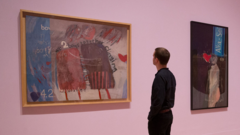
People who look at Hockney's 1961 painting, We Two Boys Together Clinging, often miss the sheer bravery stitched into the canvas. He took the title directly from a Walt Whitman poem. He couldn't just paint a straightforward realistic couple without risking severe backlash, so he used a brilliant mix of graffiti, abstract shapes, and hidden codes.
If you look closely at his work from this era, you'll see numbers hidden in the paint. He used a simple cipher where 1 stood for A, 2 for B, and so on. The numbers "4.2." frequently popped up on his canvases—a shorthand nod to DB, initials for his major crush and pop icon Cliff Richard (born Harry Webb, but known publicly as David Byron in some circles, though Hockney specifically used the code for his own personal infatuations and names like Walt Whitman). It was a secret language for a community forced to live in the shadows.
But Hockney didn't paint tragedy. He refused to buy into the mainstream narrative that gay life had to be miserable or doomed. Instead, his figures look joyful. They are holding onto each other tightly, claiming their space in a world that wanted to erase them entirely.
Trading Grey London for the Bright Pools of Los Angeles
By 1964, Hockney had enough of the cold, grey constraints of England. He flew to Los Angeles, a city he had only ever seen in magazines and films. What he found there changed the trajectory of modern art forever.
In California, the light was blindingly bright, the houses were modern, and almost everyone seemed to have a swimming pool. To Hockney, this wasn't just a luxury destination. It was the physical manifestation of the gay utopia he had been dreaming about on canvas.
"The water in a pool changes color depending on the sky, but it also reflects the light from the bottom. It's a marvelous graphic problem." — David Hockney
📖 Related: twilight breaking dawn part
Paintings like A Bigger Splash (1967) or his famous double portraits weren't just about architecture. They captured a relaxed, sun-drenched lifestyle where gay men could exist in broad daylight. The shadows of criminalization felt thousands of miles away. He traded the heavy oils of his London student days for quick-drying acrylics, capturing the flat, vibrant look of the West Coast sun. He made queer life look beautiful, enviable, and completely normal.
The Secret Behind the Masterpieces
What made Hockney truly exceptional was his refusal to be a martyr. Many artists of his generation who identified as queer hid their personal lives entirely or focused their art on the pain of oppression. Hockney took a completely different stance. He normalized his relationships by treating his boyfriends, friends, and lovers as classic artistic subjects.
When he painted his friends Christopher Isherwood and Don Bachardy, or his lover Peter Schlesinger, he used the same formal grandeur that historical painters used for royalty. He didn't ask for permission, and he didn't apologize. By presenting gay intimacy as quiet, gentle, and deeply ordinary, he forced the conservative art establishment to accept it on his own terms.
What to Do Next
If you want to understand how Hockney's early defiance laid the groundwork for his legendary seven-decade career, don't just look at his famous pool paintings. Start tracing the evolution of his rebellion from the very beginning.
- Study the early texts: Read Walt Whitman's Calamus poems to see the exact lines that inspired Hockney to create We Two Boys Together Clinging.
- Look for the ciphers: Next time you view his 1960–1963 works online or in a gallery, zoom in on the margins. Search for the hidden number codes he used to flag his desires.
- Compare the light: Look at a digital gallery of his London works side-by-side with his early California paintings. Notice how the colors shift from muddy and guarded to bright, flat, and completely exposed.