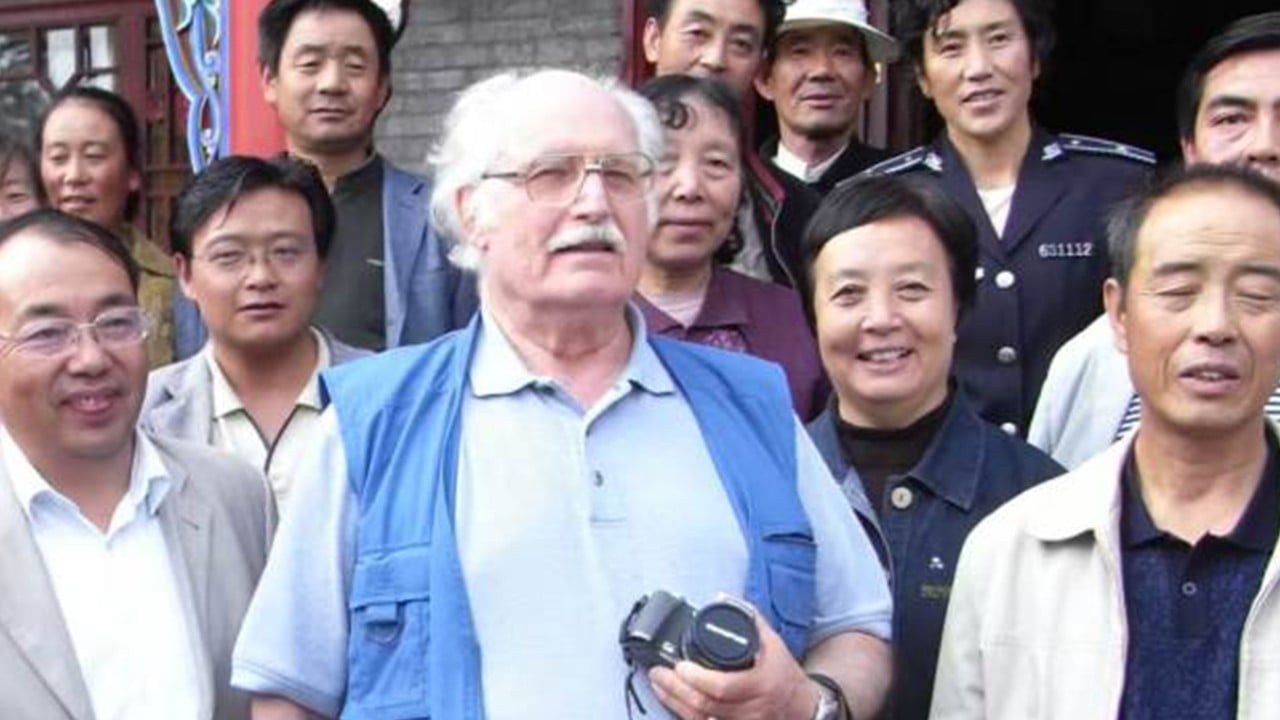
Bowing to a CT scanner sounds strange until you hear why he did it. In July 2000, at a hospital in Huangyuan County on the Qinghai-Tibet Plateau, 68-year-old American David Plymire bent down in front of a newly arrived Japanese machine and pleaded with it to serve his hometown well.
Plymire, now 95 and living in Missouri under his Chinese name Bai Dawei, has spent more than two decades helping bring over 30 pieces of medical equipment—valued at more than six million yuan, or roughly US$900,000—to a high-altitude county sitting around 2,700 meters above sea level. Born in 1931 and brought from New York to Huangyuan in 1932 when his parents worked in trade and practiced medicine there, he lived in the county until 1949. Decades later, after returning to China in 1987 and visiting more than 20 times since the late 1980s, he built a bond that outlasted geopolitics, borders, and time. In related news, we also covered: Why Hacked Russian Data Pointing To 500,000 War Dead Is Only The Floor.
Most people read a story like this and see a simple feel-good headline. Honestly, there's way more going on underneath.
Why His Story Resonates Beyond a Feel-Good Headline
People search for stories like Plymire's because they want to know how one person's quiet persistence can outlast headlines about international friction. When China's foreign ministry spokeswoman Mao Ning pointed to Plymire in October as an example of people-to-people communication, she was highlighting a personal link that didn't start in a diplomatic briefing room. It started in childhood memories of skating, swimming, and playing on Daebo Mountain alongside Tibetan, Hui, and Han neighbors. NBC News has analyzed this important topic in extensive detail.
Plymire didn't inherit a fortune to pull this off. According to retired Huangyuan County People's Hospital president Wang Shikang, who met Plymire in 1988 and stayed close friends over decades of letters and visits, Plymire lived frugally, often staying in hospital wards instead of hotels to stretch funds and wearing a blue vest so often that washing faded it toward white. He bought the first two B-mode ultrasound scanners out of pocket in Hong Kong in 1988 and 1989, then rallied overseas relatives, friends, and charitable funds to finance bigger gear—including that CT scanner he pushed for starting in 1997, which took three years of import and transport hurdles before arriving in 2000.
He also talks about his motivation in terms that surprise some Western readers. Plymire has described his giving through the lens of filial piety, saying a child who leaves home brings something back for family and that he had developed a Chinese mindset toward his hometown. In 1998 he became an Honorary Citizen of Huangyuan County, and five years later he received the title of Qinghai Province Honorary Citizen. Even after his sister Mary Ann passed away in 2016 and her ashes were returned to the county, and even as bladder cancer and failing eyesight have kept him in Missouri from flying back, he kept up video calls with old friends in September and early November, speaking the Huangyuan dialect and asking about suan jiu jiu, the local name for seabuckthorn.
The Hard Truth About Donating Medical Gear to Remote Clinics
Here's where I put on my practical hat: heartfelt intentions don't keep a diagnostic machine running on a high plateau. Getting equipment across borders is only half the battle. Keeping it calibrated, powered, and repaired years later is where well-meaning donations often stall.
Global health researchers have documented this problem for years. A review published in Globalization and Health noted that an estimated 40% of healthcare equipment in low- and middle-income settings sits out of service, compared with less than 1% in high-income settings, and a National Academy of Medicine perspective similarly highlighted how high proportions of donated biomedical devices end up broken, unused, or mismatched to local conditions. As World Health Organization medical device donation principles emphasize, effective donations require matching real recipient needs, avoiding quality double standards, planning logistics and customs carefully, and supporting installation, training, and spare parts over time.
When people skip those steps, three mistakes happen over and over:
- Treating old or complex gear as a free win: High-tech machines like CT scanners demand stable electricity, climate control, specialized technicians, and replacement parts. Without those pieces, even an expensive scanner can become a heavy paperweight.
- Ignoring local readiness: A clinic doesn't just need hardware in a crate. Staff need training on operation and maintenance, and leaders need clarity on who pays for consumables and repairs in year three or year five.
- Confusing one-off charity with partnership: A single shipment feels dramatic on day one, yet real healthcare improvement depends on steady communication, honest feedback about what works, and long-term follow-through.
That three-year gap between Plymire's 1997 CT scanner push and its July 2000 arrival wasn't a minor detail—it's a classic example of how slow and intricate cross-border medical logistics can be, especially when moving specialized equipment into a remote mountain county.
Common Misconceptions About Cross-Border Medical Philanthropy
A lot of myths float around charitable equipment drives. Let's clear a few up before anyone plans a fundraiser or ships a pallet.
First, people assume you need to be rich to make a dent. You don't. Plymire isn't wealthy; he started with two ultrasound units he funded personally in Hong Kong and then built trust with overseas donors and charities by showing personal commitment and frugal discipline.
Second, people often assume "any medical device is better than none." Not true. In fact, equipment that arrives without manuals in the right language, without training, or without a way to fix a blown part can create extra headaches for busy hospital staff.
Third, there's a tendency to view cross-border aid purely through political talking points. Real life is messier and more human. A man born in New York, raised in Qinghai, living in Missouri, practicing dialect words in front of a mirror so he wouldn't forget them, and keeping a room of Huangyuan mementos—including soil from Daebo Mountain, an empty vinegar bottle, and a bilingual hospital banner—doesn't fit neatly into a slogan. His story is personal, layered, and shaped by decades of ordinary friendships.
Practical Next Steps If You Want to Support Rural or Cross-Border Healthcare
If Plymire's story makes you want to do something concrete rather than just admire it, don't start by buying random gear online. Start with homework.
- Ask the receiving clinic what's actually missing: Reach out to established hospitals, health boards, or vetted nonprofits first. Find out whether their biggest bottleneck is ultrasound probes, patient monitors, basic surgical tools, staff training, or maintenance budgets.
- Check lifecycle costs before committing: Factor in shipping, customs rules, voltage and altitude or climate conditions, installation, operator training, and spare parts. If there's no clear plan to keep a machine running, fund something with lower failure risk or support local training instead.
- Partner with proven operators: Unless you have deep regulatory, logistics, and biomedical expertise, work through organizations that already handle compliance, quality checks, and long-term follow-up rather than going solo.
- Stay involved past the ribbon-cutting: Real impact shows up months and years later. Build in check-ins to learn what broke, what helped patients most, and where your time or money can do the next round of good.