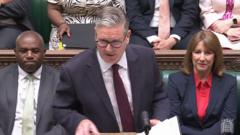
Westminster is playing a dangerous game with national security, and the latest clash at Prime Minister’s Questions proves it. On the surface, the government wants you to believe everything is under control. They just dropped a massive £298 billion strategy over four years, complete with a headline-grabbing £15 billion cash injection for things like high-tech drones and nuclear missiles. But look under the hood for more than five seconds, and the whole thing starts to come apart at the seams.
Kemi Badenoch didn’t pull her punches when she stood up at the dispatch box. The Conservative leader looked straight at Keir Starmer and declared his shiny new defence plan is already £5 billion short. Well, technically £4.7 billion if you want to get precise with the Treasury spreadsheets, but the point stands. The government has announced a massive spending strategy without actually securing all the cash to pay for it.
This isn't just standard political theatre or opposition point-scoring. It matters because Britain is trying to navigate an increasingly dangerous world, with a hot war in the Middle East and a relentless conflict in Ukraine, while running its military on empty promises.
The Reality Behind the Five Billion Pound Hole
If you buy a house, you don't sign the contract and tell the bank you'll figure out how to pay for the roof later. Yet that’s exactly what’s happening with the Defence Investment Plan. The government committed to spending billions more on frontline military hardware but left a massive multi-billion-pound gap over the next four years.
Starmer’s defence of this gap is fascinating, if completely reckless. He basically told the House of Commons that his successor can just borrow the money. He pointed to the £22 billion of fiscal headroom left over from the last budget, arguing that this space is exactly what fiscal buffers are for.
That logic is incredibly flimsy. Economists are already pointing out that the ongoing war in Iran has severely squeezed the UK's financial wiggle room. You can't keep spending the same pound three times over. Ruth Curtice from the Resolution Foundation noted that this strategy will instantly erode a massive chunk of whatever borrowing space the next prime minister inherits. It's a classic case of kicking the financial can down the road, leaving someone else to deal with the economic fallout.
Why the Transition of Power Makes This a Financial Trap
What makes this situation uniquely messy is the current political transition. Starmer is winding down his time in office, and Andy Burnham is widely expected to step into Number 10. Burnham’s team was briefed on the massive defence blueprint, but guess what they weren't told about? The £4.7 billion black hole.
An insider from Burnham’s camp reportedly compared the unfinanced plan to an unexploded bomb left on the doorstep of the next administration. Burnham has already stated he won't try to rip up and renegotiate the baseline figures because the military needs stability. But that leaves his future Chancellor with a brutal headache on day one. They have to find nearly £5 billion in a budget that is already stretched to its absolute absolute breaking point.
The Secret Cuts Painfully Funding the Frontline
The money has to come from somewhere. Since the government didn't magically discover a new goldmine, officials are quietly working behind the scenes to slash capital budgets in other departments to cover the immediate shortfalls.
The Department for Energy Security and Net Zero is about to take a massive hit. Sources indicate that up to £2 billion could be chopped directly from the national home insulation scheme. That is a brutal trade-off. To pay for advanced drone fleets and missiles, the government is actively defunding a programme meant to lower energy bills for struggling families and reduce carbon emissions. It shows how desperate the scramble for cash has become.
Keeping Troops in Substandard Housing to Pay for Missiles
The trade-offs get even nastier when you look at how the military itself is being forced to balance its books. The Royal British Legion has raised immediate alarms over a decision to push back critical funding meant to repair dilapidated military housing.
We aren't talking about luxury upgrades here. British personnel have been living in accommodation plagued by black mould, broken heating systems, and leaky roofs for years. Pushing back these repairs to fund headline-grabbing procurement projects sends a terrible message to the people actually serving in uniform. It tells them that high-tech kit matters more than their basic living conditions.
The Bigger Geopolitical Picture and the Missing Strategy
Let's look at the broader numbers. This plan nudges British defence spending from 2.6% of GDP up to 2.7% by 2030. Starmer claims this puts the country on a clear path toward hitting 3% in the next parliament.
But let’s be totally honest about the international reality. Last year, under immense pressure from Washington, Donald Trump made it crystal clear that NATO allies need to step up. The target being pushed across the alliance is 3.5% by 2035. The Institute for Fiscal Studies has already crunched the numbers on this new plan, and their verdict is clear. This strategy doesn’t provide a viable, funded path to hitting that 3.5% benchmark. It’s an intermediate fix that fails to address long-term systemic shortfalls.
The Debate Over Welfare versus Defence Spending
Badenoch used her time at the dispatch box to argue that the state needs to change its priorities entirely. Her stance is clear: if Britain wants a serious military capable of deterring modern threats, it has to fund it by shrinking the welfare state. She explicitly called for welfare cuts to bridge the gap.
Naturally, that drew a furious counter-attack from Starmer, who pointed out that the Conservatives oversaw a massive expansion of the welfare bill during their years in power while letting military readiness slide. It is a fundamental philosophical divide. One side wants to squeeze social spending to pay for hard power, while the other tries to fund defense through creative accounting and borrowing, hoping the economy grows fast enough to cover the difference.
Next Steps for Fixing the Security Balance
The political finger-pointing won't fix the reality that the UK military is under-resourced for the current global environment. If the next administration wants to avoid a total collapse of this strategy, they need to take specific, immediate actions.
- Audit the Procurement Process: The Ministry of Defence is notorious for blowing budgets on delayed equipment projects. Every contract in the new plan needs a ruthless efficiency audit to stop cash leaking into corporate delays.
- Establish a Ring-Fenced Personnel Fund: Living conditions for troops shouldn't be treated as a flexible piggy bank to fund tech projects. Accommodation budgets must be legally protected from internal raiding.
- Be Honest with the Public About the Cost: Politicians need to stop pretending we can have superpower-level security on a bargain-bin budget. If the country needs a 3.5% GDP defence allocation, the government must clearly explain what taxes or public services will change to pay for it.
The current strategy relies entirely on economic luck and political buck-passing. Leaving a multi-billion-pound hole for the next prime minister to figure out isn't a strategy. It's an abdication of responsibility at a time when the world is watching closely.