Most billion-dollar tech origin stories are romanticized tech-garage myths. Nvidia's birth happened over greasy eggs, lukewarm coffee, and a soundtrack of police officers writing incident reports.
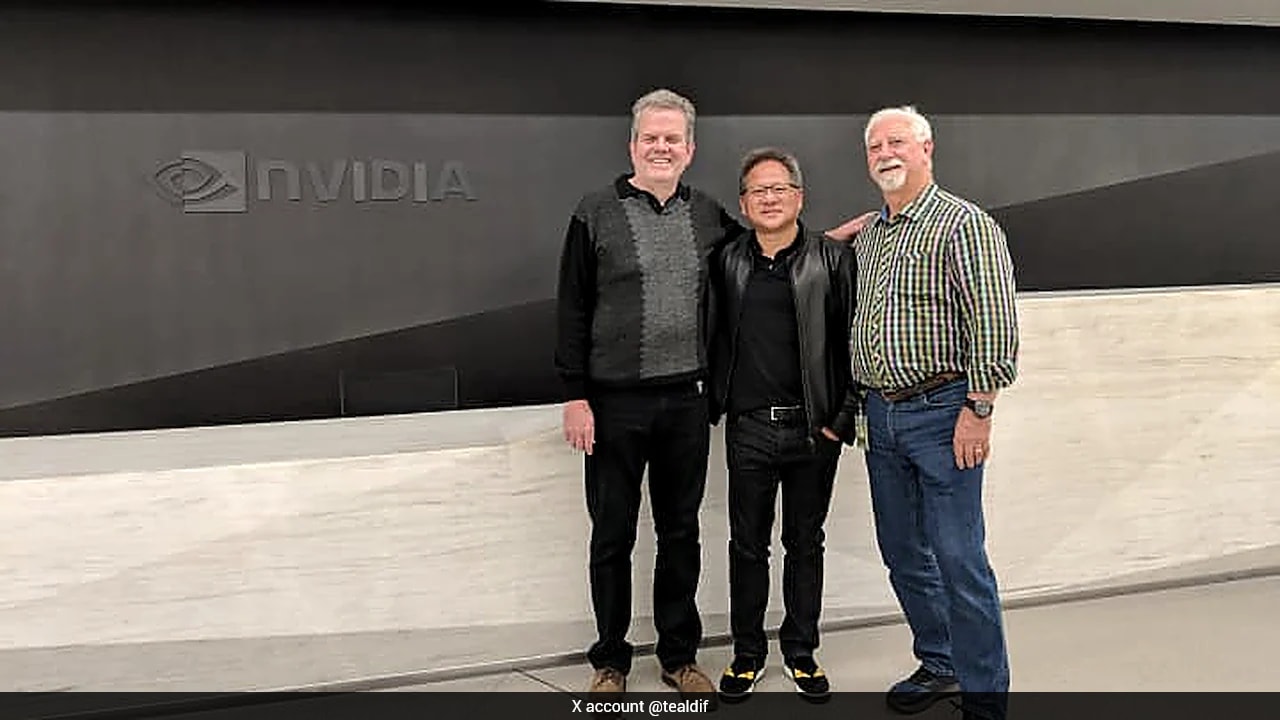
Back in 1993, three engineers didn't have fancy venture-backed incubators or pristine Silicon Valley office space. They had a vinyl booth at a Denny's. Jensen Huang, Chris Malachowsky, and Curtis Priem spent hours camping out at that table, plugging in early laptops and sketching out architectures for chips that nobody else believed were possible.
They weren't ideal diners. They ordered a few cups of coffee, stayed for four hours straight, and basically turned a family restaurant into their makeshift war room. Eventually, the staff moved them to the back room because they occupied space for too long. That back room came with a unique atmosphere. San Jose police officers sat nearby working on paperwork while the future of computing was being drawn on napkins.
The $50 Million Rule That Almost Didn't Happen
Jensen Huang didn't jump into this blind. He had a strict requirement before he would agree to co-found the company and take the helm. He told Malachowsky and Priem that he wouldn't join unless the venture had a realistic shot at hitting fifty million dollars in revenue within a year.
At the time, that ambition sounded completely absurd. The trio were engineers from Sun Microsystems and LSI Logic who understood silicon design, but building a hardware startup from scratch was a monumental financial gamble. Even Huang's own mother gave him the classic parental advice most entrepreneurs dread hearing. When he told her what he was planning, she flatly asked why he wouldn't just go get a normal job.
They pushed forward anyway. They wanted to fix 3D computer graphics, which were painfully slow and blocky in the early nineties. They realized that standard computer processors weren't built to handle the heavy mathematical calculations required for realistic three-dimensional rendering.
Naming a Trillion-Dollar Brand
Before they had a product, they needed a moniker. Curtis Priem liked using the letters NV because they kept showing up as shorthand for graphics files in engineering specs. He also liked the phonetic ring of the word envy.
Their first working idea was Nvision. Priem even recorded an answering machine greeting introducing Nvision's corporate headquarters to anyone who called. That name hit a brick wall when they realized multiple existing businesses already owned similar trademarks.
Priem did what any exhausted engineer would do. He grabbed a Latin dictionary. He flipped through the pages until he landed on invidia, the Latin word for envy. They dropped the leading letter, slapped an 'ia' on the end, and Nvidia was born.
Moving Past the Bullet Holes
The Denny's era didn't last forever, and part of that was due to safety. One evening, the co-founders noticed fresh bullet holes shattered across the front window of the restaurant. They looked at each other, packed up their laptops, and decided it was probably time to find a quieter workspace.
They relocated their strategy sessions to Priem's townhouse. That simple living room became the operational ground zero where they engineered the architecture that would eventually spawn a hardware revolution.
What makes their story fascinating isn't just the humble beginnings. It's the sheer scale of the blind luck combined with stubborn vision. In 1993, they were targeting video game developers who wanted smoother textures and faster polygon rendering. They had zero inkling that decades later, those exact same graphics processing units would become the foundational fuel for the global artificial intelligence boom.
They didn't set out to build an AI monopoly. They just wanted to make video games look incredible. The fact that those early diner meetings accidentally engineered the infrastructure for modern machine learning proves that timing and relentless execution matter infinitely more than a fancy office address.