Folarin Balogun found out his World Cup career was back from the dead while sitting on a team bus. The United States squad was heading to a practice field when the news broke. Players started screaming and shouting. The energy inside that vehicle went through the roof. Just days earlier, the young striker faced a mandatory ban after picking up a straight red card against Bosnia and Herzegovina. He thought his tournament was over. Then, the President of the United States picked up the phone.
What followed was one of the most bizarre and rule-bending episodes in international sports history. Donald Trump called FIFA President Gianni Infantino directly. He did it multiple times. He wanted the red card reviewed because he thought the decision was unfair. FIFA listened. They suspended the ban.
This move shook the foundation of soccer governance. It showed that when the stakes are high enough, political power can bend the rules of the world game.
The Incident That Sparked a White House Intervention
The trouble started in Santa Clara during a Round of 32 clash. The US men's national team was cruising to a 2-0 victory. Balogun had already scored the opening goal, continuing a brilliant tournament run that drew comparisons to historic American performances. Then came the 61st minute.
Balogun challenged Bosnian defender Tarik Muharemović for a loose ball. He miscalculated. His studs came down directly on Muharemović's ankle. On the field, referee Raphael Claus did not even blow for a foul. The game kept moving. But in the replay booth, VAR official Juan Soto saw something different. He flagged the play and sent Claus to the monitor. After watching the slow-motion replay, Claus walked back onto the pitch and held up a red card for serious foul play.
Balogun became part of a rare club, joining stars like Zinedine Zidane who have scored and been sent off in the same World Cup match. The immediate consequence was clear. Under standard FIFA rules, a straight red card means an automatic one-match suspension. He would miss the critical Round of 16 knockout match against Belgium in Seattle.
That is when the political machinery of the host nation swung into action.
Behind the Scenes of the Trump Phone Calls
Donald Trump admitted later that he did not really understand how soccer discipline worked before this week. He did not know what a red card meant or what kind of penalty it carried. Once his team explained that the United States would lose its top goalscorer for a massive knockout match, he decided to take action.
Insiders revealed that Trump made three separate phone calls to Infantino starting on Wednesday night. He was not the only one pushing the issue. Andrew Giuliani, who heads the White House World Cup task force, made his own calls. Commerce Secretary Howard Lutnick also contacted FIFA officials. It was a full-court press from the highest levels of the American government.
Trump publically insisted that he did not pressure the soccer chief. He claimed he just asked for a second look because he felt the call was horrible. He argued that losing a star player over a challenge like that would leave a major stain on the entire tournament.
FIFA fast-tracked a solution. The governing body used Article 27 of its own Disciplinary Code to find a loophole. They did not officially overturn the red card. Instead, they chose to suspend the implementation of the one-match ban for a probationary period of one year. They also hit the US Soccer Federation with a forty-thousand-dollar fine. Balogun was legally cleared to play against Belgium.
International Outrage and Broken Rules
The decision went down like a lead balloon across the Atlantic. European soccer officials were absolutely furious. UEFA issued an angry statement accusing FIFA of crossing a red line. They labeled the decision unprecedented, incomprehensible, and completely unjustifiable. They argued it ruined the integrity of the tournament.
The Royal Belgian Football Association was stunned. They tried to launch an immediate appeal to block Balogun from taking the field. FIFA quickly shut them down, ruling that Belgium had no legal standing in the case because they were not a direct party to the initial disciplinary proceedings. Former England and Manchester United star Wayne Rooney spoke for many traditionalists when he called the situation an absolute disgrace, stating that Infantino should be deeply ashamed.
The International Olympic Committee even received a formal ethics complaint from human rights group FairSquare. They argued that Infantino violated rules regarding political neutrality by taking instructions from a head of state. Sources indicate that the IOC will likely avoid any real investigation because they do not want to start a war with FIFA right before the Los Angeles Olympics. Still, the damage to the sport's credibility was done.
The Dress Room Reality and the Tragic Defeat
While executives argued in boardrooms, the actual players had to deal with the fallout. Balogun later admitted that the entire situation created an incredibly strange atmosphere inside the American camp.
The team spent days practicing tactics without him, assuming he was banned. He had accepted a supporting role to keep team morale high. When the sudden reversal came on the bus, it brought excitement, but it also brought an intense wave of outside noise. Balogun noted that he could see nerves creeping into his teammates because the situation was so bizarre. It was almost impossible to block out the distraction.
The extra help on paper did not translate to success on the grass. The United States met Belgium in Seattle and got completely dismantled in a 4-1 loss. Balogun played, but he could not stop the European side from dominating the match. The American World Cup dream ended right there on the pitch.
Stage Separation and No Regrets
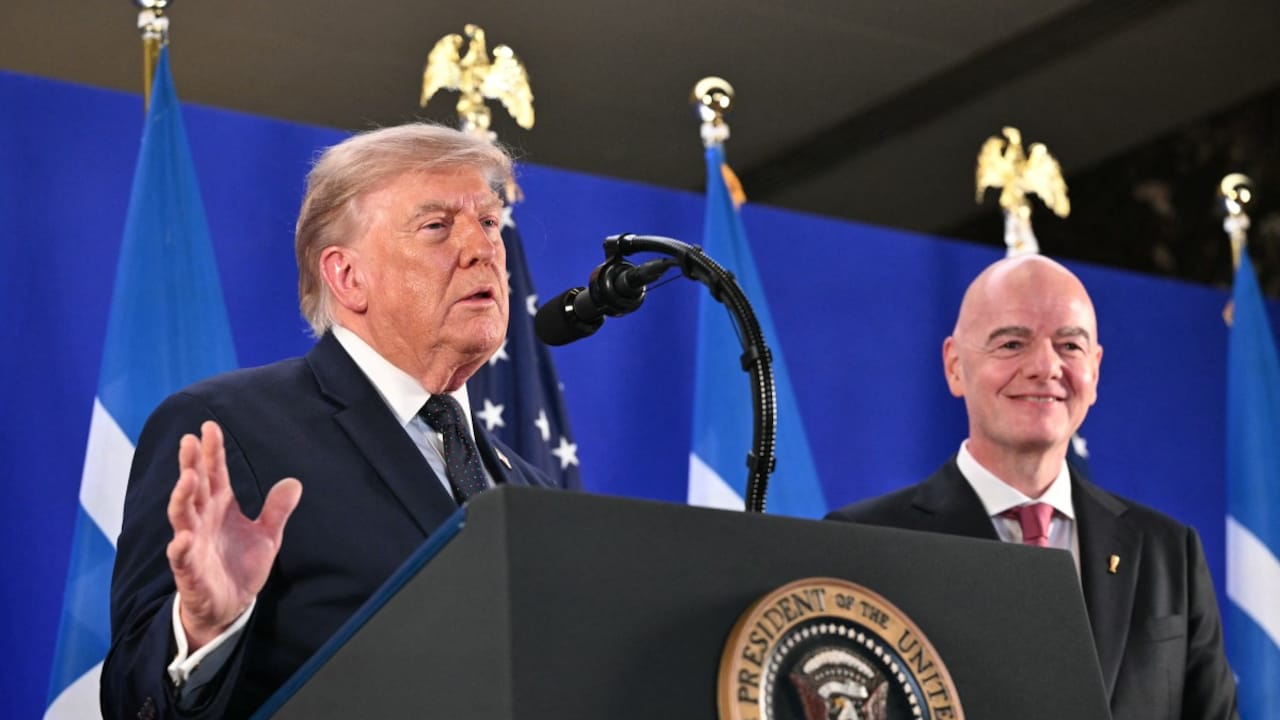
Days after the American elimination, Trump and Infantino shared a stage at Trump Tower ahead of a FIFA Council meeting. They walked out together as patriotic music echoed through the atrium. Neither man showed any regret over the phone calls or the controversial ruling.
Trump used his speech to praise Infantino, calling the suspension delay another great decision. He looked at the situation through a purely pragmatic lens. He argued that because the US lost with all its players on the field, there could be no lingering conspiracy theories. Nobody could complain that the Americans only lost because their best striker was forced to sit out.
The event quickly shifted into traditional political rhetoric. Trump repeated old complaints about the 2020 election, pointing out that if he had served a traditional consecutive term, he would have been out of office by the time the tournament arrived. He took personal credit for bringing both the World Cup and the Olympics to American soil. He even joked that he would love to host another World Cup in the future, but would leave Canada and Mexico out of the bid next time. Infantino smiled and thanked the President for putting on a massive cultural event.
What This Means For the Future of Soccer
This incident changed how international sports bodies interact with powerful governments. By adjusting disciplinary measures after political intervention, FIFA created a playbook for future tournaments.
The next time a major nation faces a controversial red card or an unexpected suspension, their political leaders have a clear path forward. They know that direct lines to sports executives can result in late-night rule adjustments. The independent judicial bodies that sports organizations love to talk about do not look so independent anymore.
The United States learned that political leverage can buy you a player's availability, but it cannot buy a victory against a better-prepared opponent. The rules were bent, an international sports scandal was born, and the US team still went home early.