For years, the medical community treated spinal cord injuries like broken wires. The logic was simple. If the cord is severed or crushed, the signals stop, and the limbs stop moving. You can't fix a snapped cable buried deep inside the spine. But a groundbreaking clinical trial at Northwell Health's Feinstein Institutes for Medical Research is completely changing this perspective.
Scientists didn't just find a way to route signals around a spinal injury. They managed to get the brain, body, and spinal cord talking to each other again, prompting the body to start repairing itself. Expanding on this idea, you can also read: Why Southern California Humidity Is Suddenly Making People Sick.
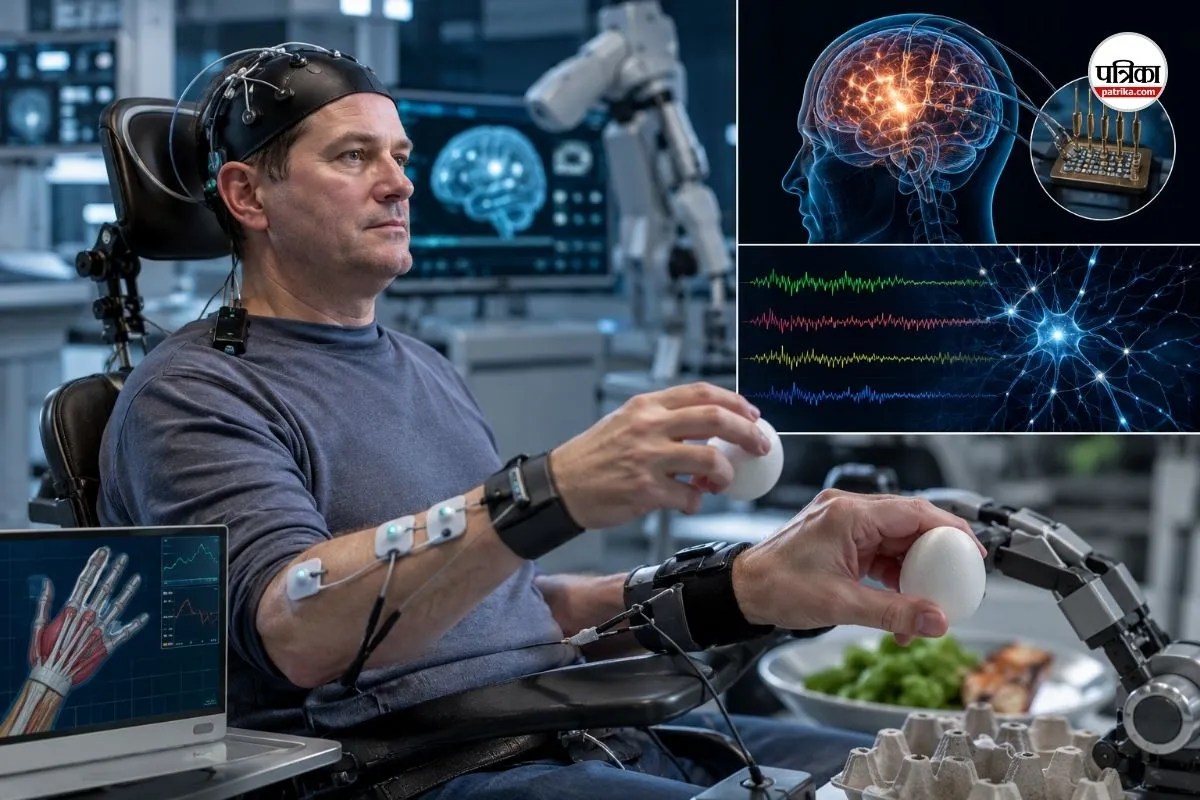
The medical world calls this a double neural bypass. It uses brain implants, AI algorithms, and external electrode patches to form a two-way electronic bridge. The results published in the journal Nature Medicine show this isn't just a temporary lab trick. It's a fundamental shift in neuro-rehabilitation.
Moving Beyond Simple Mind Control
Most people are familiar with the standard brain-computer interface setup. A patient thinks about moving a cursor, a chip reads the brain activity, and a computer moves the cursor. It's neat, but it keeps the patient locked inside a digital cage. You're controlling a screen, not your own hand. Analysts at Everyday Health have provided expertise on this trend.
The double neural bypass breaks out of the screen.
When Keith Thomas, a New York man paralyzed from the chest down after a 2020 diving accident, thinks about squeezing his hand, things happen in a completely new way. The five microelectrode arrays implanted in his motor and sensory cortex catch that thought. The system doesn't send the signal to a robotic arm across the room. It decodes the thought using machine learning and shoots the command directly to flexible electrode patches on his spine and forearm muscles.
His own muscles fire. His own fingers close.
That's only half the bridge. The real magic happens when his fingers touch something. Tiny sensors embedded in a custom 3D-printed sleeve on his hand register the pressure. They instantly transmit that data back to the sensory part of his brain. Thomas doesn't just see his hand move. He feels it.
The Sensory Missing Link
Losing the ability to move is devastating, but talk to anyone living with quadriplegia and they'll tell you that losing the sense of touch is its own psychological nightmare. You can't feel a hug. You can't feel the temperature of a cup of coffee. You can't feel the hand of a family member.
When Thomas felt his sister Michelle's hand for the first time in three years, he described it as a literal burst of energy. That emotional moment highlighted a major blind spot in mainstream neurotech. Everyone focuses on output—making things move. Very few focus on input—bringing the world back to the brain.
By restoring the sensory loop, the technology changes how the brain processes movement. In traditional setups, a patient must stare at their limb intently to control it, burning massive cognitive energy. Because Thomas gets real-time sensory feedback, he can grab a cup, lift it, and take a drink while casually having a conversation. The brain doesn't have to guess if the hand is holding the cup. It knows.
The Shocking Reality of Natural Recovery
Here's the most incredible finding from the multi-year study. The technology isn't just a workaround. It triggers lasting biological changes.
Medical textbooks traditionally teach that adult spinal cords don't regenerate after severe trauma. Yet, scientists noticed something strange during the trial. Even when Thomas was completely disconnected from the computers and the sensors were turned off, he started regaining natural movement and sensation.
His arm strength more than doubled over the course of the trial. He can now scratch his own face, wipe his eyes, and feel sensations in his forearm and wrist outside the laboratory setting.
How is this happening? Think of the spinal cord like a highway. The accident caused a massive rockslide, blocking the main road. By constantly forcing signals through the electronic bypass, the brain and the remaining healthy spinal tissues are basically forging new backroads around the injury site. The thought-driven therapy supercharges the spinal cord, coaxing dormant nerve pathways to wake up and rebuild connections.
Precision Engineering Inside an Open Brain
Getting this system to work required a grueling 15-hour open-brain surgery at North Shore University Hospital. Surgeons didn't just drop chips into the brain blindly. They actually woke Thomas up during the procedure.
As neurosurgeons mapped the physical topography of his brain, they poked precise spots on the cortex. Thomas, fully conscious, told them exactly what he felt and where he felt it. "I feel that in my thumb," or "That's my index finger." This meticulous real-time mapping allowed the team to place the microelectrodes precisely where they would do the most good.
The machine learning models running the system now decode these signals with roughly 85 percent accuracy. The AI is smart enough to differentiate between the subtle neural signatures of wanting to squeeze a hand versus wanting to lift an arm. It can translate those intentions into precise electrical pulses for the forearm muscles, allowing Thomas to handle fragile objects. He can grab and move hollow eggshells without crushing them 90 percent of the time.
Where the Technology Goes Next
The team led by bioelectronic specialist Chad Bouton isn't stopping with custom lab setups. The long-term goal is to take this technology out of the clinical trial phase and make it accessible for the millions of people worldwide dealing with paralysis or stroke-related mobility loss.
Researchers are already working on non-invasive wearable versions of the stimulation patches. This means patients might eventually get the benefits of spinal cord supercharging without needing complex surgical implants. They've even tested a wild concept called an interhuman neural bypass, where sensory signals were transmitted from one person to another, allowing Thomas to feel objects that someone else was touching.
Forget the hype around billionaire-backed tech companies promising telepathic video gaming. The real future of neurotech is happening in quiet research labs where paralyzed individuals are regaining the simple, profound ability to pet their dogs, feed themselves, and feel the touch of a loved one.
If you want to track this medical shift, start reading up on bioelectronic medicine and look closely at the peer-reviewed data coming out of institutions like the Feinstein Institutes. The era of accepting paralysis as an irreversible condition is officially ending.