When you look at the grand cosmic scoreboard, oxygen is supposed to be everywhere. It's the third most abundant element in the entire universe, forged inside the fiery cores of massive stars and sprayed across space when those stars finally go supernova. You breathe it right now because ancient stellar explosions seeded it across our corner of the Milky Way billions of years ago.
So why are some galaxies basically hoarding nothing?
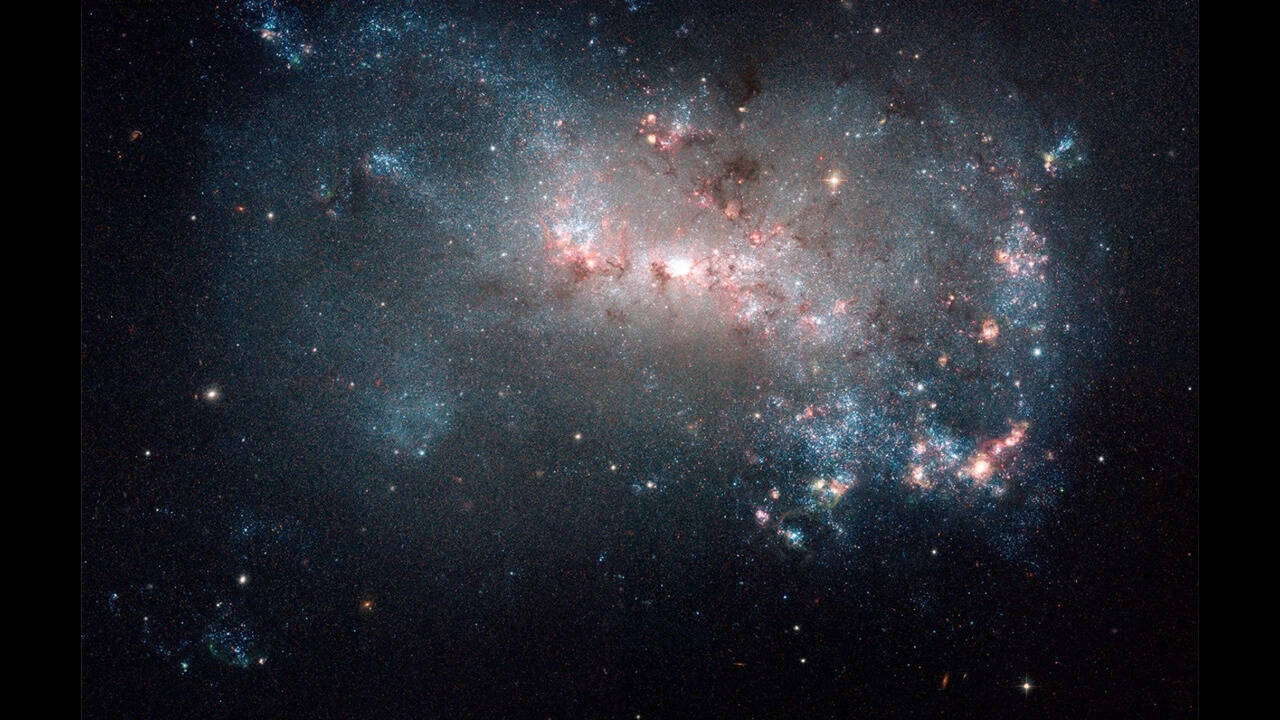
Recent observations from the Hubble Space Telescope reveal a bizarre cosmic disappearing act. When astronomers studied 37 nearby dwarf galaxies through the Galaxies Losing Oxygen via Winds (GLOW) project, they found something shocking. These tiny stellar systems retained an average of just 11% of the oxygen their stars manufactured. The remaining 89% vanished into thin air. Or rather, into the infinite void between stars.
Let's break down what's actually happening out there, why current models completely failed to predict it, and what it means for how galaxies evolve.
The Gravity Trap That Tiny Galaxies Lose
To understand why dwarf galaxies are bleeding oxygen, you have to look at how gravity works on
Why Dwarf Galaxies Lose Most of Their Oxygen and Why It Changes Everything We Know About Space
news
category>
Space looks quiet from Earth. It isn't. Galaxies bleed. They eject massive clouds of gas, heavy elements, and stellar debris into the dark void between star systems.
Recent observations from the Hubble Space Telescope reveal a staggering truth about our universe. Dwarf galaxies retain a mere 11 percent of the oxygen forged inside their stars. The rest vanishes. It blows away into intergalactic space.
Astronomers have debated galactic outflows for decades. Small galaxies possess weak gravitational fields. Massive systems like the Milky Way hold onto everything because their gravity is immense. Dwarf galaxies lack that luxury. When massive stars die, they detonate. Those explosions act like cosmic pressure cookers. They sweep gas outward with terrifying force.
Most people assume galaxies keep what they make. They think cosmic recycling is a neat, closed loop where stars form, die, enrich the gas around them, and build a second generation of richer stars. That model works fine for giant spiral galaxies. It fails completely when applied to the smaller building blocks of the universe.
The Trouble With Tiny Galaxies
Dwarf galaxies are the most common type of galaxy in the cosmos. They contain anywhere from a few thousand to a few billion stars. Compared to our hundred billion star Milky Way, they look insignificant. Yet they hold the key to understanding how chemical elements spread across the early universe.
Oxygen is critical. It is the third most abundant element in the universe by mass. It forms in the nuclear furnaces of massive stars and enters the interstellar medium when those stars die. Without oxygen, rocky planets cannot form. Water cannot exist. Life as we know it becomes impossible.
When Hubble peered at these dwarf systems, researchers expected to find decent retention rates. They expected chemistry to mirror larger galaxies. Instead, the data showed an extreme deficit. Eighty-nine percent of the oxygen produced by stellar generations vanished.
Where did it go? It did not disappear. Galactic winds pushed it out.
Supernovae do not whisper. They roar. When a cluster of massive stars in a dwarf galaxy explodes over a short geological window, the combined shockwaves punch holes in the galaxy's gas supply. Because the galaxy's escape velocity is low, the gas reaches speeds that let it break free entirely.
How Hubble Solved the Puzzle
Measuring gas outside a galaxy is brutally difficult. Diffuse gas does not shine brightly. It hides in the ultraviolet spectrum, absorbed by intervening matter or masked by starlight.
Hubble possesses a unique toolset for this exact problem. By studying the light of distant quasars shining through the halos and outflow regions of these dwarf galaxies, astronomers can map what elements are present. The ultraviolet spectrographs on Hubble can detect oxygen ions that optical telescopes miss entirely.
The data was clear. The gas escaping these galaxies carries enormous amounts of oxygen.
This finding solves a long-standing headache in astrophysics known as the missing metals problem. Theorists knew that small galaxies should theoretically enrich themselves faster than they did. The math never matched reality. Models predicted metal-rich environments inside dwarf systems, but observations kept showing metal-poor stars.
The oxygen was never missing. It was just thrown out the window.
What This Means for Cosmic Evolution
Galactic winds change the entire narrative of cosmic evolution. The universe is not a series of isolated containers. It is an open system.
When dwarf galaxies vent their oxygen and other heavy elements, they pollute the intergalactic medium. They seed the space between galaxies with the ingredients necessary for future chemistry. Without these galactic winds, the space between galaxies would remain pristine hydrogen and helium.
Think about your own origins. The oxygen in your lungs, the iron in your blood, the silicon in your devices—all of it was forged in stars. Much of it likely traveled through intergalactic space before condensing into the solar nebula billions of years later.
Dwarf galaxies act as fire hoses spraying heavy elements across the cosmos. They are messy, violent, and terribly inefficient at keeping their own wealth.
Future observations with newer instruments will map these outflows in even greater detail. Researchers want to know the exact timing of these eruptions. Did the gas escape in single massive bursts, or is it a steady, continuous leak?
The answer will rewrite textbooks. Small galaxies punch above their weight not by keeping what they build, but by sharing it with the entire universe whether anyone asked for it or not.