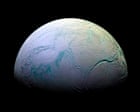
We keep looking for alien life out in the cold void, assuming it must look and act entirely different from anything we know. But recent science tells a much stranger story. Earth microbes can actually survive the brutal, alien chemistry of Saturn’s moon, Enceladus.
For years, astronomers stared at the massive water plumes erupting from that tiny 300-mile-wide ice ball. Deep beneath its frozen crust lies a global saltwater ocean. It is dark, highly alkaline, and constantly bubbling with geochemical energy. Scientists used to think it was too hostile for anything biological.
They were wrong.
Recreating an Alien Ocean in the Lab
Researchers led by geomicrobiologists at Ludwig-Maximilian University in Munich decided to test the absolute limits of biology. They built a miniature version of the Enceladus ocean right here on Earth.
They mixed water with specific salts, carbonates, and powdered rock. They wanted to simulate the intense rock-water reactions happening on a dark seafloor millions of miles away from the sun. The setup worked. The chemical reactions started churning out hydrogen, mimicking the exact processes theorized to happen inside Saturn's moon.
Then came the bold part. They introduced methanogens—Earthly microbes harvested from deep-sea hydrothermal vents in the Okinawa trough between Japan and Taiwan. These organisms normally thrive by converting hydrogen and carbon dioxide into methane.
Nobody expected them to last. The simulated ocean hit an aggressive pH of 11. That alkalinity blows past the known survival limits of these organisms. Carbon dioxide levels were brutally low, too.
Yet, the microbes grew. They adapted their metabolism on the fly and pushed right through the hostility.
What This Means for the Search for Life
This experiment completely alters how planetary scientists view habitability. David Rothery, a professor of planetary geosciences at the Open University, noted that showing methanogenesis works in these conditions removes a massive theoretical barrier.
Of course, surviving a few days in a lab beaker is not the same as thriving for a million years inside an icy moon. William Orsi, who led the work published in Science Advances, points out that if life ever sparked on Enceladus, it might be unrecognizable compared to our biology. Even if our style of microbes wound up there, sustaining a long-term population is a completely different challenge.
Yet, the odds just went up.
A second paper published alongside this study highlights another fascinating mechanism. When ice grains in those massive Enceladus plumes freeze and fragment into space, they actually separate the ocean's constituents. If microscopic alien life forms exist in those waters, tiny droplets could concentrate those microbes inside specific ice particles.
That makes future detection much easier. If we fly through those plumes again, we might not need to scoop up tons of water. A handful of hyper-concentrated ice grains could hold the smoking gun.
The Long Wait for Answers
The scientific community is buzzing about a return trip. The European Space Agency’s proposed L4 mission aims to send a Saturn orbiter and an Enceladus lander to touch down at the moon's south pole. It would hunt for biosignatures directly in the active geysers.
The catch is time. The mission is proposed for launch around 2042. It won't reach the Saturn system until the 2050s.
Until then, laboratory simulations are our best window into the dark, briny depths of the outer solar system. Biology is tougher than we give it credit for. If deep-sea vent bugs from Earth can hack it in a fake Saturnian sea, the universe might be a lot more crowded than we think.
Stop waiting for Hollywood-style green monsters. The real discovery will likely be microscopic, stubborn, and swimming in the dark beneath miles of ice.