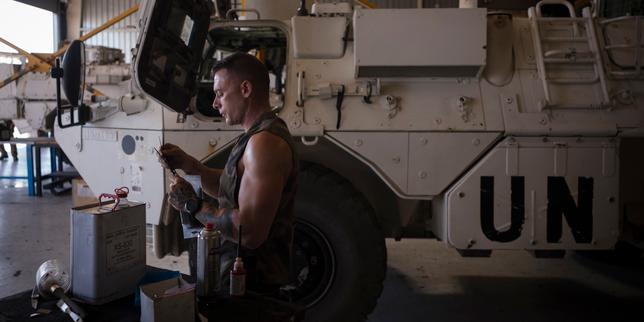
Southern Lebanon isn't a quiet place. It's a tense, heavily monitored zone where international peacekeepers try to maintain a fragile status quo against overwhelming odds. When French photojournalist Édouard Elias decided to spend a week embedded with the French contingent of the United Nations Interim Force in Lebanon, known as the Finul, he wasn't looking for cheap thrills. He wanted to capture the grinding, silent tension of modern peacekeeping missions.
If you think peacekeeping is all about sitting in guarded compounds and drinking coffee, you haven't looked closely at what these contingents actually face on a daily basis. Elias spent seven intense days living alongside these soldiers to strip away the PR gloss and reveal the gritty reality of international military deployment in a volatile region.
The Reality of Life Inside the Finul Deployment
Most news coverage focuses entirely on high-level political negotiations or sudden escalations. We hear about rockets, diplomatic friction, and troop movements. But what about the endless hours of waiting? What about the mundane patrols conducted under the constant threat of unseen danger?
Elias focused his camera precisely on those gaps between major events. His work highlights the psychological weight carried by the French peacekeepers stationed in southern Lebanon. You see soldiers maintaining watch towers, inspecting buffer zones, and interacting with local populations who live with the perpetual anxiety of cross-border conflict.
Living in these conditions requires a specific kind of mental resilience. It's not about charging into battle with guns blazing. It's about maintaining a rigid presence in a region where nobody really wants you there, but everyone secretly relies on you to keep the peace from totally collapsing.
Why Visual Documentation Matters Right Now
Photography in conflict zones serves a very specific purpose. It forces viewers to confront human faces instead of abstract casualty statistics. When Elias documented the French contingent, he didn't just take pictures of tanks and helmets. He captured exhaustion, concentration, and the human vulnerability hidden underneath heavy tactical gear.
This approach mirrors his previous work in other severe conflict zones, from the trenches of Ukraine to the Central African Republic. Elias has a long-standing history of following military units to understand the human cost of service, rather than just chasing breaking news headlines. Back in 2012, he started his career covering the war in Syria at a very young age, an experience that fundamentally shaped his gritty, unfiltered visual style.
When you look at his series with the Finul, you notice an absence of sensationalism. There are no dramatic explosions or cinematic hero shots. Instead, you get raw honesty. You see men and women dealing with isolation, stifling heat, and the constant psychological burden of being caught in the crossfire of geopolitical struggles they didn't start.
The Bigger Picture Behind the Blue Helmets
The Force intérimaire des Nations unies au Liban has operated in the region for decades, yet public understanding of its day-to-day operations remains surprisingly shallow. People ask whether these missions actually achieve anything, or if they're just expensive observation posts.
Elias's immersion doesn't offer easy political answers. It doesn't solve the Middle East crisis or tell diplomats how to negotiate a lasting ceasefire. What it does provide is a stark visual record of human endurance. It shows what it takes to stand in the middle of a powder keg day after day without losing your nerve.
If you want to understand modern military deployments, stop reading dry policy briefs. Look at how photographers like Elias capture the quiet moments before the storm, where the real endurance test happens.
Take time to look beyond the headlines the next time southern Lebanon flares up in the news. Behind every official UN statement are thousands of soldiers sitting in armored vehicles, waiting, watching, and hoping the line holds for just one more day.